Publications /
Policy Paper

Back
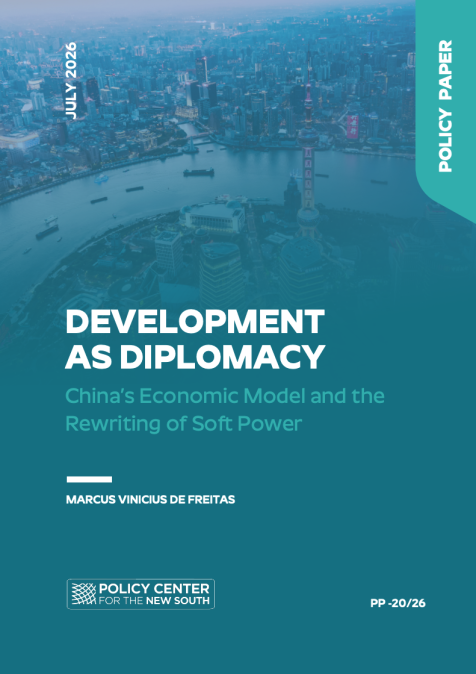
DEVELOPMENT AS DIPLOMACY : China’s Economic Model and the Rewriting of Soft Power
August 3, 2026

This policy paper explores how China’s economic development model—rooted in pragmatism, long-term planning, and civilizational renewal—has become its most compelling soft power asset, particularly in the eyes of the Global South. While critically engaging with Joseph Nye’s original conception of soft power as a primarily cultural and normative force, the paper argues that China’s ability to transform itself from an impoverished postimperial state into the world’s largest trading nation constitutes a far more persuasive and concrete form of attraction. 

Drawing on the historical context of China’s “Century of Humiliation”, the paper emphasizes the distinctiveness of the Chinese response—not one of nostalgic paralysis, but of strategic rejuvenation. Rejuvenation, as opposed to mere modernization, is presented as a deeply internal, spiritual, and civilizational force that animates the Chinese development project and distinguishes it from other postcolonial experiences. 

Additionally, the paper identifies key lessons from the Chinese model, including the strategic role of the state, the necessity of long-term and quantifiable development goals (such as GDP per capita targets), the centrality of public education and national security, the importance of meritocratic leadership, and the cultivation of national industries aligned with strategic vocation. These insights are positioned as highly relevant for countries in Latin America and Africa seeking to move beyond dependency and reclaim their development trajectories on sovereign and dignified terms. 

Ultimately, the paper calls for a new grammar of global development—one that places excellence, integrity, rejuvenation, and purpose at its core, and where multipolarity is not just a geopolitical condition but a civilizational imperative.

RELATED CONTENT

  • April 10, 2023
    This policy paper examines India’s growing engagement in North Africa, focusing on five countries: Morocco, Algeria, Tunisia, Libya, and Egypt. Despite lacking a distinct regional policy for North Africa, India has amplified its bilateral engagement with these countries, underpinned by a steadfast commitment to the principle of South-South cooperation. Through its strategic moves in North Africa, India has established a powerful southern-west axis for its foreign policy that stretch ...
  • Authors
    Pascal Chaigneau
    Alain Oudot de Dainville
    Rodolphe Monnet
    Florent Parmentier
    Olivier Tramond
    June 16, 2022
    Les Dialogues stratégiques, une collaboration entre le HEC Center for Geopolitics et le Policy Center for the New South représentent une plateforme d’analyse et d’échange biannuelle réunissant des experts, des praticiens, des décideurs politiques ainsi que le monde universitaire et les médias au service d’une réflexion critique et approfondie sur les tendances politiques mondiales et les grandes questions d’importance commune pour l’Europe et l’Afrique. Cette publication est ...
  • Authors
    Sabine Cessou
    May 17, 2022
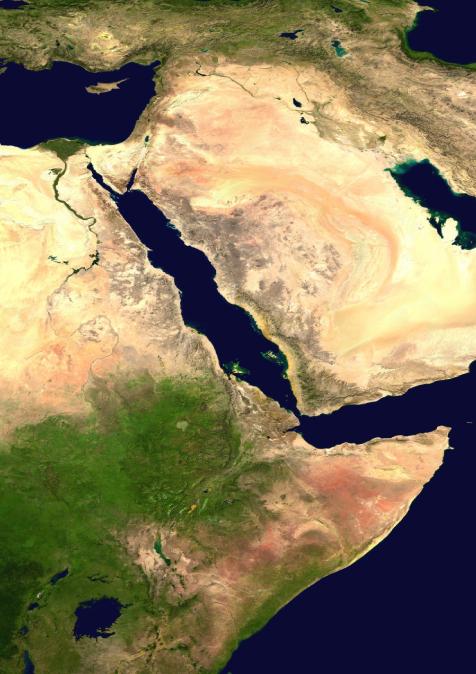
    Ce thème, abordé au Centre HEC de Géopolitique à Jouy-en-Josas, lors de la 12e édition des Dialogues stratégiques avec le Policy Center for the New South, une rencontre semestrielle, a permis de revenir dans le détail sur cette zone qui relie la Méditerranée à l’océan Indien, à la jointure de trois continents : l’Asie, l’Afrique et l’Europe. Cette route maritime qui s’étend sur plus de 2 200 km, pour une largeur qui varie de 300 km à moins de 30 km entre Djibouti et le Yémen, r ...
  • May 13, 2022
    Depuis 2016, le Policy Center for the New South et le Centre HEC de Géopolitique organisent chaque année deux éditions des « Dialogues Stratégiques ». Cette plateforme d’analyse et d’échange réunit des experts, des chercheurs provenant de différents think-tanks et du monde académique, d...
  • Authors
    Abdessalam Jaldi
    October 12, 2021
    The role played by diasporas in international relations should not be neglected. Bilateral engagements between states can be significantly affected by the practical and perspective relations between the diaspora community and their homeland. In the African context, none has been so deeply incorporated into the economic and social fabric of the continent as the Indian diaspora. Historically symbolized by Gandhi’s emblematic sojourn in South Africa and the participation of Indian inde ...
  • Authors
    July 16, 2021
    The BDA Currents: Where Diplomacy Meets Business, is the Brussels Diplomatic Academy’s annual report covering the wider geopolitical and other factors influencing and affecting the world of diplomacy, international relations and global business. The journal focuses on issues of topical interest around the centers of global power, influence and importance, including the continents of Europe and Africa, the Middle East, China, India & Asia, Russia and the Commonwealth of Independe ...
  • Authors
    Céline PAJON
    January 8, 2021
    Durant  son  mandat  (2012-2020),  le  Premier  ministre  Shinzo  Abe  s’est évertué  à  démontrer  le  fort  intérêt  duJapon  pour  l’Afrique,s’engageant notamment sur un soutien financier d’un total de 60 milliards de dollars lors des sommets de la Tokyo International Conference on African Development(TICAD)  en  2013  et  2016  et  dévoilant  sa  vision&nb ...
  • Authors
    December 2, 2020
    Les relations politiques entre la Chine et l’Australie se sont fortement dégradées avec, à la clé, la mise en œuvre de la part du géant asiatique de barrières tarifaires et non tarifaires. Si les produits agricoles (orge, bœuf, vin, homards) ont été les premières matières premières à être touchées, les exportations australiennes de gaz naturel liquéfié pourraient également être dans le viseur de Pékin. Canberra dispose, néanmoins, d’une carte maîtresse : son minerai de fer dont le s ...