Publications /
Book / Report

Back
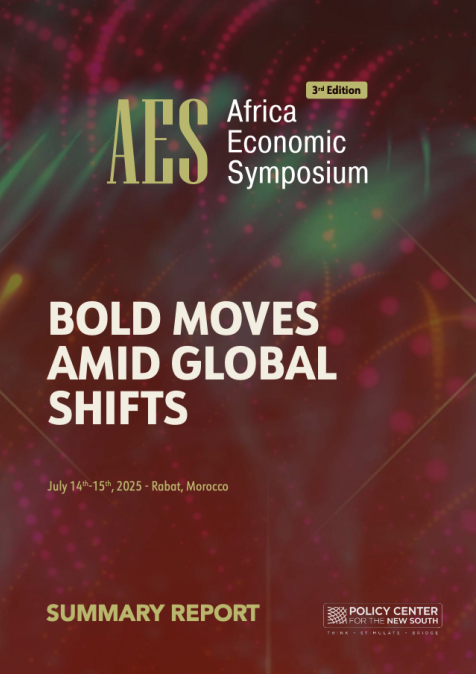
Africa Economic Symposium (AES) 3nd edition - SUMMARY REPORT
Authors
General rapporteur Mahmoud Arbouch
September 2, 2025

The Africa Economic Symposium (AES) has firmly established itself as one of the flagship annual events of the Policy Center for the New South, alongside the Atlantic Dialogues and the African Peace and Security Annual Conference (APSACO). Now in its third edition, AES continues to provide a unique platform for economists, policymakers, and academics from across the continent and beyond to exchange perspectives on the pressing macroeconomic and structural challenges facing Africa. Its mission remains to foster rigorous, evidence-based debates that inform policymaking and support long-term strategies for Africa’s development in an era of uncertainty. 

The 2025 edition, convened under the theme “Bold Moves amid Global Shifts,” explored the difficult policy trade-offs confronting African governments as they navigate a volatile global environment. The continent’s recovery from COVID-19 has been uneven, while debt pressures, supply chain disruptions, and geopolitical tensions weigh heavily on fiscal and economic resilience. Structural challenges such as persistent unemployment, low productivity, and the exclusion of Africa’s youth continue to hinder inclusive growth, even as policymakers are called upon to adapt to deep systemic uncertainty. 

The symposium underscored that many African states are increasingly resorting to short-term stabilization measures—such as accumulating reserves and postponing reforms—that may provide immediate security but risk delaying the structural transformation urgently needed. Against this backdrop, AES 2025 called for a careful balance between fiscal prudence, social investment, and the pursuit of sustainable growth, placing emphasis on reforming governance, improving macroeconomic management, and accelerating structural change. 

The discussions highlighted the urgent need to rethink Africa’s economic strategies in a shifting global order. From debt sustainability and the role of central banks to the promise of financial innovation, digital inclusion, and new instruments such as central bank digital currencies, the symposium emphasized that policy choices must align with long-term transformation goals. The debates also explored the opportunities and challenges of regional integration, trade connectivity, and development finance, all of which are essential levers for Africa’s resilience and prosperity. 

As in previous editions, the Annual Report on African Economies was launched alongside the symposium, offering an in-depth analysis of the continent’s macroeconomic dynamics and structural transformation pathways. More than just a publication, the report reflects the collective intellectual effort of leading scholars and practitioners, providing evidence-based insights to guide decision- makers. Together, the symposium and the report reinforced the Policy Center for the New South’s commitment to fostering forward-looking economic thinking that moves beyond short-term headlines to tackle Africa’s enduring challenges.


RELATED CONTENT

  • September 23, 2022
    A l’occasion de l’anniversaire des 60 ans des relations diplomatiques et économiques entre la République de Corée et le Royaume du Maroc, une rencontre est organisée par le Policy Center for the New South en collaboration avec le Korean Institute for International Economic Policy (KIEP)...
  • September 23, 2022
    Relations between Rabat and Seoul have been in a state of considerable flux in every aspect since the establishment of diplomatic relations between the two countries in July 1962. The Korean embassy in Rabat is Seoul's first permanent diplomatic representation on the African continent. ...
  • Authors
    September 15, 2022
    Le dialogue social est à la croisée des chemins. Le deuxième round du dialogue social va être lancé aujourd’hui. À l’ordre du jour, la négociation sur des dossiers en instance depuis de longues années (le droit de grève, la représentation des syndicats, le code du travail, les libertés syndicales,…). Mais la grande question qui figure dans l’agenda des parties prenantes est bien celle de l’institutionnalisation des mécanismes d’un dialogue pérenne et efficace, en plus de celle de so ...
  • Authors
    Moubarack Lo
    Amaye SY
    September 5, 2022
    Le 1er janvier 2021, les pays africains ont lancé la Zone de libre-échange continentale africaine (ZLECAf). Les caractéristiques actuelles des économies africaines mettent, en effet, en évidence un potentiel d'échanges plus intenses, complexes et diversifiés entre les pays du continent. Elles révèlent en même temps de nombreux handicaps tels que le faible niveau d'industrialisation ou de création de valeur régionale. Plusieurs études d'impact ont été menées sur les e ...
  • Authors
    August 30, 2022
    Rwanda is famous for its remarkable socio-economic performance after the ravages of the Genocide against the Tutsis and moderate Hutus in 1994. Under the leadership of President Paul Kagame, Rwanda has followed a state-led development model with stunning results. Despite these substantial accomplishments, Rwanda is still a low-income country with extensive poverty. Its agriculture is still of low productivity and highly vulnerable to climate change. Structural transformation has we ...
  • Authors
    August 24, 2022
    Chinese economic figures released since August’s beginning have shown a slowdown in its growth. New Omicron coronavirus outbreaks in the context of the Covid-zero policy, the housing slump and heat waves have been, decelerating the economy’s pace. China’s current growth slowdown is an additional step in the trajectory of gradually declining rates that has accompanied the “great rebalancing” since the beginning of the 2010s. One significant difference now is the perception of exhaus ...
  • Authors
    August 23, 2022
    Disruptions to global value chains (GVCs) – caused by conflicts, natural disasters, and accidents that close transport routes – and that affect specific regions or sectors, are not unusual. However, in recent years and amid the Covid-19 pandemic, they have become more frequent and severe. High profile, sizeable, and repeated disruptions raise pressing questions: Is the breakdown in many GVCs a temporary glitch, or a permanent phenomenon? Have GVCs become endemically more accident pr ...