Publications /
Book / Report

Back
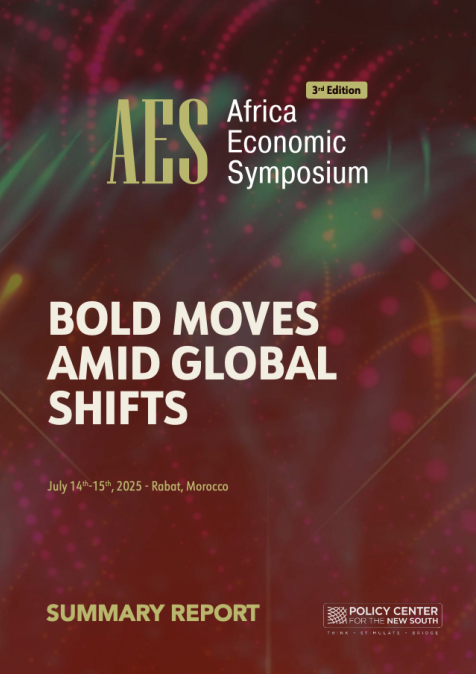
Africa Economic Symposium (AES) 3nd edition - SUMMARY REPORT
Authors
General rapporteur Mahmoud Arbouch
September 2, 2025

The Africa Economic Symposium (AES) has firmly established itself as one of the flagship annual events of the Policy Center for the New South, alongside the Atlantic Dialogues and the African Peace and Security Annual Conference (APSACO). Now in its third edition, AES continues to provide a unique platform for economists, policymakers, and academics from across the continent and beyond to exchange perspectives on the pressing macroeconomic and structural challenges facing Africa. Its mission remains to foster rigorous, evidence-based debates that inform policymaking and support long-term strategies for Africa’s development in an era of uncertainty. 

The 2025 edition, convened under the theme “Bold Moves amid Global Shifts,” explored the difficult policy trade-offs confronting African governments as they navigate a volatile global environment. The continent’s recovery from COVID-19 has been uneven, while debt pressures, supply chain disruptions, and geopolitical tensions weigh heavily on fiscal and economic resilience. Structural challenges such as persistent unemployment, low productivity, and the exclusion of Africa’s youth continue to hinder inclusive growth, even as policymakers are called upon to adapt to deep systemic uncertainty. 

The symposium underscored that many African states are increasingly resorting to short-term stabilization measures—such as accumulating reserves and postponing reforms—that may provide immediate security but risk delaying the structural transformation urgently needed. Against this backdrop, AES 2025 called for a careful balance between fiscal prudence, social investment, and the pursuit of sustainable growth, placing emphasis on reforming governance, improving macroeconomic management, and accelerating structural change. 

The discussions highlighted the urgent need to rethink Africa’s economic strategies in a shifting global order. From debt sustainability and the role of central banks to the promise of financial innovation, digital inclusion, and new instruments such as central bank digital currencies, the symposium emphasized that policy choices must align with long-term transformation goals. The debates also explored the opportunities and challenges of regional integration, trade connectivity, and development finance, all of which are essential levers for Africa’s resilience and prosperity. 

As in previous editions, the Annual Report on African Economies was launched alongside the symposium, offering an in-depth analysis of the continent’s macroeconomic dynamics and structural transformation pathways. More than just a publication, the report reflects the collective intellectual effort of leading scholars and practitioners, providing evidence-based insights to guide decision- makers. Together, the symposium and the report reinforced the Policy Center for the New South’s commitment to fostering forward-looking economic thinking that moves beyond short-term headlines to tackle Africa’s enduring challenges.

RELATED CONTENT

  • Authors
    Inácio F. Araújo
    Ademir Rocha
    Karina Sass
    August 12, 2022
    The Russian invasion of Ukraine on February 24, 2022, scaled up the ongoing conflict in Donbas beyond its regional borders, hindering and halting different aspects of economic life. Considering the internal geography of Ukraine’s economic structure, the damages to physical infrastructure and supply chain disruptions are likely to propagate to other parts of the country through an intricate plot of production and income linkages. From a disaggregated analysis of multiregional and mul ...
  • August 4, 2022
    Dans cet épisode d’Africafé, Gilles Yabi analyse les enjeux des inégalités en Afrique et les moyens de palier à ce manquement des économies Africaines. En compagnie de Hamza Saoudi, cet épisode passe aussi en revue les politiques publiques mises en œuvre par les Etats Africains pour com...
  • Authors
    August 2, 2022
    L’invasion russe de l'Ukraine a incité l'Union Européenne, en coordination avec d’autres puissances mondiales, à monter en urgence une réponse coordonnée de sanctions sans précédent. La plus emblématique d'entre elles est l'embargo partiel contre le pétrole et autres produits raffinés russes, qui signifie en essence la transition du commerce pétrolier d’une logique économique vers une logique géopolitique. D'où la montée en flèche des cours du pétrole et d'autres matières premières. ...
  • Authors
    Moubarack Lo
    Amaye SY
    August 1, 2022
    Avant la pandémie Covid-19, le continent abritait les économies à la croissance la plus rapide du monde et plusieurs pays africains montraient les premiers signes de transformation structurelle et de progrès vers l’émergence économique. Plus de deux ans après la pandémie et les ondes de choc qui en ont résulté, deux questions cruciales se posent : dans quelle mesure le choc sanitaire Covid-19, exacerbé par la crise ukrainienne, a-t-il constitué un tournant dans le processus général ...
  • July 29, 2022
    يخصص مركز السياسات من أجل الجنوب الجديد حلقة برنامجه الأسبوعي "حديث الثلاثاء"   لمناقشة آفاق التعاون بين كوريا الجنوبية و إفريقيا مع المصطفى الرزرازي، الباحث البارز بمركز السياسات من أجل الجنوب الجديد. شهدت العلاقات الكورية الإفريقية إنطلاقاً من العقد الأول من الألفية تط...
  • Authors
    Said El Hachimi
    July 27, 2022
    Sleepless nights and the tireless search for compromise allowed WTO members to agree on concrete deliverables during the WTO 12th Ministerial Conference held last June. Those results reinforce Multilateralism. And this is a significant gain given the multiplicity of global crises that surround us. The Outcome include 6 Agreements, Declarations and Ministerial Decisions that respond to some of today's challenges, notably on Fisheries and Ocean Sustainability as well as responses to P ...
  • Authors
    Noamane Cherkaoui
    July 25, 2022
    Foreign aid has a well-established and significant role in international relations. The role of foreign aid in the repertoire of international development programs is extensively documented, with its goal being the promotion of human and economic development. Foreign aid can be defined as “all forms of assistance that a country derives from other governments or multilateral agencies and financial institutions to fill noticeable gaps, especially in production, savings, and investment ...
  • Authors
    Joseph Hammond
    July 18, 2022
    The world is facing its worst food crisis in 70 years as a perfect storm of geopolitical events contributes to a spike in prices. Wheat alone has jumped 53% since the start of the year. Alarmingly, a number of governments have responded to the crisis with export bans. Governments and organizations worldwide must act decisively to avoid knee-jerk neo-mercantilism, which would add to the volatility in the global economy. Globalization is at a fragile moment, and mercantilism still lur ...
  • From

    15
    6:00 pm July 2022
    L’apparition de de la COVID-19 a engendré une crise sanitaire mondiale, qui s’est rapidement transformé à d’autres crises bouleversant le vécu des humains de par la planète. En ce qui concerne les marchés mondiaux, notamment du travail, les incertitudes ont fortement impacté les comportements des agents. Aussi, les mises sous restrictions, totales ou partielles, des facteurs de production ont eu leur incidence sur l’activité globale -via différents canaux -, y compris celle des acteurs du marché du travail. À court terme, la pandémie est synonyme de fortes perturbations pour les citoyens et les marchés du travail. Celles-là concernent les revenues et les dépenses des particuliers comme elles portent sur l’activité des entreprises et donc les dynamiques de création d’emploi et ...