Publications /
Book / Report

Back
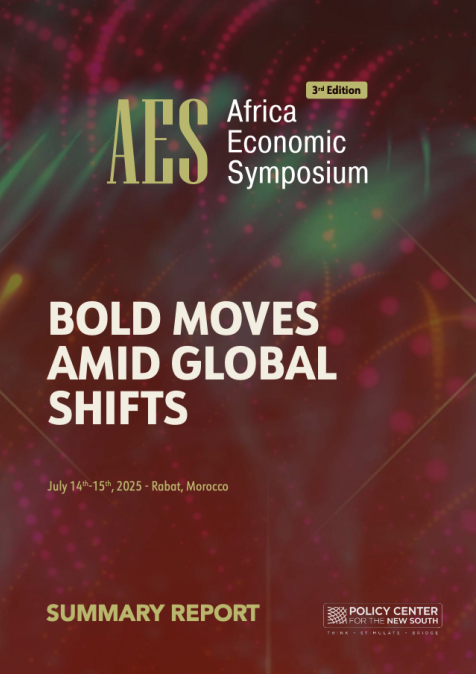
Africa Economic Symposium (AES) 3nd edition - SUMMARY REPORT
Authors
General rapporteur Mahmoud Arbouch
September 2, 2025

The Africa Economic Symposium (AES) has firmly established itself as one of the flagship annual events of the Policy Center for the New South, alongside the Atlantic Dialogues and the African Peace and Security Annual Conference (APSACO). Now in its third edition, AES continues to provide a unique platform for economists, policymakers, and academics from across the continent and beyond to exchange perspectives on the pressing macroeconomic and structural challenges facing Africa. Its mission remains to foster rigorous, evidence-based debates that inform policymaking and support long-term strategies for Africa’s development in an era of uncertainty. 

The 2025 edition, convened under the theme “Bold Moves amid Global Shifts,” explored the difficult policy trade-offs confronting African governments as they navigate a volatile global environment. The continent’s recovery from COVID-19 has been uneven, while debt pressures, supply chain disruptions, and geopolitical tensions weigh heavily on fiscal and economic resilience. Structural challenges such as persistent unemployment, low productivity, and the exclusion of Africa’s youth continue to hinder inclusive growth, even as policymakers are called upon to adapt to deep systemic uncertainty. 

The symposium underscored that many African states are increasingly resorting to short-term stabilization measures—such as accumulating reserves and postponing reforms—that may provide immediate security but risk delaying the structural transformation urgently needed. Against this backdrop, AES 2025 called for a careful balance between fiscal prudence, social investment, and the pursuit of sustainable growth, placing emphasis on reforming governance, improving macroeconomic management, and accelerating structural change. 

The discussions highlighted the urgent need to rethink Africa’s economic strategies in a shifting global order. From debt sustainability and the role of central banks to the promise of financial innovation, digital inclusion, and new instruments such as central bank digital currencies, the symposium emphasized that policy choices must align with long-term transformation goals. The debates also explored the opportunities and challenges of regional integration, trade connectivity, and development finance, all of which are essential levers for Africa’s resilience and prosperity. 

As in previous editions, the Annual Report on African Economies was launched alongside the symposium, offering an in-depth analysis of the continent’s macroeconomic dynamics and structural transformation pathways. More than just a publication, the report reflects the collective intellectual effort of leading scholars and practitioners, providing evidence-based insights to guide decision- makers. Together, the symposium and the report reinforced the Policy Center for the New South’s commitment to fostering forward-looking economic thinking that moves beyond short-term headlines to tackle Africa’s enduring challenges.

RELATED CONTENT

  • Authors
    July 16, 2026
    Thanks to the AI investment boom, the U.S. economy has performed well at the macroeconomic level. However, it is on an unsustainable fiscal and debt path. Mr. Trump’s fiscal policy in his second term has aggravated this trajectory. In turn, Mr. Trump’s tariff-based trade policy has failed to address what he sees as U.S. economic problems associated with the trade balance. Besides explaining why this has been the case, and what its implications are for the U.S. economy and the r ...
  • July 15, 2026
    تناقش هذه الحلقة واقع المنافسة في الأسواق المغربية وعلاقتها بتطور الأسعار والقدرة الشرائية للمواطنين. كما تسلط الضوء على أبرز العوامل المؤثرة في الأسعار، سواء المرتبطة بالمنافسة أو بتكاليف الإنتاج وسلاسل التوزيع. ويتناول الحوار دور مجلس المنافسة والسلطات العمومية والفاعلين الاقتصاديين ف...
  • Authors
    Edited by
    July 13, 2026
    Available soon on livremoi. The 2026 edition of the Annual Report on the African Economy examines the issue of the valorization of Africa’s natural resources, particularly its mineral wealth. While the continent holds some of the world’s largest known reserves of a wide range of minerals and metals, the objective is not merely to catalogue these resources, but rather to explore the conditions under which natural resource endowments can be transformed into drivers of Africa’s in ...
  • Authors
    July 13, 2026
    This paper provides a structural assessment of India’s services-led development trajectory, and its integration into global value chains (GVCs) between 2012 and 2022. Applying an analytical framework that categorizes services into knowledge (KS), enabling (ES), and local (LS) sectors, the study utilizes sixteen OECD indicators to move beyond the narrative of India as a ‘services champion’ and reveal a more complex economic reality. The analysis identifies three central structur ...
  • Authors
    July 13, 2026
    This paper examines the evolution of China’s services sector between 2012 and 2022, analyzing the country’s structural transformation based on a novel three-tier taxonomy: knowledge services (KS), enabling services (ES), and local services (LS). Using sixteen quantitative indicators from OECD databases, the study evaluates China’s transition in comparison to the EU15 benchmark, highlighting three core challenges: manufacturing rebalancing, labor absorption, and global integration.Th ...
  • July 10, 2026
    For much of the post-war period, the Global South was framed as an object of history, defined by dependency, constrained by structural asymmetries, and confined to the margins of global decision-making. That narrative, once empirically grounded, is now no longer adequate. A profound yet uneven transformation is underway. The Global South is no longer only reacting; it is increasingly shaping rules, institutions, and narratives.This Policy Brief argues that the Global South is thus t ...
  • July 6, 2026
    Cette interview explore les grands enjeux de l’urbanisation au Maroc, en mettant l’accent sur les défis de gouvernance, de planification et de politiques publiques. Elle revient sur l’évolution des modèles de développement urbain, les effets du changement climatique sur les villes, ains...
  • July 3, 2026
    This Policy Paper has also been published in French and Spanish by Le Grand Continent Morocco offers a compelling example of how a middle-income economy can navigate a more fragmented global environment, characterized by weak growth and slower convergence. Since 2022, economic activity has remained relatively strong, with growth exceeding that of many comparable economies. Non-agricultural growth has averaged 4.4% since 2022, around 1.3 percentage points above its historical av ...