Publications /
Book / Report

Back
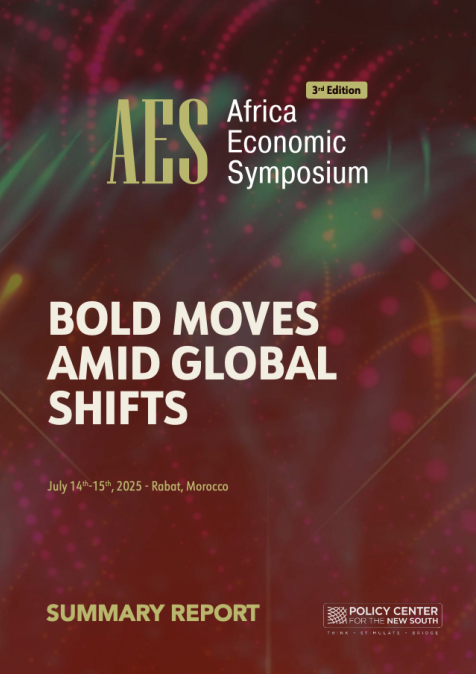
Africa Economic Symposium (AES) 3nd edition - SUMMARY REPORT
Authors
General rapporteur Mahmoud Arbouch
September 2, 2025

The Africa Economic Symposium (AES) has firmly established itself as one of the flagship annual events of the Policy Center for the New South, alongside the Atlantic Dialogues and the African Peace and Security Annual Conference (APSACO). Now in its third edition, AES continues to provide a unique platform for economists, policymakers, and academics from across the continent and beyond to exchange perspectives on the pressing macroeconomic and structural challenges facing Africa. Its mission remains to foster rigorous, evidence-based debates that inform policymaking and support long-term strategies for Africa’s development in an era of uncertainty. 

The 2025 edition, convened under the theme “Bold Moves amid Global Shifts,” explored the difficult policy trade-offs confronting African governments as they navigate a volatile global environment. The continent’s recovery from COVID-19 has been uneven, while debt pressures, supply chain disruptions, and geopolitical tensions weigh heavily on fiscal and economic resilience. Structural challenges such as persistent unemployment, low productivity, and the exclusion of Africa’s youth continue to hinder inclusive growth, even as policymakers are called upon to adapt to deep systemic uncertainty. 

The symposium underscored that many African states are increasingly resorting to short-term stabilization measures—such as accumulating reserves and postponing reforms—that may provide immediate security but risk delaying the structural transformation urgently needed. Against this backdrop, AES 2025 called for a careful balance between fiscal prudence, social investment, and the pursuit of sustainable growth, placing emphasis on reforming governance, improving macroeconomic management, and accelerating structural change. 

The discussions highlighted the urgent need to rethink Africa’s economic strategies in a shifting global order. From debt sustainability and the role of central banks to the promise of financial innovation, digital inclusion, and new instruments such as central bank digital currencies, the symposium emphasized that policy choices must align with long-term transformation goals. The debates also explored the opportunities and challenges of regional integration, trade connectivity, and development finance, all of which are essential levers for Africa’s resilience and prosperity. 

As in previous editions, the Annual Report on African Economies was launched alongside the symposium, offering an in-depth analysis of the continent’s macroeconomic dynamics and structural transformation pathways. More than just a publication, the report reflects the collective intellectual effort of leading scholars and practitioners, providing evidence-based insights to guide decision- makers. Together, the symposium and the report reinforced the Policy Center for the New South’s commitment to fostering forward-looking economic thinking that moves beyond short-term headlines to tackle Africa’s enduring challenges.

RELATED CONTENT

  • Authors
    Hajar Kabbach
    May 11, 2026
    Closing Morocco's gender employment gap could increase GDP per capita by 40-50 percent; yet female labor force participation stands at just 19 percent—among the lowest in the world and still declining. This policy paper argues that investing in the care economy is not merely a social expenditure, but a productive economic strategy with measurable returns. Drawing on international evidence from Uruguay, Mexico, Colombia, and India, the brief demonstrates that well-designed care syste ...
  • May 7, 2026
    Le rapport de diagnostic du secteur privé au Maroc met en lumière les principaux défis qui freinent encore l’investissement privé et la création d’emplois, malgré les avancées réalisées en matière de stabilité macroéconomique, d’infrastructures et de réformes. Il identifie notamment la ...
  • May 6, 2026
    Dans cette interview, l’évolution de la politique industrielle marocaine est analysée : planification étatique (1960–1980), libéralisation (1980–1990), puis intégration dans les chaînes de valeur mondiales (à partir des années 2000). Aujourd’hui, face au protectionnisme et au nearshorin...
  • May 5, 2026
    Présentation du rapport « Croissance et emploi au Maroc » par Javier Diaz Cassou, Économiste Senior à la Banque mondiale, qui analyse les dynamiques de croissance de l’économie marocaine et leur impact sur la création d’emplois. Le rapport met en évidence les principaux moteurs de la cr...
  • April 30, 2026
    يشهد المغرب تحولًا سريعًا في صناعة السيارات الكهربائية، مدفوعًا باستثمارات كبيرة وطموح للانتقال من مجرد منصة تركيب إلى فاعل صناعي متكامل. وبين فرص بناء صناعة بطاريات محلية وخلق وظائف جديدة، تبرز أيضًا تحديات مرتبطة بنقل التكنولوجيا، والتشغيل، والاستدامة. في هذه الحلقة، نفكك هذا التحول و...
  • Authors
    April 30, 2026
    This paper is the second in a series examining services-led development and global value chain (GVC) integration in the Global South. It applies a three-category analytical framework covering knowledge services (ICT and professional business services), enabling services (transport, logistics, and finance), and local services (retail, hospitality, health, and personal services), to OECD Trade in Value Added indicators. The paper thus  ...
  • April 29, 2026
    Cet épisode revient sur la politique monétaire au Maroc, en soulignant sa capacité à maintenir une inflation faible et stable sur le long terme grâce à un cadre macroéconomique solide. Il met en avant le rôle central des réformes institutionnelles et de la Banque centrale dans le renfor...
  • April 29, 2026
    Cette chronique a été initialement publiée sur le site lesechos.fr Les économies en développement font face à un double défi : créer des emplois à grande échelle tout en soutenant la productivité. Quels types de services permettent cette convergence ? Les économistes Hinh T. Dinh et Karim El Aynaoui répondent dans la chronique du « Cercle des économistes ».Les services peuvent-ils se substituer à l'industrie manufacturière comme moteur du développement ...
  • Authors
    April 28, 2026
    Climate policy is increasingly reshaping the conditions under which firms participate in international markets. As some jurisdictions introduce carbon border adjustments, lifecycle emissions standards, and supply-chain traceability requirements, market access is starting to be made conditional on verifiable characteristics of production processes, such as carbon intensity, embedded emissions, and input sourcing, rather than solely on product characteristics or prices. This paper exa ...