Publications /
Book / Report

Back
Africa Economic Symposium (AES) 3nd edition - SUMMARY REPORT
Authors
General rapporteur Mahmoud Arbouch
September 2, 2025

The Africa Economic Symposium (AES) has firmly established itself as one of the flagship annual events of the Policy Center for the New South, alongside the Atlantic Dialogues and the African Peace and Security Annual Conference (APSACO). Now in its third edition, AES continues to provide a unique platform for economists, policymakers, and academics from across the continent and beyond to exchange perspectives on the pressing macroeconomic and structural challenges facing Africa. Its mission remains to foster rigorous, evidence-based debates that inform policymaking and support long-term strategies for Africa’s development in an era of uncertainty. 

The 2025 edition, convened under the theme “Bold Moves amid Global Shifts,” explored the difficult policy trade-offs confronting African governments as they navigate a volatile global environment. The continent’s recovery from COVID-19 has been uneven, while debt pressures, supply chain disruptions, and geopolitical tensions weigh heavily on fiscal and economic resilience. Structural challenges such as persistent unemployment, low productivity, and the exclusion of Africa’s youth continue to hinder inclusive growth, even as policymakers are called upon to adapt to deep systemic uncertainty. 

The symposium underscored that many African states are increasingly resorting to short-term stabilization measures—such as accumulating reserves and postponing reforms—that may provide immediate security but risk delaying the structural transformation urgently needed. Against this backdrop, AES 2025 called for a careful balance between fiscal prudence, social investment, and the pursuit of sustainable growth, placing emphasis on reforming governance, improving macroeconomic management, and accelerating structural change. 

The discussions highlighted the urgent need to rethink Africa’s economic strategies in a shifting global order. From debt sustainability and the role of central banks to the promise of financial innovation, digital inclusion, and new instruments such as central bank digital currencies, the symposium emphasized that policy choices must align with long-term transformation goals. The debates also explored the opportunities and challenges of regional integration, trade connectivity, and development finance, all of which are essential levers for Africa’s resilience and prosperity. 

As in previous editions, the Annual Report on African Economies was launched alongside the symposium, offering an in-depth analysis of the continent’s macroeconomic dynamics and structural transformation pathways. More than just a publication, the report reflects the collective intellectual effort of leading scholars and practitioners, providing evidence-based insights to guide decision- makers. Together, the symposium and the report reinforced the Policy Center for the New South’s commitment to fostering forward-looking economic thinking that moves beyond short-term headlines to tackle Africa’s enduring challenges.

RELATED CONTENT

  • May 06, 2022
    In a large majority of countries political leaders have tried to place regional integration in the center of their economic growth and development strategies, yet, despite all attempts, A ...
  • April 29, 2022
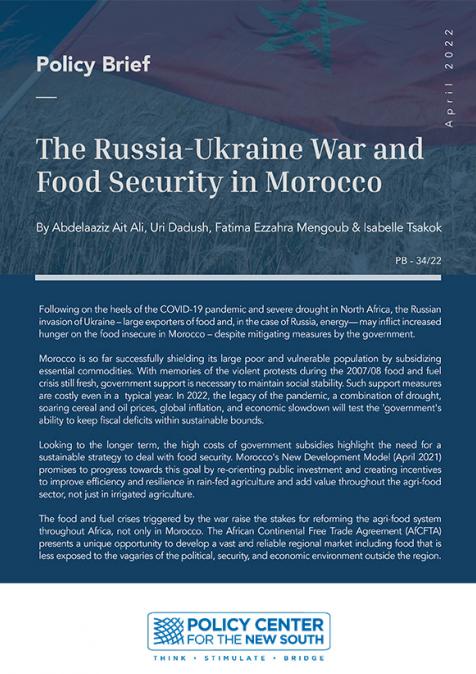
    Following on the heels of the COVID-19 pandemic and severe drought in North Africa, the Russian invasion of Ukraine – large exporters of food and, in the case of Russia, energy— may inflict increased hunger on the food insecure in Morocco – despite mitigating measures by the government. Morocco is so far successfully shielding its large poor and vulnerable population by subsidizing essential commodities. With memories of the violent protests during the 2007/08 food and fuel crisis ...
  • Authors
    Sebastian Carranza
    April 28, 2022
    Last March, a proposal of dollarizing Argentina’s economy arrived at its Congress. We summarize here the potential consequences of such a route in case the bill succeeds in getting approval. First, we point out the broad implications of dollarizing an economy. Then, we set out some cases of Latin American experiences with dollarization. Finally, we address the case of Argentina. The main potential benefit of dollarization would be elimination of domestic inflation, but at a very hi ...
  • April 25, 2022
    Retrouvez en exclusivité l’interview de Abdelhak Bassou, Senior Fellow au Policy Center for the New South, qui se livre à Helmut Sorge, Columnist au Policy Center for the New South, au sujet des multi-disparités présentes en Afrique. Abdelhak Bassou est l’auteur du Chapitre 5 du rapport...
  • Authors
    April 22, 2022
    Emerging market and developing economies (EMDE) face a common set of external shocks: rising energy and food prices; tightening in global financial conditions caused by the prospect of sharper interest rate hikes and anticipation of "quantitative tightening"; and return of restrictions on mobility in China, on account of the Covid zero policy, leading to slumping in growth and weakening one of the primary growth drivers for the other EMDE. However, the impacts of those common shocks ...
  • April 21, 2022
    On February 24, 2022, Russia launched a military action in Ukraine. This operation and subsequent events is having a global impact, with far-reaching political and economic implications. In the short term, the conflict will affect the global economy through three main channels: financia...
  • April 19, 2022
    يخصص مركز السياسات من أجل الجنوب الجديد حلقة برنامجه الأسبوعي "حديث الثلاثاء" لمناقشة التأثيرات الأجنبية في منطقة المغرب الكبير مع عبد الله ساعف، باحث بارز بمركز السياسات من أجل الجنوب الجديد منطقة المغرب الكبير لا تزال بطبيعتها منطقة حافلة بالرهانات العابرة للحدود، والتي تعد أكثر تعق...
  • Authors
    Abdelmounaim Fanidi
    April 19, 2022
    Suivant une analyse réaliste des relations internationales, des ‘facteurs objectifs’ ont été longtemps mis en avant pour expliquer le blocage de l’intégration régionale au Maghreb (e.g. le conflit du Sahara). Par une approche constructiviste, cet article a pour vocation d’analyser un facteur subjectif susceptible de freiner ou favoriser l’intégration maghrébine, en l’occurrence les identités nationales. Il se focalisera sur « les discours primordialistes ». Autrement dit, les discou ...
  • April 13, 2022
    Le Policy Center for the New South et le Centre pour l’Intégration en Méditerranée organisent un webinaire sur le thème « Le nexus éducation-compétences-mobilité » le mercredi 13 avril 2022 à 12:00 GMT/14:00 CET. La mobilité dans toutes ses ...