Publications /
Policy Brief

Back
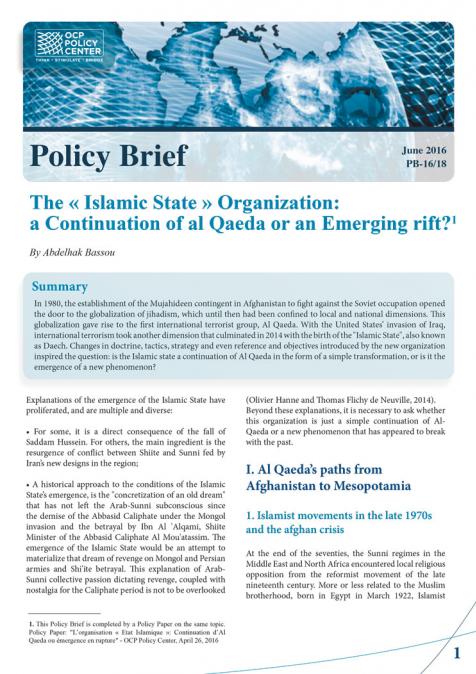
The “Islamic State” organization: A Continuation of Al Qaeda or an Emerging Rift?
Authors
June 13, 2016

In 1980, the establishment of the Mujahideen contingent in Afghanistan to fight against the Soviet occupation opened the door to the globalization of jihadism, which until then had been confined to local and national dimensions. This globalization gave rise to the first international terrorist group, Al Qaeda. With the United States’ invasion of Iraq, international terrorism took another dimension that culminated in 2014 with the birth of the "Islamic State", also known as Daech. Changes in doctrine, tactics, strategy and even reference and objectives introduced by the new organization inspired the question: is the Islamic state a continuation of Al Qaeda in the form of a simple transformation, or is it the emergence of a new phenomenon?

RELATED CONTENT

  • Authors
    Seleman Yusuph Kitenge
    December 1, 2021
    Tanzania has been closely following the evolution of the security situation in the region of Cabo Delgado in Mozambique. Worsening living conditions and safety in this bordering region suggest the eruption of a multifaceted security and human threat of transnational magnitude. This paper looks at the different cultural, linguistic, and socio-economic ties that link Tanzania and Mozambique, while exploring how the security situation in Cabo Delgado might impact national security in T ...
  • Authors
    November 9, 2021
    Events in the Sahel, and Mali especially, are taking an uncertain and worrying turn. Mali witnessed two coups d’état in less than a year, while the West African Sahel went through its most violent year yet and there are no signs that the violence is slowing down. In the midst of this unprecedented instability, recent developments involving Mali’s transitional government and the international community, France in particular, provide no assurances that things are likely to improve any ...
  • Authors
    Pascal Chaigneau
    Eugène Berg
    Rodolphe Monnet
    Jacques Gravereau
    Jérémy Ghez
    Olivier Tramond
    Niagalé Bagayoko
    Alain Oudot de Dainville
    Jérôme Evrard
    Coordination de l’ouvrage: Imane Lahrich
    Fatine Cherkaoui
    October 28, 2021
    Depuis l’accession au trône du Roi Mohammed VI, l’Afrique s’est transformée en priorité de la diplomatie marocaine. Sur le plan économique, l’Afrique est devenue le prolongement naturel du Maroc en termes d’investissements et d’implantations. Pascal Chaigneau s’attarde sur les relations affaiblies Europe-Afrique, l’ambitieuse relation Chine-Afrique ainsi que les relations entre la Russie, les Etats-Unis, la Turquie ou encore les pays du Golf et l’Afrique. Ce chapitre traite égalemen ...
  • October 15, 2021
    La bande sahélo-saharienne connaît, depuis quelques années, une instabilité liée à plusieurs facteurs: le terrorisme, les effets du changement climatique, les tensions ethniques et commun ...
  • Authors
    Sous la direction de
    June 23, 2021
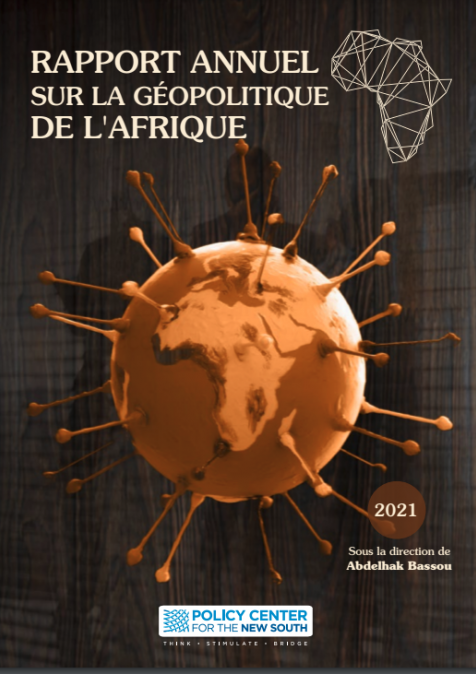
    Cette édition du Rapport géopolitique de l’Afrique, la quatrième, s’inscrit dans la droite ligne de la philosophie et de l’esprit du Policy Center for the New South, qui milite pour une Afrique partie intégrante du Sud global et acteur, en devenir, dans les affaires mondiales. L’Afrique comme continent et comme espace est le théâtre où se déploient les actions des Africains pour réagir et interagir avec les conjonctures internationales, et l’Afrique comme populations et institutions ...
  • May 4, 2021
    The Sahelian states of Niger, Mali, and Burkina Faso continue to face unprecedented violence arising from multidimensional conflicts. According to the Africa Center for Strategic Studies (2019), “the Sahel has experienced the most rapid increase in activity by militant groups of any region in Africa in recent years. Violent events involving extremist groups in the region have doubled every year since 2015”. In addition to the presence of multiple violent extremist organizations (VEO ...