Publications /
Opinion

Back
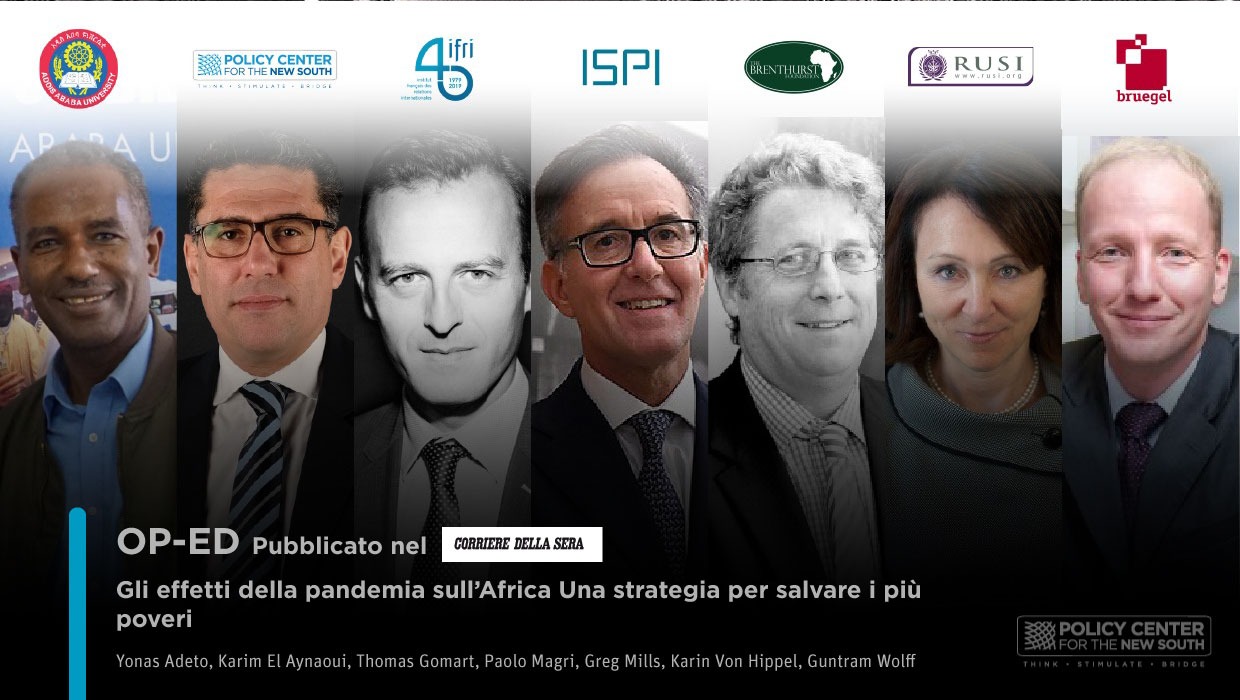
Gli effetti della pandemia sull’Africa Una strategia per salvare i più poveri
Authors
Yonas Adeto
Thomas Gomart
Paolo Magri
Greg Mills
Karin Von Hippel
Guntram Wolff
April 9, 2020
PCNS

Il coronavirus promette di cambiare la politica globale. La velocità e la portata del contagio, così come la gravità del suo impatto, non sono fake news, come abbiamo già imparato a nostre spese. Il virus si diffonde rapidamente nel mondo, passando da persona a persona, e il contenimento delle sue conseguenze è indissolubilmente legato alla disponibilità di risorse e al buon funzionamento dei meccanismi di governance. Per queste ragioni, i leader globali dovrebbero porre molta attenzione all’impatto che la pandemia potrebbe avere sui paesi più vulnerabili, in particolare in Africa.

Solo tre mesi fa, il 31 dicembre 2019, le autorità cinesi informavano l’ufficio di Pechino dell’Organizzazione Mondiale della Sanità del rischio di una possibile epidemia. Cento giorni dopo, tre miliardi di persone in tutto il mondo sono costrette in quarantena nelle loro abitazioni. Si tratta di un approccio radicale per affrontare una emergenza sanitaria senza precedenti. Ma quali possono essere le conseguenze per quegli stati che non dispongono di infrastrutture sanitarie di base e in cui, in generale, gli strumenti a disposizione dei governi scarseggiano?

Il testo integrale è disponibile sul Corriere della Sera : https://www.corriere.it/esteri/20_aprile_08/gli-effetti-pandemia-sull-africa-strategia-salvare-piu-poveri-c1594a88-797f-11ea-afb4-c5f49a569528.shtml

RELATED CONTENT

  • Authors
    February 3, 2022
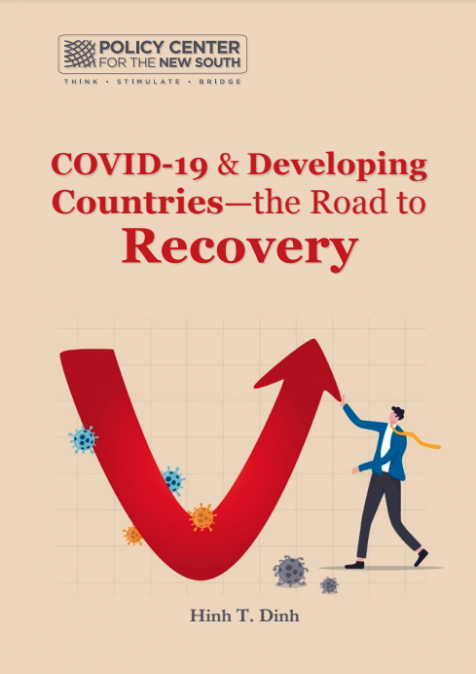
    COVID-19 has ravaged nearly every country in the world, with the globalization of recent decades intensifying its spread. As of mid-2021, the world had spent $16.5 trillion—18% of global GDP—to fight the disease. And that amount does not even include the most important losses such as deaths, mental health effects, restrictions on human freedom, and other nonmonetary suffering. Nearly 90% of this spending was by developed economies, with the rest by emerging market and developing eco ...
  • Authors
    December 6, 2021
    Between January 2020 and June 2021, the world spent about US $16.5 trillion (18% of world GDP) to fight COVID-19, and this amount does not even include the most important losses such as deaths, mental health effects, restrictions on human freedom, and other nonmonetary suffering. Nearly 90% of this amount was spent by developed economies; the rest by emerging market and developing economies. Low-income countries spent just US $12.5 billion, or less than 0.0001% of the total. Moreove ...
  • Authors
    October 11, 2021
    The current global pattern of democratic retrenchment has multiple causes, including economic inequality, American imperial overreach, and increased migration, all of which have led to disillusionment with democratic systems, and inspired a populist demand for populist leaders. This populist wave has also led to the personalization of political regimes, democratic and authoritarian, with power highly concentrated in the hands of a single individual, as seen in Turkey, Philippines, P ...
  • Authors
    July 16, 2021
    The BDA Currents: Where Diplomacy Meets Business, is the Brussels Diplomatic Academy’s annual report covering the wider geopolitical and other factors influencing and affecting the world of diplomacy, international relations and global business. The journal focuses on issues of topical interest around the centers of global power, influence and importance, including the continents of Europe and Africa, the Middle East, China, India & Asia, Russia and the Commonwealth of Independe ...
  • May 20, 2021
    The Policy Brief ‘Pandemic, Preparedness, Morocco, and Africa’ by Uri Dadush provoked a personal reaction: Morocco may never be crowned football’s world champions, alas, but which nation, besides China, New Zealand, Israel, Japan, Denmark, Vietnam, organized its anti-COVID-19 offensive more digitally and in a more modern way than the Kingdom? Morocco’s bureaucracy is at times suffocating and unpleasant, its public hospital system stressed and underfunded. But today I can v ...
  • May 20, 2021
    The fourth edition of the African Peace & Security Annual Conference (APSACO) was held on September 23-25, 2020 under the theme ‘COVID-19 & Security in Africa.’ The three-day event, organized by the Policy Center for the New South (PCNS), was composed of two panels and two workshops: - Panel 1: The Security Sector in Africa During and After the COVID-19 Health Crisis - Panel 2: The Privatization of Violence in Africa: Non-State Armed Groups and Private Security - Workshop ...
  • Authors
    Eugène Berg
    Pascal Chaigneau
    Jérémy Ghez
    May 3, 2021
    Les Dialogues Stratégiques, une collaboration entre HEC Center for Geopolitcs et Policy Center for the New South, représentent une plateforme d’analyse et d’échange biannuelle réunissant des experts, des praticiens, des décideurs politiques, ainsi que le monde universitaire et les médias au service d’une réflexion critique et approfondie sur les tendances politiques mondiales et les grandes questions d’importance commune pour l’Europe et l’Afrique. Cette publication est issue de la ...
  • Authors
    April 28, 2021
    Preparedness for the next pandemic is an essential investment. To get it right, countries must stay flexible and reinforce their international health networks, not abandon them. With its new health law, Morocco has taken a step in the right direction. ...