The US-Iran Conflict and the New Great-Power Landscape: Transatlantic Strains and China's Strategic Calculus

July 7, 2026

Following recent developments in the Middle East, the Policy Center for the New South is launching a three-part webinar series on the strategic, geopolitical, security, and economic consequences of the US-Iran conflict. 

Building on the publication Hormuz and the Invisible Fractures: The Price of a Distant War – Views from the New South, the series examines the Strait of Hormuz as both a vital maritime chokepoint and a fault line in a changing global order. While the recent U.S.–Iran agreement has eased immediate tensions, the crisis remains ongoing and continues to evolve, making this publication a timely snapshot of a dynamic and still-unfolding geopolitical landscape.

Drawing on the volume's multidisciplinary analysis, the webinars explore the conflict's implications for the New South, global trade routes, energy security, and the evolving international order, while fostering informed discussion on the long-term strategic lessons emerging from the crisis.

This session explores how the US-Iran conflict is reshaping relations among major global powers. The discussion assess the impact of the crisis on transatlantic cohesion, the evolving positions of Europe and the United States, and China's strategic calculations in this changing environment. Particular attention is being paid to the implications for global governance, great-power competition, and the emerging international order.


Speakers
Khadija Mamouni
Junior Analyst - International Relations Research Department
...
Ian O. Lesser
Senior Fellow
Ian Lesser is Senior Fellow at the Policy Center for the New South (PCNS). Based in Brussels, he also serves as Distinguished Fellow and Advisor to the President at the German Marshall Fund of the United States (GMF), where he has held several senior leadership roles, including Vice President and Acting President. Dr. Lesser has built a distinguished career at the intersection of transatlantic relations, strategy, and international security. He holds the Chair in Transatlantic Affairs at the College of Europe in Bruges. Before joining GMF, he was a Public Policy Scholar at the Woodrow Wilson International Center for Scholars, Vice President and Director of Studies at the Pacific Council on International Policy, and spent over a decade at the RAND Corporation focusing on s ...
Marcus Vinicius de Freitas
Senior Fellow
Marcus Vinicius De Freitas is Senior Fellow at Policy Center for the New South, focusing on International Law, International Relations and Brazil, and is currently a Visiting Professor of International Law and International Relations at China Foreign Affairs University in Beijing, China. Previously, he was a Professor of The Armando Alvares Penteado Foundation in Sao Paulo, where he served as the coordinator of their International Relations Program from December 2012 until December 2013. He was president of the Sao Paulo Directorate of the Progressive Party, having run for vice governor of the State of Sao Paulo in 2010, where his party polled in third place with more than 1.2 million votes. He also served as the Administrative Director of the Sao Paulo Metropolitan Housing Co ...

RELATED CONTENT

  • Authors
    Jorge Arbache
    October 9, 2025
    Conventional wisdom holds that the United States has undergone massive deindustrialization in recent decades, with the country's manufacturing sector supposedly withering as it lost ground to China. This narrative has fueled debates about industrial policy, economic nationalism, and the reshoring of manufacturing production. But what if this story is only partially true? What if, instead of disappearing, American industry simply changed its address?  ...
  • June 5, 2025
    The history of relations between the West and East Asia is deeply rooted in fear, dating back to the 13th century when Mongol hordes swept from Central Asia into the European steppes. This civilizational neurosis took root in the European imagination and has since shaped Western perceptions of the East. The derogatory racial metaphor “Yellow Peril”, which emerged in the late 19th century, was not a new invention but rather a recurring theme invoked whenever politically expedient. It ...
  • Authors
    May 20, 2025
    Le retour de Trump à la présidence des États-Unis en 2025 accélère l’effondrement de l’ordre international issu de 1945, déjà fragilisé par ses contradictions internes, ses promesses non tenues et son incapacité à intégrer le Sud global. Dans un monde traversé par une polycrise — climatique, énergétique, financière et alimentaire — Trump 2.0 incarne un tournant vers un réalisme assumé, où les alliances sont conditionnelles, les institutions multilatérales instrumentalisées, et les r ...
  • May 2, 2025
    The first hundred days of Donald Trump's presidency have again demonstrated his capacity to defy convention and polarize opinion. Far from merely repeating his earlier administration, this new chapter is best understood as part of a long-term repositioning of the United States within a rapidly shifting international system—one where American primacy is no longer assumed but increasingly contested. On the domestic front, Trump's agenda has been marked by political calculation and a ...
  • April 23, 2025
    The United States is at a critical juncture, facing a pivotal dilemma: preserving global leadership in a world it no longer fully controls. While it proclaims its primacy in the liberal international order, its actions tell a different story—one marked by tariffs, reshoring policies, and an open attempt to contain China’s rise. This strategy is driven less by long-term vision than domestic political calculus, underscoring the urgent need for strategic recalibration. ...
  • Authors
    Fadoua Ammari
    April 18, 2025
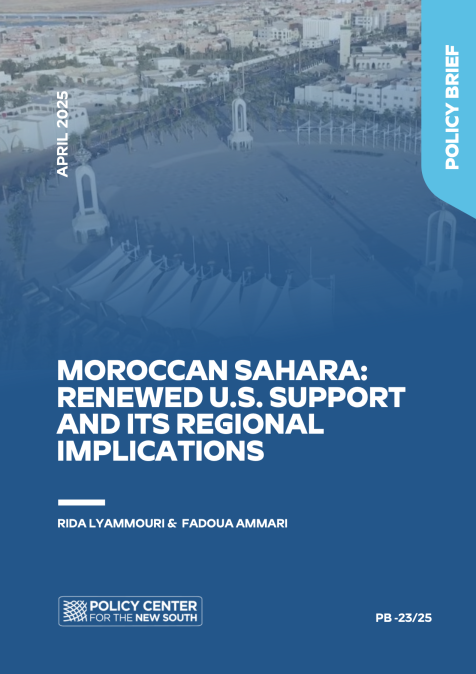
    This Policy Brief analyzes the strategic significance of the reaffirmation by the United States, on April 8, 2025, of its support for Morocco’s sovereignty over the Moroccan Sahara and of Morocco’s autonomy plan for the territory. This position, which has been maintained under different U.S. administrations, confirms the appropriateness of the Moroccan approach based on compromise, regional stability, and economic integration. It reinforces the isolation of the Polisario Front, whos ...
  • Authors
    Fadoua Ammari
    April 16, 2025
    Le présent Policy Brief analyse la portée stratégique de la réaffirmation, le 8 avril 2025, du soutien américain à la souveraineté du Maroc sur son Sahara et à son plan d’autonomie. Ce positionnement, maintenu sous différentes Administrations américaines, consacre la pertinence de l’approche marocaine fondée sur le compromis, la stabilité régionale et l’intégration économique. Il renforce la dynamique d’isolement du Front Polisario, dont le discours figé sur l’indépendance ...