
Is Brazil back? The question arises from the promise made by president Lula, upon his re-election, that his country would make a return to international affairs, after years of relative isolation during the Bolsonaro administration. While the personality of Lula can play a key role in boosting Brazil’s international profile, some questions remain on the country’s ability to maintain its standing. One of them lies in the strong internal polarization within the country. Pedro Vormittag, chief of staff to the chairman of the Brazilian Center of International Relations and member of the ADEL 2023 cohort, explores some of these issues in this interview.
RELATED CONTENT
-
 September 18, 2018If I were to synthesize the current situation of the Brazilian economy in one sentence, I would say: “it is suffering from a combination of ‘productivity anemia’1 and ‘public sector obesity2’". On the one hand, the mediocre performance of productivity in Brazil in recent decades has limited its GDP growth potential. On the other, the gluttony for expanding public spending has become increasingly incompatible with such limits in the potential expansion of GDP, particularly since ...
 -
 July 14, 2017Thinking creatively the bilateral relationship of Brazil and Morocco is quintessential for enhancing its reach and possibilities. The world is currently facing enormous changes whose outcomes are unpredictable. From a revival in the cold war realist dispute of power between the United States and Russia, the collapse of International Law in relation to Ukraine, Crimea and the South China Sea, BREXIT and the imponderable results that may impact the European Union and to the possible d ...
 -
 April 21, 2017There is much room for deepening Brazil and Morocco’s bilateral economic relationship, in the fields of trade and investment flows. This is the main conclusion of the assessment of both countries external economic relations and of their bilateral trade and investment flows. This policy brief aims at presenting a roadmap for fostering bilateral economic relations, focusing on the avenues for a bilateral free trade agreement and for bilateral treaties on investment promotion. This app ...
 -
 May 17, 2016Emerging economies started playing a more predominant role in the international agenda. Finance and defence, which were the major determinants of the global chessboard until the end of the Cold War, though still relevant, should give room to other essential elements to secure growth and prosperity. Energy security is of quintessential importance in this new world order. ...
 -
 February 18, 2016Although the United States is less active in Africa than France, their security policies on the continent often have shared objectives and are sometimes pursued jointly. While the urgency of humanitarian crises has been at the centre of foreign interventions for a long time, now it tends to give way to the terrorist threat. The emergence and expansion of terrorist groups with a complex character, which are sometimes rivals of each other and claiming to follow radical Islam, has incr ...
 -
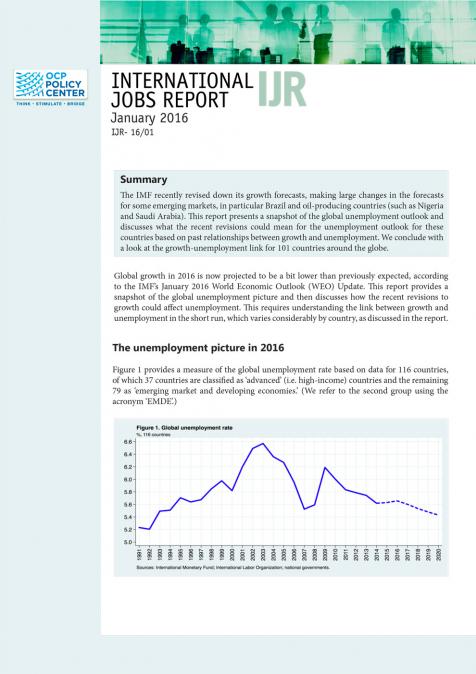 January 27, 2016The IMF recently revised down its growth forecasts, making large changes in the forecasts for some emerging markets, in particular Brazil and oil-producing countries (such as Nigeria and Saudi Arabia). This report presents a snapshot of the global unemployment outlook and discusses what the recent revisions could mean for the unemployment outlook for these countries based on past relationships between growth and unemployment. We conclude with a look at the growth-unemployment link f ...
 -
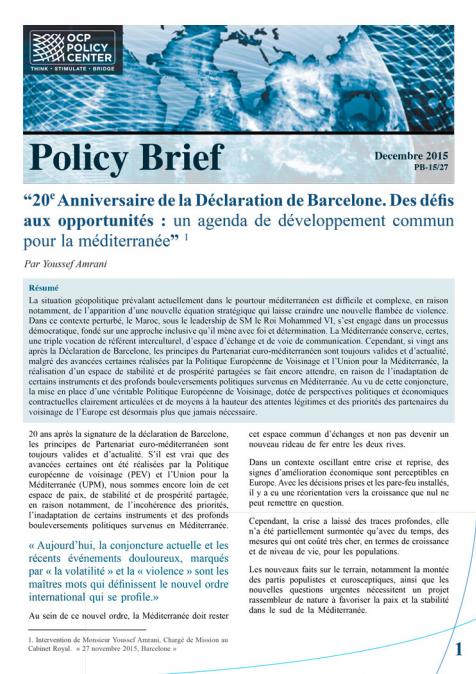 December 22, 2015La situation géopolitique prévalant actuellement dans le pourtour méditerranéen est difficile et complexe, en raison notamment, de l’apparition d’une nouvelle équation stratégique qui laisse craindre une nouvelle flambée de violence. Dans ce contexte perturbé, le Maroc, sous le leadership de SM le Roi Mohammed VI, s’est engagé dans un processus démocratique, fondé sur une approche inclusive qu’il mène avec foi et détermination. La Méditerranée conserve, certes, une triple vocation ...
 -
 December 18, 2015...
 -
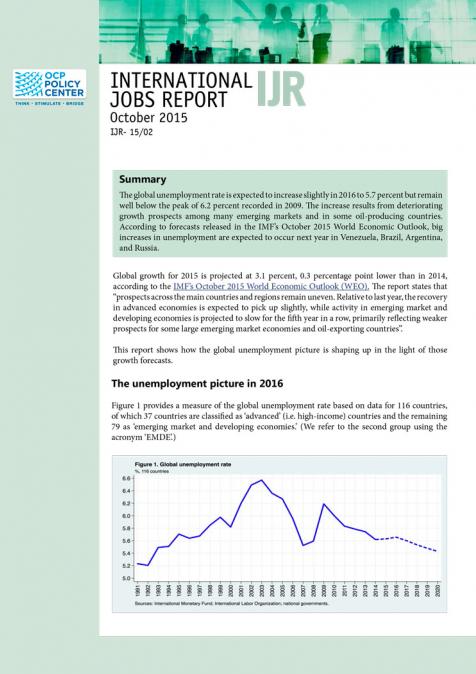 November 5, 2015The global unemployment rate is expected to increase slightly in 2016 to 5.7 percent but remain well below the peak of 6.2 percent recorded in 2009. The increase results from deteriorating growth prospects among many emerging markets and in some oil-producing countries. According to forecasts released in the IMF’s October 2015 World Economic Outlook, big increases in unemployment are expected to occur next year in Venezuela, Brazil, Argentina, and Russia. ...
 -

