
Is Brazil back? The question arises from the promise made by president Lula, upon his re-election, that his country would make a return to international affairs, after years of relative isolation during the Bolsonaro administration. While the personality of Lula can play a key role in boosting Brazil’s international profile, some questions remain on the country’s ability to maintain its standing. One of them lies in the strong internal polarization within the country. Pedro Vormittag, chief of staff to the chairman of the Brazilian Center of International Relations and member of the ADEL 2023 cohort, explores some of these issues in this interview.
RELATED CONTENT
-
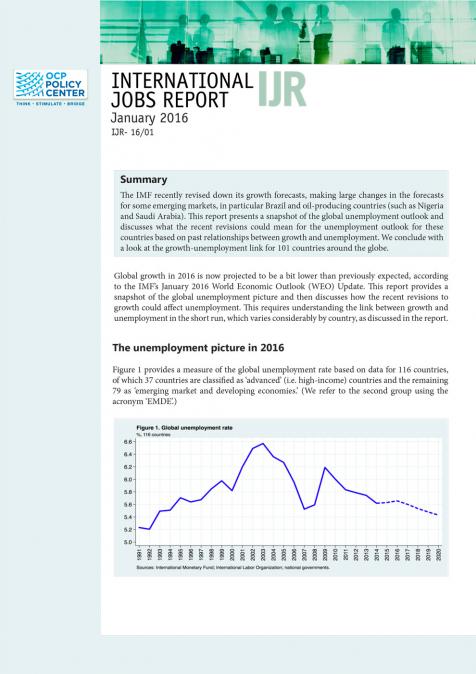 January 27, 2016The IMF recently revised down its growth forecasts, making large changes in the forecasts for some emerging markets, in particular Brazil and oil-producing countries (such as Nigeria and Saudi Arabia). This report presents a snapshot of the global unemployment outlook and discusses what the recent revisions could mean for the unemployment outlook for these countries based on past relationships between growth and unemployment. We conclude with a look at the growth-unemployment link f ...
-
 December 22, 2015La situation géopolitique prévalant actuellement dans le pourtour méditerranéen est difficile et complexe, en raison notamment, de l’apparition d’une nouvelle équation stratégique qui laisse craindre une nouvelle flambée de violence. Dans ce contexte perturbé, le Maroc, sous le leadership de SM le Roi Mohammed VI, s’est engagé dans un processus démocratique, fondé sur une approche inclusive qu’il mène avec foi et détermination. La Méditerranée conserve, certes, une triple vocation ...
-
 December 18, 2015...
-
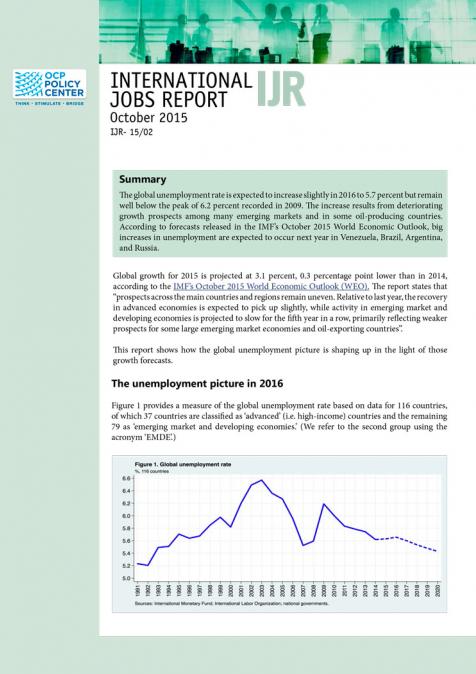 November 5, 2015The global unemployment rate is expected to increase slightly in 2016 to 5.7 percent but remain well below the peak of 6.2 percent recorded in 2009. The increase results from deteriorating growth prospects among many emerging markets and in some oil-producing countries. According to forecasts released in the IMF’s October 2015 World Economic Outlook, big increases in unemployment are expected to occur next year in Venezuela, Brazil, Argentina, and Russia. ...
-
-
July 1, 2015Otaviano CANUTO, Executive Director at the International Monetary Fund, Previous Senior Adviser on BRICS Economies at the World Bank ...
-
 February 27, 2015Brazil’s future prospects, and ability to harness its advantages, will hinge on its own policy choices over the next few years. Yet the outlook for meaningful change is unclear. At present, Brazil is in a weaker position than four years ago, from both an economic and a foreign policy standpoint. Even in a scenario where Brazil’s economy gradually returns to the course it was on until 2008, no major strategic changes are likely to happen in Rousseff’s four-year term. ...
-
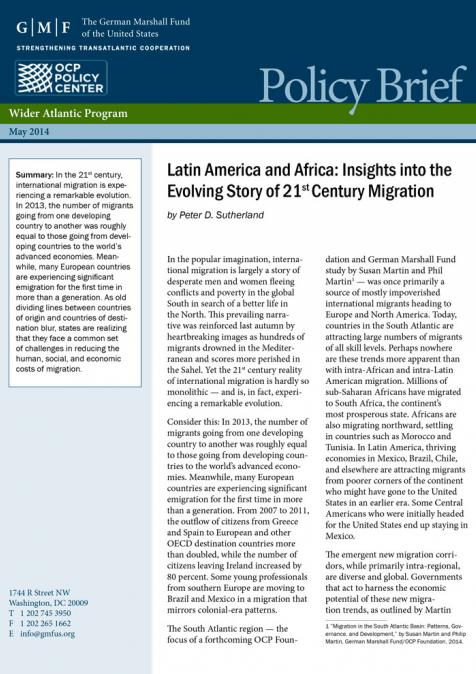 May 1, 2014In the 21st century, international migration is experiencing a remarkable evolution. In 2013, the number of migrants going from one developing country to another was roughly equal to those going from developing countries to the world’s advanced economies. Meanwhile, many European countries are experiencing significant emigration for the first time in more than a generation. As old dividing lines between countries of origin and countries of destination blur, states are realizing that ...
-
 December 1, 2012This policy paper examines the role of China and India in Latin America and Africa, and the implications for the United States and Europe. China and India have arrived as active players in the Southern Atlantic space. Their economic presence is expanding rapidly, with a focus on their acquisition of — and access to — raw materials such as fossil fuels, minerals, and agricultural commodities. The political and security implications of their arrival in the region is only now coming u ...

