Publications /
Book / Report

Back
International Jobs Report: Update 2015
November 5, 2015

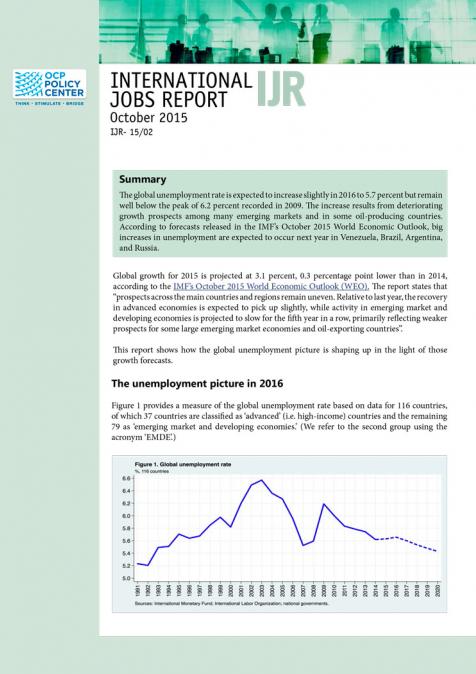
The global unemployment rate is expected to increase slightly in 2016 to 5.7 percent but remain well below the peak of 6.2 percent recorded in 2009. The increase results from deteriorating growth prospects among many emerging markets and in some oil-producing countries. According to forecasts released in the IMF’s October 2015 World Economic Outlook, big increases in unemployment are expected to occur next year in Venezuela, Brazil, Argentina, and Russia.

RELATED CONTENT

  • Authors
    December 14, 2020
    This article has originally been published on OECD Development matter platform Many donor countries seem eager to see middle-income countries (MICs) “master out” and graduate to a non-client status in multilateral development institutions before fully achieving their development potential. We argue that such institutions can still significantly contribute to the sustainable development of MICs, while also seizing many benefits from this relationship (Middle income countries and mul ...
  • Authors
    May 21, 2020
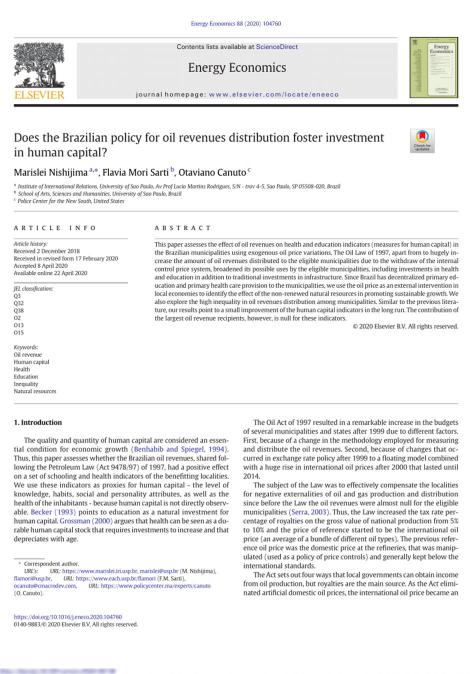
    Our senior fellow, Otaviano Canuto, has contributed to Science Direct academic Journal, with a research paper entitled « Does the Brazilian policy for oil revenues distribution foster investment in human capital? », Volume 88, May 2020, 104760. This paper assesses the effect of oil revenues on health and education indicators (measures for human capital) in the Brazilian municipalities using exogenous oil price variations. The Oil Law of 1997, apart from to hugely increase the amoun ...
  • Authors
    August 13, 2018
    The Brazilian economy pays a price in terms of productivity foregone because of its lack of trade openness. A trade opening process would bring an adjustment impact that could nonetheless be mitigated with public policies that facilitate labor mobility and job migration. Benefits from trade opening would also hinge on policy improvements in complementary areas, such as infrastructure investments, business environment and others. The Brazilian economy would benefit from opening trad ...
  • Authors
    March 7, 2018
    Brazilian conditional cash transfers are small amounts of money the government distributes directly to very poor households on condition that their children attend school and are vaccinated. The money goes to the women of the household, because research undertaken in the 1990s – and later confirmed in other countries – showed an increase in babies' height and weight when women have more control over household income. Greater control over household resources by women can strengthen a ...
  • Authors
    Ana Maria Bonomi Barufi
    December 21, 2017
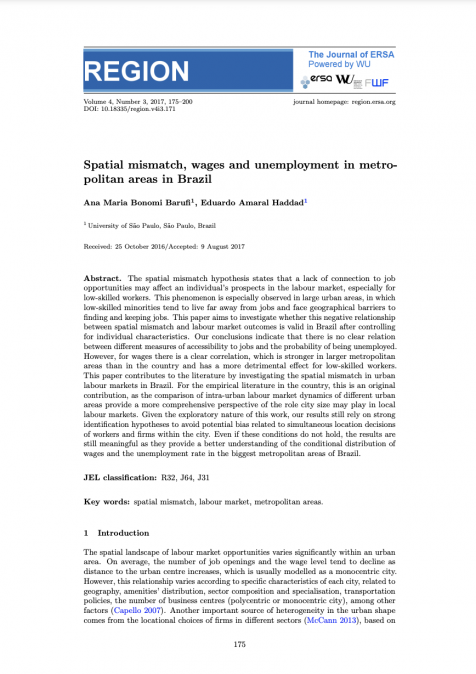
    The spatial mismatch hypothesis states that a lack of connection to job opportunities may affect an individual’s prospects in the labour market, especially for low-skilled workers. This phenomenon is especially observed in large urban areas, in which low-skilled minorities tend to live far away from jobs and face geographical barriers to finding and keeping jobs. This paper aims to investigate whether this negative relationship between spatial mismatch and labour market outcomes is ...
  • Authors
    Prakash Loungani
    November 9, 2016
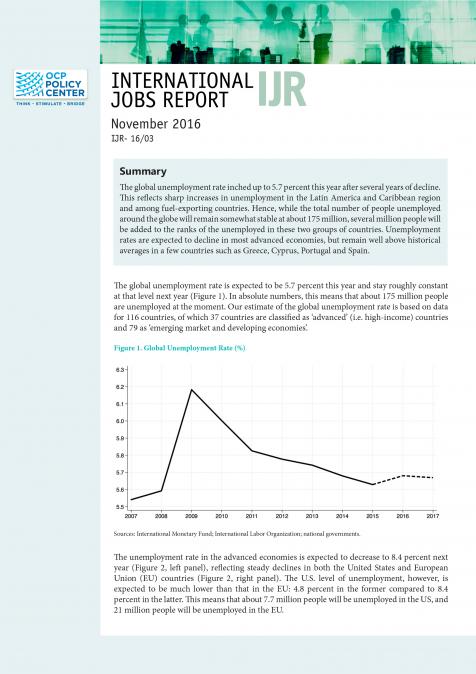
    The global unemployment rate inched up to 5.7 percent this year after several years of decline. This reflects sharp increases in unemployment in the Latin America and Caribbean region and among fuel-exporting countries. Hence, while the total number of people unemployed around the globe will remain somewhat stable at about 175 million, several million people will be added to the ranks of the unemployed in these two groups of countries. Unemployment rates are expected to decline in m ...
  • Authors
    Russel Dinh
    January 27, 2016
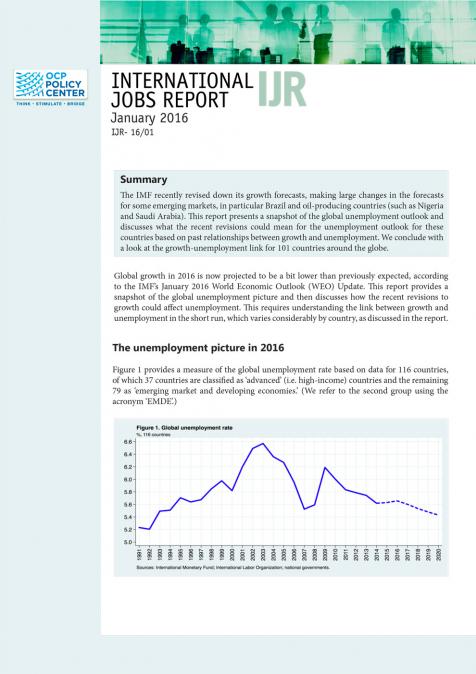
    The IMF recently revised down its growth forecasts, making large changes in the forecasts for some emerging markets, in particular Brazil and oil-producing countries (such as Nigeria and Saudi Arabia). This report presents a snapshot of the global unemployment outlook and discusses what the recent revisions could mean for the unemployment outlook for these countries based on past relationships between growth and unemployment. We conclude with a look at the growth-unemployment link f ...
  • November 5, 2015
    The global unemployment rate is expected to increase slightly in 2016 to 5.7 percent but remain well below the peak of 6.2 percent recorded in 2009. The increase results from deteriorating growth prospects among many emerging markets and in some oil-producing countries. According to forecasts released in the IMF’s October 2015 World Economic Outlook, big increases in unemployment are expected to occur next year in Venezuela, Brazil, Argentina, and Russia. ...