Publications /
Opinion
The early March 2026 Pentagon briefings were tuned towards triumph and surrender - unconditional. The white flag of defeat was visible on the Iran horizon, and America's commander in chief needed only a few more weeks to declare "their military is gone. Wiped out". His secretary of war, Pete Hegseth, added to Trump's assessment his own, the Iranian navy was "decimated, destroyed and defeated", the naval fleet of the enemy rested on the bottom of the Persian Gulf. Iran's defense industrial base, insisted Hegseth, a former Fox News moderator, "and missile stockpiles were functionally destroyed, leaving them unable to quickly rebuild or project power." The Pentagon further reported that Iranian missile and drone launches were down by over 90 percent, resulting in the combined control of Israel and the US over Iranian airspace, neutralizing their integrated air defence system.
The President promised victory, "in a few days", or he insisted "we already won", or just, "a quick detour" and "the end is in sight", and "if the enemy remains stubborn" we will bomb them back into the stone ages, where they belong", or another zigzag, America, the greatest democracy in history, would wipe out Persia's thousands of years old, noble, culture and, since we are engaged in historic demolition, the US would eradicate the whole civilization. "Military force has got the US nowhere with Iran", stated the British "Guardian" (May 8, 2026). "After months of war, the US has struggled mightily to compel Iran to restore stable passage through the Strait of Hormuz, let alone accept Washington's core demands—the abandonment of Iran's nuclear programme, dismantlement of their missile forces and cancellation of their proxy networks.
The top of the iceberg
After five months of war, the second Iran attack in two years in a row, the global economy is still at risk, Donald Trump's domestic approval is sliding and US military preparedness—particularly in the Indo Pacific—is suffering. Christopher Chivvis, author of the "Guardian" article, is asking: "Why has Iran been able to frustrate the US's designs so thoroughly?" His own answer: "The core problem is that while Trump has claimed to be negotiating, in practice he has relied almost exclusively on military and economic pressure, rather than the give and take of real diplomacy." They discussed here, debated there, yet in July the Strait of Hormuz was blocked again and Washington reacted with 5000-pound penetrating bombs, delivered by stealth bombers, to Iranian provocations, the attack on a container giant, and firing on two Emirati oil tankers—"two days of US strikes in Iran", reported the "New York Times" (July 10, 2026), "signal a sharp escalation", and Trump, confirmed the "Washington Post" (July 15, 2026), is ready to knock out power plants and bridges unless Tehran returns to the negotiating table.
Linda Bilmes, Professor of Public Policy at Harvard University's Kennedy School, who studied the cost of the Iran war, estimating a one trillion dollar price as credible and probable, believes that "the Trump administration expected that this war would be over quickly and would be relatively inexpensive", a thought Putin may have had when he sent his tanks into Kyiv. According to the Pentagon, argues the professor in a Harvard newsletter (April 7, 2026), the first three to five days of the war did account for 11.3 to possibly 16 billion dollars, and no end in sight, since "we are spending down ammunition at an extraordinary speed", says Bilmes, "we fired more Patriot missiles in the first four weeks of the Iran war than we have given Ukraine in the first four years." Based on "what we know now" suggests the professor, the war in Iran is costing the US "about two billion dollars a day in short term, upfront costs; which is the top of the iceberg." Possibly Linda Bilmes did not add, for example, the loss of sophisticated US radar long-range missile interceptor stations, THAAD, on US military installations in Kuwait and Jordan, destroyed by Iranian missiles or drones—each loss estimated at 1.1 billion dollars.
The truth is, confirmed by satellite imagery, that Iran's airstrikes have damaged or destroyed at least 228 structures on an estimated 16 US installations in the Middle East and added in July more damage in Gulf states, all of them Washington allies. Key American radar installations and satellite communication radomes in Kuwait, where another high-value radar system, 300 million dollars worth, was hit. Iranian strikes penetrated sites in Bahrain, including the US Navy's 5th Fleet headquarters. Damage included destroyed runways, flattened aircraft hangars and disabled Patriot and THAAD systems. Tehran targeted the Jebel Ali Port in Dubai, and damaged Qatar's Al Udeid Air Base, part of the largest US military command center in the Middle East, witnessed the destruction of their ballistic missile early warning radar, valued at 1.1 billion dollars. This critical radar provides early detection of long-range threats for US missiles. Iran's "Tasnim" news agency reported that an Iranian strike destroyed a 300 million dollar radar system, a key component of the Terminal High Altitude Area Defense System (THAAD) at Jordan's Muwaffaq Salti Air Base—the loss of even a single component would significantly impact combat operations, and a replacement unit would need to be rebuilt in three to five years.
Built for a war with China
The enemy was not retreating, publicly begging for negotiations, offering surrender, but instead dared to fire two ballistic missiles at the British island, Diego Garcia, in the Indian Ocean, located 4000 kilometers from Tehran, where 2200 US soldiers are stationed. Air Force General Dan Caine, the Chairman of the Joint Chiefs of Staff, admitted in a hearing by the Senate Armed Services Committee in Washington to a question of conservative Senator Lindsey Graham (who suddenly died in the US capital through a heart attack), whether the Iranians had the capacity to reach those distant targets with an Intermediate Range Ballistic Missile (IRBM), a fact unknown, or kept secret? "Yes", was the short answer. Yes, one of the missiles fell on route from the sky, a second one, allegedly, was intercepted by a US warship. The message from Tehran was clear—its missiles could strike Paris, Berlin and Rome and one day sooner or later, (a dream the Iranians share with Trump's admired comrade in North Korea), reach targets in the USA, preferably nuclear-armed: despite the one trillion dollar war investment, Washington has yet to find the hidden 900 pounds of highly enriched uranium needed to, finally, frighten neighbors like Israel or Saudi Arabia and a distant enemy in the US capital with the devastating weapon.
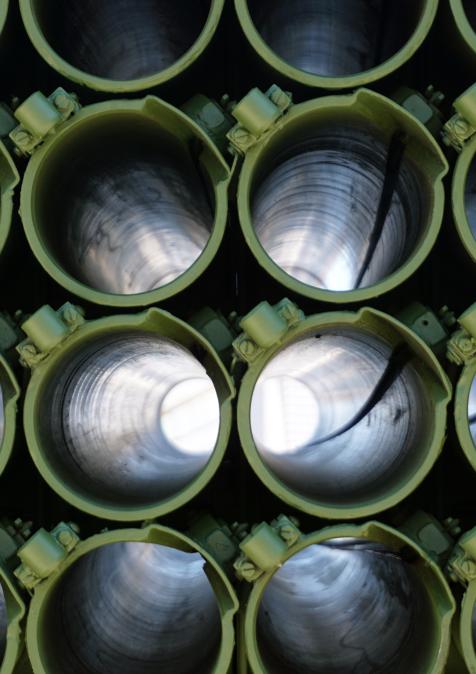
The "Deutsche Welle" (DW) (March 16, 2026) reported that the Pentagon seemed stressed enough to ship part of a THAAD system from South Korea to the Middle East, confirmed by the US Korea commander, Xavier Brunson, in a Senate hearing six weeks later—the US had to admit that it does face a severe depletion of critical munition and missile stockpiles. Sustained conflicts, including deliveries to Ukraine, have burned through years' worth of weapons at rates that vastly exceed domestic manufacturing capacity. Eric Schmitt, national security correspondent of the "New York Times", and his White House colleague Jonathan Swan reported that since the Iran war began February 28, the US "has burned through around 1100 long-range stealth cruise missiles built for a war with China", close to the total number remaining in the US stockpile (April 23, 2026).