Publications /
Opinion

Back
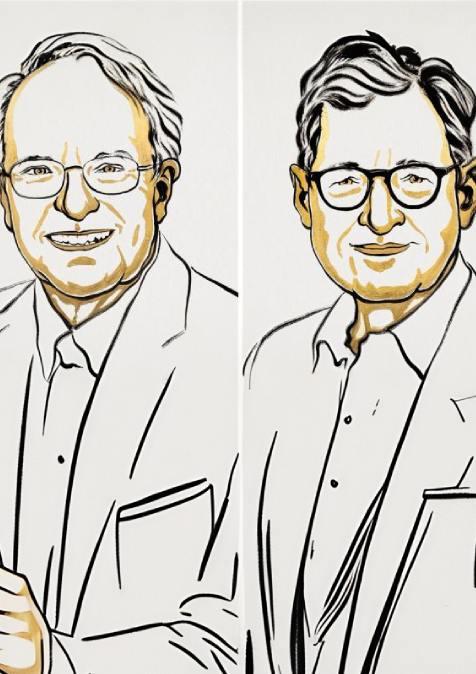
Robert E .Hall et Michael Woodford, Prix Nobel d’Économie 2026
October 26, 2026

Depuis que l’économie a été reconnue par les Nobel en 1969, il revient à cette discipline de clore les cérémonies annuelles d’attribution des Prix aux lauréats. C’est le 12 octobre 2026 que le jury du prix de la Banque de Suède, en sciences économiques en mémoire d’Alfred Nobel, a consacré deux Américains Prix Nobel de l’économie : Robert E. Hall et MichaelWoodford, pour leur contribution aux « fondements microéconomiques de la stabilisation macroéconomique de la stabilisation ».

Le choc pétrolier de 1973, aboutissant à la stagflation, va mettre à mal les recettes keynésiennes de l’après-guerre. Mais, à la différence de nombreux   Keynésiens qui désiraient tourner la page du Maitre de Cambridge, nos deux lauréats vont chercher à donner une nouvelle dimension à son analyse, à partir d’une approche micro économique comportementale des individus et des entreprises. Et ils vont agir en complémentarité, Robert E .Hall, en privilégiant la demande, Michael Wood, l’offre.

Robert E .Hall enseigne toujours à l’université de Stanford (Californie), aux États-Unis, après avoir soutenu sa thèse de doctorat, sous la direction de Robert Solow, Prix   Nobel d’Économie en 1987. Ses travaux vont porter principalement sur la prise en compte des anticipations dans la décision   de consommer ou de ne pas consommer. Avant sa contribution, on considérait que la consommation dépendait du revenu disponible et de lui seul. Hall va montrer qu’on ne peut comprendre l’évolution de la consommation sans prendre en compte les anticipations individuelles du consommateur, par exemple celle qui concerne son salaire ou son pouvoir d’achat. Dans un article fondateur de 1978, il montre que le changement de consommation est imprévisible, ce qui le conduit à conclure que la meilleure prédiction de la consommation ne peut se fonder que sur la consommation du moment, à une variation imprévisible près. (Son ouvrage de   référence : ‘’The 

Rational Consumer :Theory  and Evidence ‘’, MIT Press /Cambridge, Massachusetts 1990)

Michael Woodford enseigne à l’université de Columbia (New York). Ses travaux concernent la version offre de la problématique. Et ce, en analysant la fixation des prix par les entreprises, et plus particulièrement les raisons pour lesquelles , en cas de choc, les prix ne s’ajustaient pas rapidement. Il va montrer que si ces prix pouvaient baisser, cela ne pouvait être que très lentement, leur adaptation au choc nécessitant de multiples, et parfois couteuses, micro-décisions. À partir de ce constat, il va développer, en y intégrant, les travaux de Hall sur la consommation, un modèle macroéconomique beaucoup plus efficace, montrant, par exemple, que l’inflation globale est fonction des anticipations et du niveau actuel de la production, qu’il va intégrer à celui de Hall. Woodford va ainsi influencer les politiques économiques et monétaires du monde entier. Ce qui lui vaudra d’être qualifié par certains du « plus grand économiste monétaire de son temps ». ( Son ouvrage de référence : ‘’ Interest   and Prices :Foundations  of a Theory of Monetary Policy ‘’ Princeton University Press   2003 )

En distinguant un champ de recherche, celui de la nouvelle économie keynésienne, le jury ne pouvait en ignorer le pionner :Robert E .Hall , et celui qui va le plus contribuer à la faire progresser, allant jusqu’à la modéliser avec des applications concrètes : Michael Woodford.



RELATED CONTENT

  • Authors
    Mohamed Hamza Sallouhi
    March 23, 2016
     Partie 1. Le ralentissement économique de la Chine : une transition inquiétante  L’incertitude sur les marchés financiers, la transition de l’économie chinoise vers un modèle de croissance moins extraverti et le ralentissement du rythme de la croissance des pays émergents, sont autant de facteurs qui fragilisent considérablement une croissance mondiale durable et synchronisée. Dans ce contexte, l’OCP Policy Center a tenu une table ronde animée par Patrick Artus ...
  • March 17, 2016
    Jointly organized by OCP Policy Center and Shanghai Institutes for International Studies, the roundtable on "Current African Economic and Strategic Challenges and Opportunities; Intersecting Views from China and Morocco" was a great opportunity to gather experts from both side, to brainstorm opportunities to enhance the role of think-tanks and civil society organization in the consolidation of the Afro-Asian cooperation more efficiently and in a more comprehensive way. Th ...
  • Authors
    March 8, 2016
    Along with phosphorus and nitrogen, potash constitutes one of the three nutrients used in the production of fertilizers. Although the factors that influence its demand are mostly common to other fertilizers and in large part determined by the agricultural market conditions, its supply depends on specific factors. Long known to be controlled by two production and export cartels, the potash market experienced a major change in 2013 with the end of the RussianBelarusian agreement. In a ...
  • Authors
    Zouhair Aït Benhamou
    March 2, 2016
    Discrepancies in output fluctuations between emerging and developed economies are well documented in the literature. Differences however within developing economies have not been sufficiently scrutinised. This paper argues that global and regional shocks primarily drive the business cycle in emerging economies, and provides estimated results for cycle variance decomposition. The paper also offers a theoretical framework to check on the set of stylized facts common and specific to em ...
  • February 22, 2016
    If one opens the newspapers nowadays, Brazil will come out as a melting opportunity. The country is currently facing its largest economic crisis, mostly resulting from a negative political environment where the current Administration has been deeply swollen by Brazil´s largest corruption scandal, the so-called Lava Jato (Car Wash) Operations, whose investigations have brought to light the fact that billions of US$ dollars were being used for campaign financing, illicit enrichment an ...
  • February 8, 2016
    Brazil is in a good position to serve as a bridge to Africa and to reignite more cooperation between both sides of the South Atlantic. Brazil has increased its presence in Africa in recent years in terms of trade, investment, development cooperation, and political alliances with the goal to secure a greater say for the global South in the new world order that has been under construction since the of the Cold War. This has been pursued through financial support and proactive economic ...
  • Authors
    February 1, 2016
    Industrial policy is a controversial, even taboo, subject in policy circles. Yet it is widely practiced by advanced and developing countries alike2 . This note tries to make sense of this paradox. It argues that industrial policy can be a useful weapon in the development policy arsenal. However, the effectiveness of industrial policy is more circumscribed than many of its practitioners think, and there are significant risks associated with getting it wrong, especially in a poor gove ...
  • January 27, 2016
    This podcast is performed by Prakash Loungani. He is Senior Fellow at Policy Center for the New South and Advisor in the Research Department of the International Monetary Fund, was interv ...