Prakash Loungani - Labour Market - Senior Fellow OCP Policy Center

February 18, 2016
Speakers
Rim Berahab
Senior Economist
Rim Berahab is Senior Economist at the Policy Center for the New South, which she joined in 2014. She is currently working on themes related to energy issues and their impacts on economic growth and long-term development. Her research areas also cover trade and regional integration challenges in Africa. Previously, she has also worked on questions related to gender inequalities in the labor market of North African countries. Rim spent three months at the International Monetary Fund (IMF), in 2016, in the Commodities Unit of the Research Department. She holds a State Engineering degree from the National Institute of Statistics and Applied Economics (INSEA). ...

Tayeb Ghazi
Senior Economist
Tayeb Ghazi is Senior Economist at the Policy Center for the New South (PCNS). He is also a member of the Social and Solidarity Economy Research Group at Cadi Ayyad University and holds a master's degree in applied finance from the same university. He is currently working on topics related to labour market, education, migration and some aspects of international trade in developing countries. ...
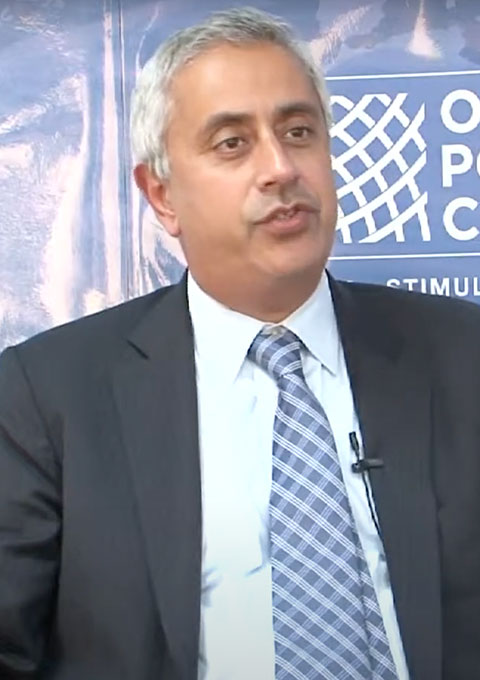
Prakash Loungani
Senior Fellow
Prakash Loungani is Senior Fellow at the Policy Center for the New South as well as Advisor in the IMF’s Research Department and Co-Chair of the IMF’s group on Jobs and Growth. His research focuses on Labour Markets, Macroeconomics, and Energy. He is also an adjunct Professor of Management at Vanderbilt University’s Owen School of Business, where he has taught in the Executive MBA program for the past 15 years. During 2013-14, he was on the World Economic Forum’s council on employment issues. His academic work has been published in top-tier journals and the citations to this work place him among the top 5% of economists worldwide. He was the co-author of the IMF’s background paper for the ILO-IMF conference in Oslo on tackling unemployment. More recently, he is the co-author ...

RELATED CONTENT

  • May 12, 2026
    Why only globally connected, knowledge-intensive services — not local services — can drive long-term development and productivity growth. This Commentary was originally published on stimson.org For decades, manufacturing was considered the indispensable engine of economic development, creating jobs, boosting productivity, and integrating countries into global markets. But automation, robotics, and intensifying global competition have made industrialization far harder for d ...
  • Authors
    Hajar Kabbach
    May 11, 2026
    Closing Morocco's gender employment gap could increase GDP per capita by 40-50 percent; yet female labor force participation stands at just 19 percent—among the lowest in the world and still declining. This policy paper argues that investing in the care economy is not merely a social expenditure, but a productive economic strategy with measurable returns. Drawing on international evidence from Uruguay, Mexico, Colombia, and India, the brief demonstrates that well-designed care syste ...
  • Authors
    April 30, 2026
    This paper is the second in a series examining services-led development and global value chain (GVC) integration in the Global South. It applies a three-category analytical framework covering knowledge services (ICT and professional business services), enabling services (transport, logistics, and finance), and local services (retail, hospitality, health, and personal services), to OECD Trade in Value Added indicators. The paper thus  ...
  • April 29, 2026
    Cette chronique a été initialement publiée sur le site lesechos.fr Les économies en développement font face à un double défi : créer des emplois à grande échelle tout en soutenant la productivité. Quels types de services permettent cette convergence ? Les économistes Hinh T. Dinh et Karim El Aynaoui répondent dans la chronique du « Cercle des économistes ».Les services peuvent-ils se substituer à l'industrie manufacturière comme moteur du développement ...
  • April 27, 2026
    This episode examines firms’ access to finance in Morocco, highlighting its critical role in business creation and growth, especially for SMEs. It challenges common assumptions by showing that medium-sized firms, rather than small ones, face the most binding financial constraints. The d...
  • April 27, 2026
    This episode examines Morocco’s handicraft sector, highlighting its economic importance as a major source of employment and value creation, despite being often overlooked. It presents new empirical evidence showing the sector’s gradual shift toward more formalized SMEs, while exposing i...
  • Authors
    April 20, 2026
    This paper was published as a book chapter in “The Economic Potential of Islamic Countries, Part B: Sustainability, Governance, Energy and Digital Transformation,” released by Emerald Publishing. The COVID-19 pandemic exposed significant deficiencies within social protection systems worldwide, especially in Middle Eastern and North African (MENA) countries. This underscores the urgent need to fortify these social protection schemes to ensure resilience in the face of crises (Sa ...
  • April 13, 2026
    Résumé exécutif stratégiqueLe Maroc s’est engagé avec détermination dans une trajectoire de modernisation fondée sur la transition numérique, la transition verte et l’innovation. Ces dynamiques sont devenues des leviers stratégiques pour la compétitivité, l’attractivité et la création d’emplois à forte valeur ajoutée. Pourtant, l’analyse des données microéconomiques récentes révèle un paradoxe préoccupant : les entreprises les plus modernisées, moteurs de la croissance de demain, re ...
  • Authors
    March 12, 2026
    Historically, manufacturing has served as the primary pathway to economic development, offering strong scale economies, learning-by-doing effects, and the capacity to generate the foreign exchange necessary to import capital goods and technology. However, advances in robotization and artificial intelligence (AI) are fundamentally undermining manufacturing’s traditional role, making it increasingly skill- and capital-intensive while limiting its ability to absorb labor. Thi ...