Publications /
Policy Paper
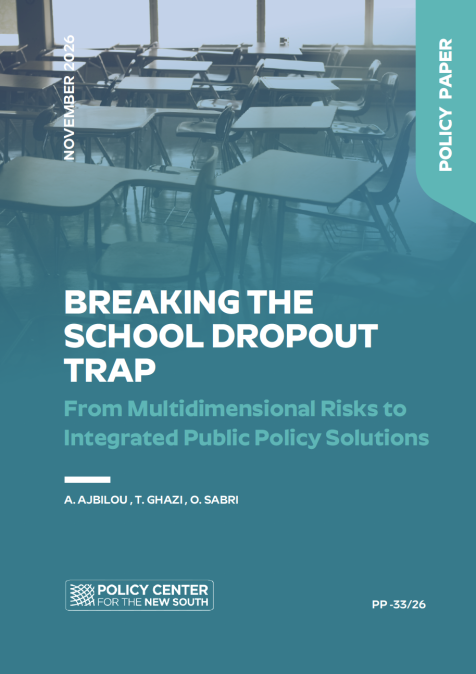
School dropout remains a major challenge for education systems and public policy, with lasting consequences for human capital, labor market integration, social cohesion, and long-term economic growth. Despite sustained efforts to expand access to schooling, many countries continue to experience high dropout rates, particularly at key transition points in lower- and uppersecondary education. Policy responses have often relied on fragmented, sector-specific interventions—addressing education quality, poverty, social norms, or health constraints in isolation— thereby limiting both their effectiveness and sustainability.
This paper conceptualizes school dropout as a systemic phenomenon resulting from the interaction of four interdependent dimensions. Based on a systematic literature review conducted according to PRISMA guidelines and complemented by recent studies published between 2021 and 2025, it proposes a fourpillar analytical framework encompassing: (i) education quality and institutional capacity; (ii) economic constraints and incentive structures; (iii) social norms, governance, and community dynamics; and (iv) health, hygiene, and student well-being. The analysis shows that single-pillar policies generate fragile and short-term effects, whereas integrated and multisectoral strategies produce more sustainable reductions in school dropout. The framework highlights coordination gaps and identifies priority actions for strengthening school retention through coherent human capital policies.