Publications /
Policy Paper

Back
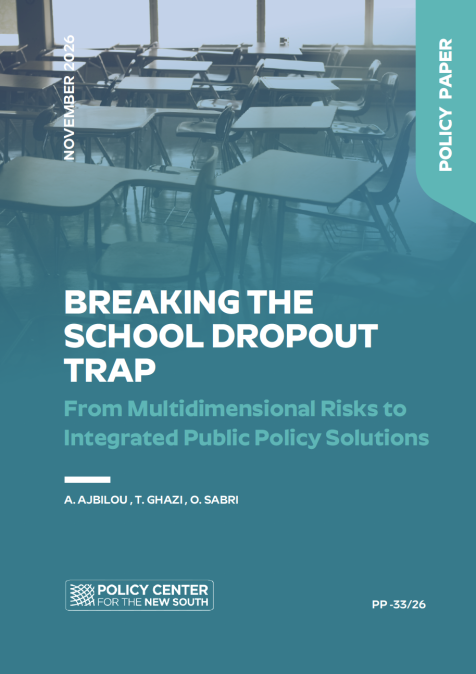
Breaking the School Dropout Trap: From Multidimensional Risks to Integrated Public Policy Solutions
Authors
Aziz Ajbilou
Ouidade Sabri
November 4, 2026

School dropout remains a major challenge for education systems and public policy, with lasting consequences for human capital, labor market integration, social cohesion, and long-term economic growth. Despite sustained efforts to expand access to schooling, many countries continue to experience high dropout rates, particularly at key transition points in lower- and uppersecondary education. Policy responses have often relied on fragmented, sector-specific interventions—addressing education quality, poverty, social norms, or health constraints in isolation— thereby limiting both their effectiveness and sustainability.

This paper conceptualizes school dropout as a systemic phenomenon resulting from the interaction of four interdependent dimensions. Based on a systematic literature review conducted according to PRISMA guidelines and complemented by recent studies published between 2021 and 2025, it proposes a fourpillar analytical framework encompassing: (i) education quality and institutional capacity; (ii) economic constraints and incentive structures; (iii) social norms, governance, and community dynamics; and (iv) health, hygiene, and student well-being. The analysis shows that single-pillar policies generate fragile and short-term effects, whereas integrated and multisectoral strategies produce more sustainable reductions in school dropout. The framework highlights coordination gaps and identifies priority actions for strengthening school retention through coherent human capital policies.
RELATED CONTENT

  • June 26, 2026
    In Morocco, the issue of young NEETs (Not in Employment, Education, or Training) is a national emergency, fueled by 300,000 students dropping out of school each year. In response to this challenge, the “New Generation Second Chance School” (E2C-NG) model has proven its effectiveness by achieving an exceptional employment rate of 81%.However, this institutional success rests entirely on a local network of organizations that is now under strain. A previously unpublished analysis of da ...
  • June 26, 2026
    Au Maroc, la problématique des jeunes NEETs (Ni en emploi, ni en études, ni en formation) constitue une urgence nationale, alimentée par 300 000 abandons scolaires annuels. Face à ce défi, le modèle de l'École de la Deuxième chance nouvelle génération (E2C-NG) a démontré sa pertinence en affichant un taux d'insertion exceptionnel de 81 %.Cependant, ce succès institutionnel repose intégralement sur un tissu associatif local aujourd'hui fragilisé. L'analyse inédite des donné ...
  • Authors
    Karim El Mokri
    Idriss El Abbassi
    June 8, 2026
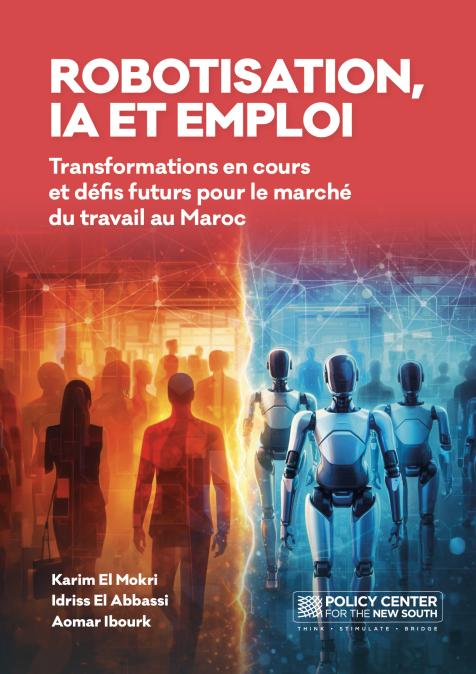
    Le monde du travail est engagé dans un processus de mutation sans précédent. La quatrième révolution industrielle, portée par l’intelligence artificielle (IA) et la robotisation, a été le point de commencement d’une ère nouvelle où les repères économiques et sociaux se redéfinissent à une vitesse inédite. Ces technologies suscitent un engouement légitime et offrent des perspectives prometteuses, mais requièrent une vigilance accrue face aux incertitudes qui les entourent.Bien que, à ...
  • January 5, 2026
    This Paper was originally published on sciencedirect.com This study provides an original and significant contribution to evaluating educational service quality in Morocco by leveraging, for the first time, microdata from the Service Delivery Indicators (SDI) survey. The survey covers a nationally representative sample of 300 public and private primary schools across rural and urban areas. The use of SDI data represents a major methodological advancement, shifting away from perc ...
  • Authors
    September 16, 2025
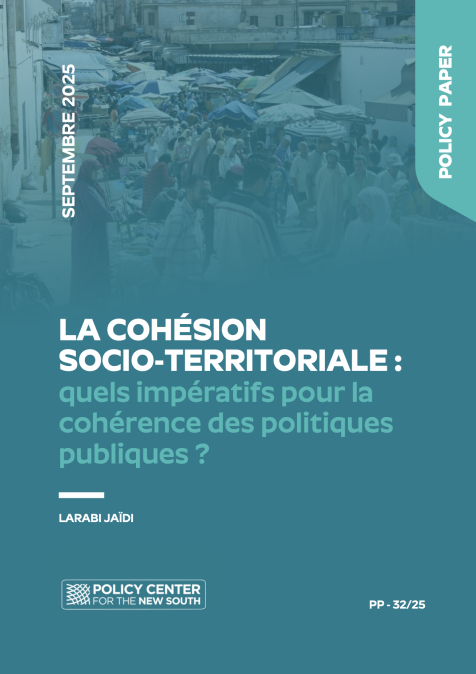
    Les questions des inégalités sociales et des inégalités territoriales sont profondément liées.  Les politiques publiques ne peuvent réduire l’une sans s’attaquer à l’autre.  Le phénomène des inégalités peut s’accentuer avec la fragilité de la situation socio-économique de certains territoires d’autant que le développement territorial n’est pas spontanément équitable. La réduction de ces inégalités, un des enjeux majeurs des politiques publiques, oblige à con ...
  • Authors
    Soukaina Raoui
    September 12, 2025
    This Paper was originally published on springer.com This paper provides an in-depth analysis of socio-economic convergence across communes in Morocco, focusing on monetary poverty and educational inequalities. This research investigates the impact of the well-known territorial and inclusive development policies of the National Initiative for Human Development on the catch-up process. We explore the data from the last two general population and housing censuses (2004 and 20 ...
  • September 11, 2025
    Ce travail apporte un éclairage critique sur l'alignement des dispositifs publics d'orientation des étudiants marocains à l'étranger avec les ambitions de développement du pays. Il interroge la capacité de ces mécanismes à transformer la mobilité étudiante d'une potentielle "fuite des cerveaux" en un véritable "gain de cerveaux". S'appuyant sur une étude de cas qualitative, nous avons mené une analyse de contenu systématique (cartographie) de 204 programmes promus par le ministère d ...
  • August 28, 2025
    This Paper was originally published on tandfonline.com The gender gap in education remains a concern for Moroccan policymakers and researchers, yet it is rarely measured quantitatively. This study examines differences in reading and mathematics performance between girls and boys, both at the national level and by place of residence, using PIRLS (2016, 2021) and TIMSS (2015, 2019) data covering 21,129 students. The Blinder-Oaxaca decomposition method is applied to distingui ...
  • June 16, 2025
    This Paper was originally published on tandfonline.com This paper analyzes gender disparities in reading and mathematics among Moroccan 4th-grade students using data from PIRLS 2021 (7,017 students) and TIMSS 2019 (13,536 students). Using the Blinder-Oaxaca decomposition method, it separates performance gaps into explained (observable characteristics such as age, family background, teacher, and school factors) and unexplained (structural) components. In reading, the unexpl ...
  • Authors
    Kabir Elmakhloufi
    June 11, 2025
    This Paper was originally published on springer.com Au Maroc, en plus de leurs missions religieuses, les mosquées jouent un rôle dans l’apprentissage qualifiant des adultes, favorisant ainsi leur intégration. L’article développe un indice à caractère économique pour évaluer cette intégration. Il mobilise des données ad hoc constituées par le suivi d’une cohorte de l’ensemble des 351 apprenantes pendant cinq ans et demi. Des résultats prometteurs témoignent d’un p ...