Publications /
Policy Brief

Back
Industrial Policy: A Guide for the Perplexed
Authors
February 1, 2016

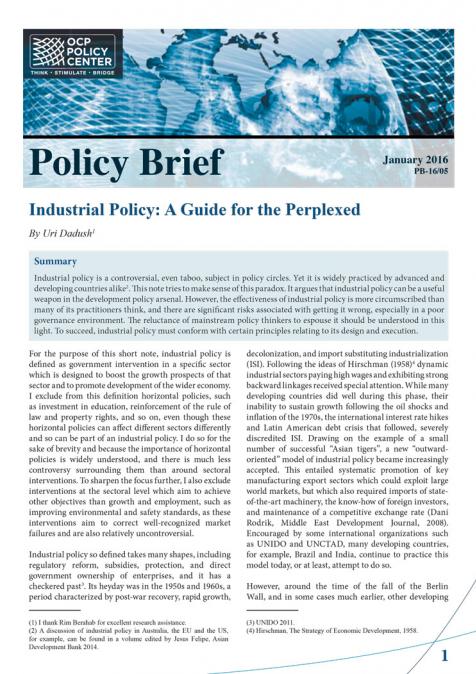
Industrial policy is a controversial, even taboo, subject in policy circles. Yet it is widely practiced by advanced and developing countries alike2 . This note tries to make sense of this paradox. It argues that industrial policy can be a useful weapon in the development policy arsenal. However, the effectiveness of industrial policy is more circumscribed than many of its practitioners think, and there are significant risks associated with getting it wrong, especially in a poor governance environment. The reluctance of mainstream policy thinkers to espouse it should be understood in this light. To succeed, industrial policy must conform with certain principles relating to its design and execution.

RELATED CONTENT

  • Authors
    May 15, 2026
    This paper is the third in a series of country and comparative studies that together comprise a research program on services as drivers of economic growth and structural transformation in the Global South. The paper analyzes the pattern of Tunisia's services-led economic growth from 2012- 2022 using a specialized three-category framework: knowledge services (KS), enabling services (ES), and local services (LS). Using data from the OECD Trade in Value Added (TiVA), Trade in Employmen ...
  • May 15, 2026
    In this podcast recorded during the Growth Summit, Naomi Kengurungu, Director of Marketing and Communication at the African Management Institute, discusses the key conditions needed for h ...
  • May 14, 2026
    In this episode of Africafé, Neema CHUSSI discusses the opportunities and challenges artificial intelligence presents for Africa. She highlights the need for the continent to develop its own AI governance approach, rooted in African democratic values, while addressing critical issues su...
  • Authors
    Jorge Arbache
    May 14, 2026
    Decarbonization is reconfiguring global relative prices. As clean energy, natural capital, and location-specific assets become dominant industrial inputs, the relative cost of producing low-carbon goods is increasingly determined by geography. Two systematic distortions explain why the expected reallocation of investment toward renewable-rich economies remains incomplete. First, industrial policy interventions, including subsidies, trade barriers, and certification systems, disconne ...
  • May 12, 2026
    Why only globally connected, knowledge-intensive services — not local services — can drive long-term development and productivity growth. This Commentary was originally published on stimson.org For decades, manufacturing was considered the indispensable engine of economic development, creating jobs, boosting productivity, and integrating countries into global markets. But automation, robotics, and intensifying global competition have made industrialization far harder for d ...
  • May 12, 2026
    Cet épisode analyse le poids du secteur informel dans l’économie marocaine et ses principaux défis. Les intervenants expliquent que l’informel constitue à la fois un mécanisme de survie pour une grande partie de la population et un frein à la productivité, à la fiscalité et à la protect...
  • May 6, 2026
    Dans cette interview, l’évolution de la politique industrielle marocaine est analysée : planification étatique (1960–1980), libéralisation (1980–1990), puis intégration dans les chaînes de valeur mondiales (à partir des années 2000). Aujourd’hui, face au protectionnisme et au nearshorin...
  • Authors
    April 30, 2026
    This paper is the second in a series examining services-led development and global value chain (GVC) integration in the Global South. It applies a three-category analytical framework covering knowledge services (ICT and professional business services), enabling services (transport, logistics, and finance), and local services (retail, hospitality, health, and personal services), to OECD Trade in Value Added indicators. The paper thus  ...
  • April 29, 2026
    Cette chronique a été initialement publiée sur le site lesechos.fr Les économies en développement font face à un double défi : créer des emplois à grande échelle tout en soutenant la productivité. Quels types de services permettent cette convergence ? Les économistes Hinh T. Dinh et Karim El Aynaoui répondent dans la chronique du « Cercle des économistes ».Les services peuvent-ils se substituer à l'industrie manufacturière comme moteur du développement ...
  • April 14, 2026
    Cet épisode met en avant les industries automobile et aéronautique du Maroc en tant que moteurs de transformation industrielle, portées par le Pacte pour l’Émergence et le Plan d’Accélération Industrielle. Un écosystème solide composé de donneurs d’ordre, de fabricants internationaux et...