Publications /
Policy Paper

Back
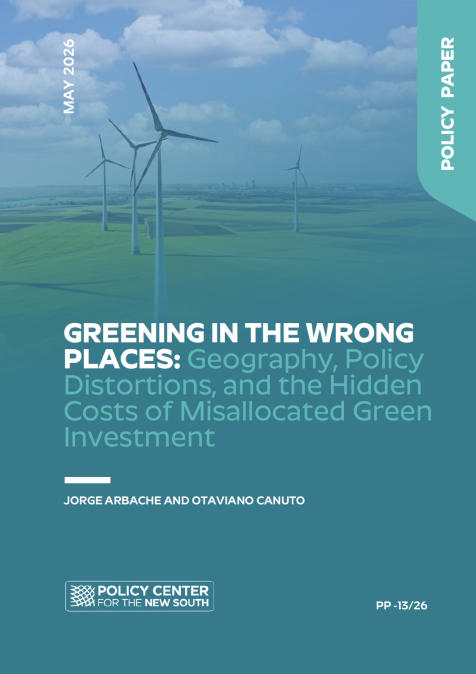
Greening in the Wrong Places: Geography, Policy Distortions, and the Hidden Costs of Misallocated Green Investment
Authors
Jorge Arbache
May 14, 2026

Decarbonization is reconfiguring global relative prices. As clean energy, natural capital, and location-specific assets become dominant industrial inputs, the relative cost of producing low-carbon goods is increasingly determined by geography. Two systematic distortions explain why the expected reallocation of investment toward renewable-rich economies remains incomplete. First, industrial policy interventions, including subsidies, trade barriers, and certification systems, disconnect effective prices from underlying structural costs. Second, institutional failures create demand uncertainty that leaves structurally competitive projects unbankable. Together, these distortions generate static misallocation, leading to slower technological learning, higher fiscal burdens, delayed emissions reductions, and suppressed industrial opportunities in developing economies. This paper is part of broader research on powershoring and green comparative advantage, which focuses on the idea that decarbonization is a spatial and price reorganization of global production, in addition to a technological transition.


RELATED CONTENT

  • Authors
    Jorge Arbache
    May 14, 2026
    Decarbonization is reconfiguring global relative prices. As clean energy, natural capital, and location-specific assets become dominant industrial inputs, the relative cost of producing low-carbon goods is increasingly determined by geography. Two systematic distortions explain why the expected reallocation of investment toward renewable-rich economies remains incomplete. First, industrial policy interventions, including subsidies, trade barriers, and certification systems, disconne ...
  • Authors
    February 24, 2026
    This Paper was originally published on sciencedirect.com This paper assesses the national and regional impacts of the Marrakech–Fès highway project in Morocco using a Spatial Computable General Equilibrium (SCGE) model combined with GIS-based road network data. The analysis captures how improved connectivity alters economic performance and emissions patterns across space and time. Results show that while overall economic gains are modest, the benefits are unevenly distributed—f ...
  • November 30, 2023
    In this episode, we dive into the pressing necessity for climate initiatives in Africa. Despite its minimal global emissions, Africa grapples with severe climate challenges and a substantial funding shortfall. Yet, as obstacles persist, including the disconnect between investor expectat...
  • Authors
    Marianna Albuquerque
    Rogerio Studart
    July 5, 2023
    This policy brief was originally published on t20ind.org   Despite the perception of abundant financial resources and technology worldwide, building quality project pipelines of sustainable infrastructure and securing funding for them remains a challenge for most developing countries. One potential solution to these obstacles is international cooperation among governments through enhancing cooperation among their national, regional, and multilateral development banks, wh ...
  • Authors
    April 26, 2023
    It is estimated that $1 trillion to $6 trillion per year (up to 2050) needs to be invested globally if the world is to stay below the 2°C global warming ceiling of the Paris Agreement and to meet its adaptation goals. Currently, investments stand at about $630 billion per year, way below the original target. And although great efforts have been made in the climate-finance area, more than 70% of the funds deployed have gone to one sector, renewable energy, followed by the transportat ...
  • Authors
    Camila Callegari
    Tarik Tanure
    Ana Carolina Oliveira Fiorini
    Edson Domingues
    Aline Magalhães
    Fernando Perobelli
    Alexandre Porsse
    André F. P. Lucena
    Eveline Vasquez-Arroyo
    Mariana Império
    Luiz Bernardo Baptista
    Roberto Schaeffer
    March 20, 2023
    This Paper was originally published on mdpi.com   Cities play a fundamental role in reducing greenhouse gas emissions and advancing the 2030 Agenda for Sustainable Development. In this context, public authorities need tools to help in identifying the best set of available solutions for the urban environment. Here, we developed an approach to help decision makers in evaluating sustainable solutions, considering aspects such as emission rate, economic attractiveness, job c ...
  • July 6, 2022
    Le Policy Center for the New South et Enel Green Power Maroc co-organisent un webinaire sur "la tarification du carbone et le développement économique". Cette rencontre permettra de débattre des défis, des avantages et des limites des mécanismes de tarification du carbone et de leur imp...