Publications /
Policy Paper

Back
Regionalism and G20 Support for Neighboring Non-G20 Developing Countries
Authors
Bambang Brodjonegoro
November 2, 2026

This policy note was published as part of the T20 U.S. 2026 Workstreams, under the workstream “Fostering Trade and People-Centered Economic Growth,” which brings together policy experts to develop recommendations for G20 policymakers.


The Group of Twenty (G20) accounts for most of the world’s output, yet its decisions shape the prospects of 174 United Nations Member States without G20 membership, among them the great majority of least developed countries and small states. Many of these non-G20 economies are close trading neighbors of a large G20 member and depend on that neighbor for export demand, investment, remittances, and development finance. These links are increasingly exposed to fragmentation of the global economy. New trade restrictions nearly tripled between 2019 and 2022, and remained elevated in 2025. Under a two-bloc trade fragmentation scenario, low-income countries could lose more than 4 percent of output over the long run. Such risks compound debt vulnerabilities and food insecurity. 

External support is also contracting. Preliminary data show that official development assistance from Development Assistance Committee members and associates fell by 23.1 percent in real terms in 2025, the steepest annual fall on record, returning to its 2015 level. Developing countries also face an annual financing gap for the Sustainable Development Goals of around 4 trillion dollars. 

Regionalism offers G20 economies a durable channel to keep supporting their non-G20 neighbors even as multilateral cooperation weakens. Asia illustrates this approach, having built dense regional production networks, a large regional financial safety net, and shared institutions that allow larger economies to anchor smaller ones. In Africa, connector economies can link fragmented markets to wider production networks. Morocco exemplifies this potential through its logistics infrastructure, industrial capabilities, and access to European and United States markets, provided that firms in smaller African economies can participate in the resulting value chains. 

The G20 should finance regional public goods through regional platforms and reformed multilateral development banks, and expand the use of low-cost remittance services; design open and inclusive regional trade arrangements that allow smaller neighbors to join regional value chains; and strengthen regional financial safety nets and improve their coordination with the International Monetary Fund (IMF). Each recommendation builds on existing G20 workstreams and on an agenda centered on growth.
RELATED CONTENT

  • Authors
    Sandra Polónia Rios
    Pedro da Motta Veiga
    Eduardo Augusto Guimarães
    February 22, 2017
    Despite the sustained growth in the bilateral trade observed at the beginning of the Century, Moroccan – Brazilian economic relations are still going through what could be called the ‘shallow’ phase of relations between two middle-income countries. Trade is concentrated in a few products – those where both countries enjoy long lasting and natural comparative advantages – and face strong difficulties to diversify in terms of products and to upgrade towards more complex models of lin ...
  • Authors
    February 1, 2017
    An analysis of trade relations between Morocco and sub-Saharan Africa indicates a growing volume of trade, reflecting a continuation of stimulated trade relations. A similar trend is observed in foreign direct investment (FDI), which has continued to grow in recent years, reflecting Morocco's determination to become a major player in the development of the African continent. This Policy Brief first presents trends in inter-regional trade between Morocco and sub-Saharan Africa, focus ...
  • Authors
    Thomas Awazu Pereira da Silva
    January 2, 2017
    This year, under the patronage of His Majesty King Mohammed VI, the OCP Policy Center (OCPPC) - in collaboration with the German Marshall Fund of the United States (GMFUS) - hosted and organized the fifth Atlantic Dialogues, gathering over 300 high-level international public- and private-sector leaders from the Atlantic Basin to discuss cross-regional issues ranging from economic and social development, security and trade, to migration, resources, and energy. This year’s e ...
  • Authors
    Onasis Tharcisse A. Guedegbe
    December 23, 2016
    Trade integration is a prerequisite for the success of any economic integration project. The factors hindering trade integration therefore constitute a bottleneck to the economic integration project of the countries of the Economic Community of West African States (ECOWAS), which is an effective means of coping with the substantial expansion of sub-regional food demand. The aim of this paper is to highlight the factors that constrain trade flows and increase the cost of trade in the ...
  • Authors
    Vera Songwe
    December 23, 2016
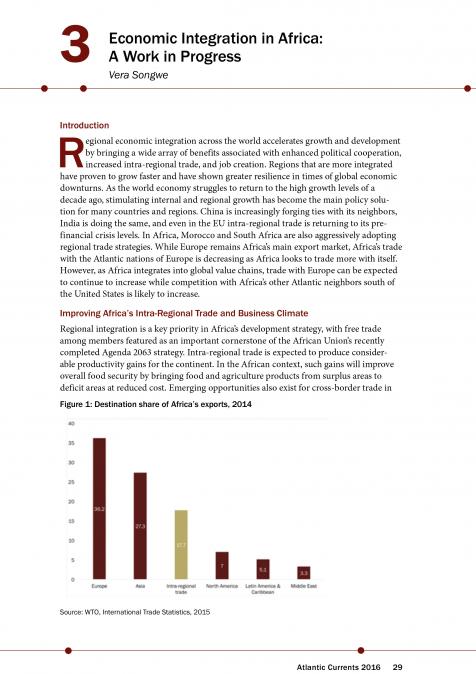
    Regional economic integration across the world accelerates growth and development by bringing a wide array of benefits associated with enhanced political cooperation, increased intra-regional trade, and job creation. Regions that are more integrated have proven to grow faster and have shown greater resilience in times of global economic downturns. As the world economy struggles to return to the high growth levels of a decade ago, stimulating internal and regional growth has become t ...
  • Authors
    Vera Songwe
    December 23, 2016
    Partout dans le monde, l'intégration économique régionale permet d'accélérer la croissance et le développement en apportant une panoplie d'avantages liés à une meilleure coopération politique, à un commerce intra-régional accru et à la création d'emplois. Les régions qui sont plus intégrées se sont révélées capables de connaître une croissance plus rapide et ont fait preuve d'une plus grande capacité d'adaptation en période de ralentissement de l'économie mondiale. Alors que l'écono ...
  • Authors
    Rafael Benke
    December 14, 2016
    The government of Argentina’s new president, Mauricio Macri, has many challenges ahead. In the initial 10 months of his government, he has devalued the currency, lifted significant trade and capital barriers, and launched conversations with international investors and creditors, and has changed international perceptions toward Argentina. Macri’s election immediately generated a positive reaction from the private sector toward the new government. However, indicators for 2016 show a w ...
  • Authors
    Edité par
    Idriss El Abbassi
    Lahcen Oulhaj
    Aziz Ragbi
    November 28, 2016
    Le présent ouvrage se propose d’apporter quelques éléments d’appui supplémentaires aux policy-makers pour une meilleure identification des défaillances des marchés au Maroc et une mise en place d’une stratégie de diversification et une politique industrielle efficientes, sans toutefois tomber dans la situation inverse où une stratégie mal définie et des outils mal choisis peuvent se traduire par une défaillance des politiques publiques. L’appréhension des difficultés qu’éprouve l’é ...
  • Authors
    Silvia Colombo
    Mohamed El Harrak
    Nicolò Sartori
    May 27, 2016
    Energy is at the core of the remarkable current transitions in the global economy and geopolitics, and natural gas plays a crucial role in these processes. In this context of rapidly evolving trends at the market level and developing dynamics between regional and global actors, The Future of Natural Gas aims at analysing the role of natural gas in the future energy mix by considering several key factors: the ambitious climate policies agreed by the international community, cost issu ...
  • March 17, 2016
    Jointly organized by OCP Policy Center and Shanghai Institutes for International Studies, the roundtable on "Current African Economic and Strategic Challenges and Opportunities; Intersecting Views from China and Morocco" was a great opportunity to gather experts from both side, to brainstorm opportunities to enhance the role of think-tanks and civil society organization in the consolidation of the Afro-Asian cooperation more efficiently and in a more comprehensive way. Th ...