Publications /
Policy Brief

Back
Economic Integration in Africa: A Work in Progress
Authors
Vera Songwe
December 23, 2016

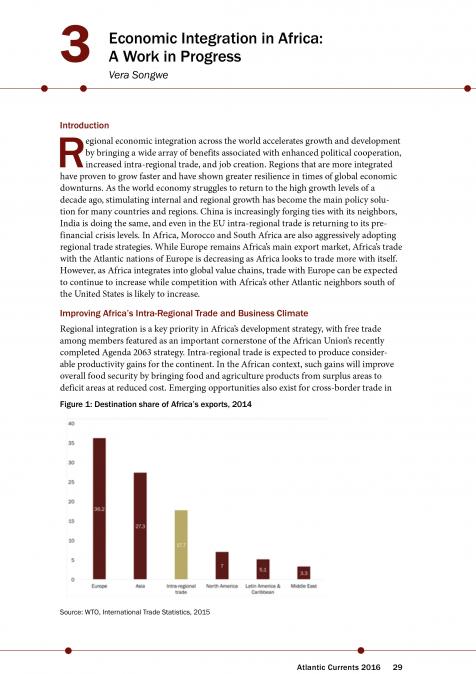
Regional economic integration across the world accelerates growth and development by bringing a wide array of benefits associated with enhanced political cooperation, increased intra-regional trade, and job creation. Regions that are more integrated have proven to grow faster and have shown greater resilience in times of global economic downturns. As the world economy struggles to return to the high growth levels of a decade ago, stimulating internal and regional growth has become the main policy solution for many countries and regions. China is increasingly forging ties with its neighbors, India is doing the same, and even in the EU intra-regional trade is returning to its prefinancial crisis levels. In Africa, Morocco and South Africa are also aggressively adopting regional trade strategies. While Europe remains Africa’s main export market, Africa’s trade with the Atlantic nations of Europe is decreasing as Africa looks to trade more with itself. However, as Africa integrates into global value chains, trade with Europe can be expected to continue to increase while competition with Africa’s other Atlantic neighbors south of the United States is likely to increase

RELATED CONTENT

  • July 3, 2026
    This Policy Paper has also been published in French and Spanish by Le Grand Continent Morocco offers a compelling example of how a middle-income economy can navigate a more fragmented global environment, characterized by weak growth and slower convergence. Since 2022, economic activity has remained relatively strong, with growth exceeding that of many comparable economies. Non-agricultural growth has averaged 4.4% since 2022, around 1.3 percentage points above its historical av ...
  • Authors
    June 8, 2026
    The energy shock caused by the war between the United States and Israel and Iran has highlighted the need for Africa to refine more of its own crude oil. Africa is a net hydrocarbon exporter, but remains stuck in the old colonial economic model: it mostly exports raw materials and imports refined products. Africa exports about 2.6 billion barrels of crude oil every year, and imports about 1.4 billion barrels of refined products. This is a problem for two reasons. First, Africa ...
  • May 29, 2026
    This Paper was originally published on tandfonline.com This paper examines how reductions in transportation costs reshape regional economic and environmental outcomes in Morocco. We simulate a reduction in delivered (purchasers’) costs via a transport-margin efficiency improvement – implemented as a margin-saving technical change in the transport sector – within a province-level Spatial Computable General Equilibrium (SCGE) framework. Simulating a 1% decline in transport costs, ...
  • Authors
    January 27, 2026
    This paper revisits Big Push industrialization theory in the context of open economies deeply integrated into global value chains (GVCs). While classical Big Push models emphasize demand complementarities and coordination failures in largely closed economies, many middle-income countries now industrialize through foreign-owned, import-intensive production networks. We develop an extended Big Push framework that incorporates GVC integration and import leakage, and show how these feat ...
  • Authors
    Arkebe Oqubay
    November 17, 2025
    Morocco has emerged as one of Africa's success stories, achieving significant progress in economic transformation and the green transition over the past 25 years. Continuing and deepening this transformation is essential to reach the country’s goal of becoming a high-income economy in the coming decades. Significant challenges include managing the risk of the middle-income trap, addressing demographic pressures, promoting inclusive growth, ensuring environmental sustainability, and ...
  • October 3, 2025
    In this episode, we explore Africa’s industrial challenges and opportunities, showing how AfCFTA-driven integration, green sectors, and inclusive policies for women, youth, and SMEs can foster sustainable growth, resilience, and domestic value capture. ...
  • July 11, 2025
    In this episode, we discuss whether Africa’s sub-regions foster unity or deepen divides, examine how they handle political crises, and consider the impact of global powers on regional dynamics. We explore what’s needed for stronger cooperation and how Africa can preserve its diversity w...
  • Authors
    Under the supervision of
    July 12, 2024
    The 2024 Annual Report on the African Economy is dedicated to monetary and financial issues on the Continent. There are three reasons for this choice. African economies are exposed to macro-financial instabilities partly generated by global monetary and financial turbulence. The Continent’s currencies and financial systems are engaged in very different dynamics, where routine methods and daring, if not risky, practices coexist. The question of the architecture of the internationa ...