Publications /
Policy Paper

Back
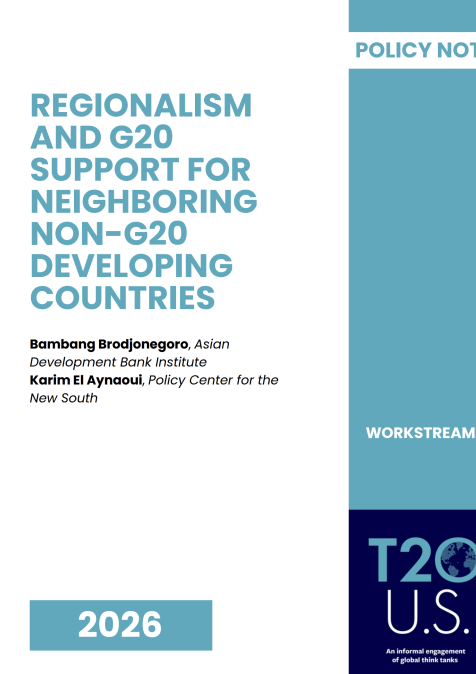
Regionalism and G20 Support for Neighboring Non-G20 Developing Countries
Authors
Bambang Brodjonegoro
November 2, 2026

This policy note was published as part of the T20 U.S. 2026 Workstreams, under the workstream “Fostering Trade and People-Centered Economic Growth,” which brings together policy experts to develop recommendations for G20 policymakers.


The Group of Twenty (G20) accounts for most of the world’s output, yet its decisions shape the prospects of 174 United Nations Member States without G20 membership, among them the great majority of least developed countries and small states. Many of these non-G20 economies are close trading neighbors of a large G20 member and depend on that neighbor for export demand, investment, remittances, and development finance. These links are increasingly exposed to fragmentation of the global economy. New trade restrictions nearly tripled between 2019 and 2022, and remained elevated in 2025. Under a two-bloc trade fragmentation scenario, low-income countries could lose more than 4 percent of output over the long run. Such risks compound debt vulnerabilities and food insecurity. 

External support is also contracting. Preliminary data show that official development assistance from Development Assistance Committee members and associates fell by 23.1 percent in real terms in 2025, the steepest annual fall on record, returning to its 2015 level. Developing countries also face an annual financing gap for the Sustainable Development Goals of around 4 trillion dollars. 

Regionalism offers G20 economies a durable channel to keep supporting their non-G20 neighbors even as multilateral cooperation weakens. Asia illustrates this approach, having built dense regional production networks, a large regional financial safety net, and shared institutions that allow larger economies to anchor smaller ones. In Africa, connector economies can link fragmented markets to wider production networks. Morocco exemplifies this potential through its logistics infrastructure, industrial capabilities, and access to European and United States markets, provided that firms in smaller African economies can participate in the resulting value chains. 

The G20 should finance regional public goods through regional platforms and reformed multilateral development banks, and expand the use of low-cost remittance services; design open and inclusive regional trade arrangements that allow smaller neighbors to join regional value chains; and strengthen regional financial safety nets and improve their coordination with the International Monetary Fund (IMF). Each recommendation builds on existing G20 workstreams and on an agenda centered on growth.
RELATED CONTENT

  • February 8, 2016
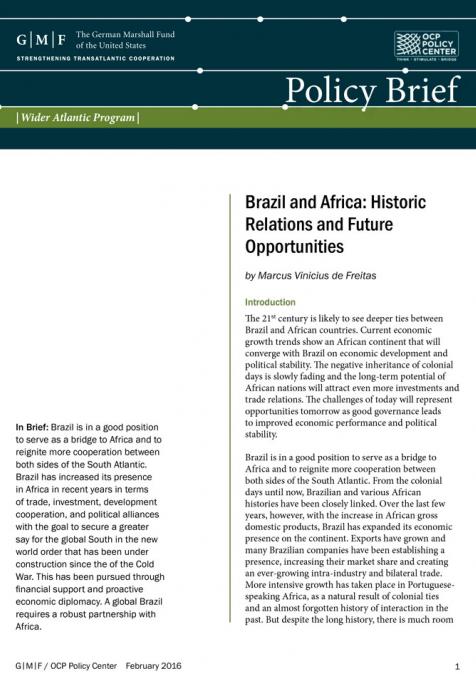
    Brazil is in a good position to serve as a bridge to Africa and to reignite more cooperation between both sides of the South Atlantic. Brazil has increased its presence in Africa in recent years in terms of trade, investment, development cooperation, and political alliances with the goal to secure a greater say for the global South in the new world order that has been under construction since the of the Cold War. This has been pursued through financial support and proactive economic ...
  • Authors
    December 14, 2015
    The end of supply chain is the natural corollary of the sustained price fall of virtually all commodities observed over the past many months. If it appears premature to state exactly what is the impact of this deconsolidation in the commodities value chain, it is believed that the strategic role of physical trading is strengthening. Under such circumstances, the industrial strategies of developing countries and commodity exporters may have to evolve and, in priority, foster optimizi ...
  • Authors
    October 27, 2015
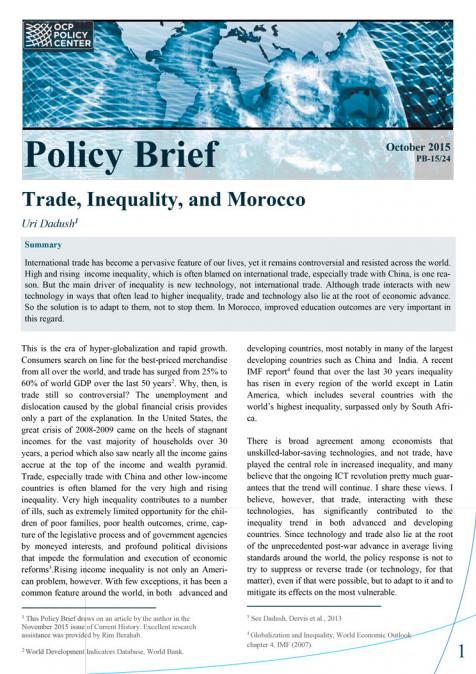
    International trade has become a pervasive feature of our lives, yet it remains controversial and resisted across the world. High and rising income inequality, which is often blamed on international trade, especially trade with China, is one reason. But the main driver of inequality is new technology, not international trade. Although trade interacts with new technology in ways that often lead to higher inequality, trade and technology also lie at the root of economic advance. So th ...
  • Authors
    Lilia Rizk
    October 19, 2015
    OCP Policy Center holds in its arsenal a wide array of different resources aimed at creating a knowledge sharing platform that constructively dissects key economic, international relations and strategic issues. To achieve this objective, research initiatives, training programs and sessions, as well as conferences and seminars are put in place, thus offering an appropriate open debate platform to stimulate new analytical approaches.  Within this range of activities, OCP Policy ...
  • Authors
    April 30, 2015
    Pour une économie ouverte, l’analyse des échanges internationaux recèle une importance capitale pour analyser ses perspectives de croissance. Bien des décisions individuelles portant sur la consommation, l’épargne et l’investissement sont, en effet, liées aux termes de l’échange. L’évolution de ces derniers, définis comme le rapport entre les prix à l’exportation et ceux à l’importation, est considérée comme un indicateur du pouvoir d’achat d’un pays et constitue une variable fort ...
  • Authors
    Ezana Bocresion
    April 23, 2015
    We finished Part I - Solving the Capital Formation Issue with a question? How should institutional investors go about looking for the best partners to help them make successful investments in Africa; and fundamentally, the real question to ask is, what are the variables required for building successful investment platforms in Africa? Whenever one meets with an allocator from an institutional investor to discuss an allocation to an Africa strategy, the first question on th ...
  • Authors
    Ezana Bocresion
    March 16, 2015
    Over the next couple of months, we want to explore the investing climate in Sub Saharan Africa (“SSA”) and try to understand where it is and what elements/variables are required to increase the continent’s attractiveness to institutional investors and thereby speed up the continent’s development. We will discuss the Private Equity industry in Africa and delve into the challenges faces. We will then work through how best to address them, and in particular, in the Agribusiness sector. ...
  • Authors
    February 10, 2015
    Manufacturing is declining as a share of GDP not only in advanced countries, but in developing countries as well. This new trend, a result of complex forces, should be seen on balance as a reason for development-optimism, not pessimism. In the 21st century economy, manufacturing remains important, but poor countries can attract investment, grow rapidly and diversify away from agriculture on the basis of many possible sources of comparative advantage, without artificially promoting m ...
  • January 26, 2015
    OCP Policy Center vient de rendre public le 10 janvier son premier Policy Brief de l’année 2015, qui traite de la question de la baisse significative des prix des produits pétroliers, ses causes, et ses conséquences macroéconomiques pour les producteurs et les consommateurs de ce produit.  Yves Jégourel, Senior Fellow à OCP Policy Center et auteur du Policy Brief en question, a accumulé une expertise dans le domaine de l’analyse des marchés des matières premières. Il ...