Publications /
Policy Paper

Back
Regionalism and G20 Support for Neighboring Non-G20 Developing Countries
Authors
Bambang Brodjonegoro
November 2, 2026

This policy note was published as part of the T20 U.S. 2026 Workstreams, under the workstream “Fostering Trade and People-Centered Economic Growth,” which brings together policy experts to develop recommendations for G20 policymakers.


The Group of Twenty (G20) accounts for most of the world’s output, yet its decisions shape the prospects of 174 United Nations Member States without G20 membership, among them the great majority of least developed countries and small states. Many of these non-G20 economies are close trading neighbors of a large G20 member and depend on that neighbor for export demand, investment, remittances, and development finance. These links are increasingly exposed to fragmentation of the global economy. New trade restrictions nearly tripled between 2019 and 2022, and remained elevated in 2025. Under a two-bloc trade fragmentation scenario, low-income countries could lose more than 4 percent of output over the long run. Such risks compound debt vulnerabilities and food insecurity. 

External support is also contracting. Preliminary data show that official development assistance from Development Assistance Committee members and associates fell by 23.1 percent in real terms in 2025, the steepest annual fall on record, returning to its 2015 level. Developing countries also face an annual financing gap for the Sustainable Development Goals of around 4 trillion dollars. 

Regionalism offers G20 economies a durable channel to keep supporting their non-G20 neighbors even as multilateral cooperation weakens. Asia illustrates this approach, having built dense regional production networks, a large regional financial safety net, and shared institutions that allow larger economies to anchor smaller ones. In Africa, connector economies can link fragmented markets to wider production networks. Morocco exemplifies this potential through its logistics infrastructure, industrial capabilities, and access to European and United States markets, provided that firms in smaller African economies can participate in the resulting value chains. 

The G20 should finance regional public goods through regional platforms and reformed multilateral development banks, and expand the use of low-cost remittance services; design open and inclusive regional trade arrangements that allow smaller neighbors to join regional value chains; and strengthen regional financial safety nets and improve their coordination with the International Monetary Fund (IMF). Each recommendation builds on existing G20 workstreams and on an agenda centered on growth.

RELATED CONTENT

  • Authors
    February 6, 2019
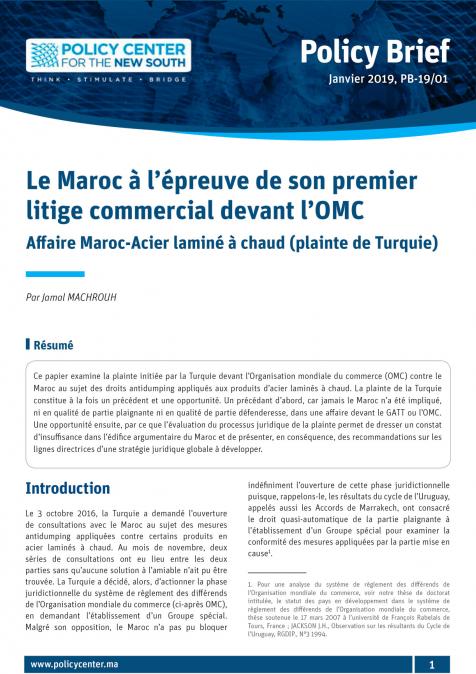
    Ce papier examine la plainte initiée par la Turquie devant l’Organisation mondiale du commerce (OMC) contre le Maroc au sujet des droits antidumping appliqués aux produits d’acier laminés à chaud. La plainte de la Turquie constitue à la fois un précédent et une opportunité. Un précédant d’abord, car jamais le Maroc n’a été impliqué, ni en qualité de partie plaignante ni en qualité de partie défenderesse, dans une affaire devant le GATT ou l’OMC. Une opportunité ensuite, par ce que l ...
  • Authors
    February 6, 2019
    This paper examines Turkey's case against Morocco before the World Trade Organization (WTO), over anti-dumping duties on hot-rolled steel products. Turkey's complaint constitutes both a precedent and an opportunity. First, it is a precedent in that Morocco was previously never involved in a case before GATT or WTO, neither as a plaintiff nor as a defendant. Second, it is an opportunity as the evaluation of the legal process of the complaint enables an assessment of adequacy of Moroc ...
  • Authors
    Yana Myachenkova
    November 27, 2018
    - The trade agreements that the European Union has with North African countries – with Algeria, Egypt, Morocco and Tunisia – are often seen as having delivered disappointing results since they came into force during the 2000s. The four North African countries have seen insufficient growth in their exports to the EU, and have undergone only limited diversification. In the meantime, the EU’s exports to North Africa have grown quite rapidly. - Economic growth in North Africa has been ...
  • Authors
    November 13, 2018
    Livelihoods of northern Niger’s population depended for centuries on trade and cross-border movement of licit goods with Libya. Historical trends of domestic and regional shocks demonstrated the ability of local communities to adapt and adjust to transformations caused by these shocks to survive. People moving through and living in the area have different motivations and reasons to cross to Libya and beyond, but economic drivers remain the key factor. The local economy has suffered ...
  • Authors
    Sabine Cessou
    October 8, 2018
    « Amérique latine, crises et sorties de crises », telle était la première des deux thématiques des 6èmes Dialogues stratégiques, organisés le 4 avril par HEC Paris (Centre de géopolitique) et OCP Policy Center. Un tableau mitigé a été dressé, avec des signes de reprise et une croissance supérieure à 2 % qui n’empêchent pas des situations de crise comme au Brésil, au Nicaragua ou au Vénézuela. Crise d’un modèle d’oligarchies anti-capitalistes Au Vénézuela, la corruption paraît si e ...
  • Authors
    Anabel Gonzalez
    August 30, 2018
    The agreement establishing the African Continental Free Trade Area (AfCFTA) is a framework to create a free trade area across the region, bringing together the 55 members of the African Union into a continental market with a cumulative Gross Domestic Product (GDP) exceeding US$2.2 trillion and a total population of over one billion people. When concluded and successfully implemented, it will become the largest free trade area in the world in terms of membership, opening up significa ...
  • Authors
    August 13, 2018
    Depuis la fin de l’année 2017, le président Donald Trump mène plusieurs batailles commerciales, contre différents partenaires, sous prétextes de sauver des emplois industriels américains et de réduire le déficit commercial des États-Unis. S’il est difficile de se prononcer sur les effets des combats commerciaux amorcés par le président Trump, l’importance des opposants et des échanges pour l’économie mondiale en fait une source de risque pour la croissance, les emplois et les prix à ...
  • August 1, 2018
    “This article has been originally published in 'Morocco in Focus 2018,' the magazine of the Moroccan Embassy in New Delhi, India on the occasion of the Morocco National Day 2018.” Introduction In an article published last year, the author stressed the role of partnership between Morocco and India for the inclusive growth of small farmers. There is no doubt that agriculture remains a major instrument for human development both in India and in Africa. Several international reports&n ...
  • Authors
    May 31, 2018
    Salutations Thank you for the invitation to address the 2018 Africa Think Tank Summit  in this memorable city of Rabat. I thank in particular, the OCP Policy Center and the Think Tank and Civil Societies Program of the University of Pennsylvania for hosting the Summit with the theme “Deepening Expertise and Enhancing Sustainability: Insight into Contemporary Challenges Facing African Think Tanks”. Rabat, Morocco has been the sprouting ground of numerous agenda-setti ...