Publications /
Paper in Academic Journals
Back
Project scale and final investment decisions in low-emissions hydrogen: evidence from ammonia, methanol and pure-hydrogen projects
Authors
Georges Ali Benyahia
November 20, 2026

This paper was originaly published on sciencedirect.com


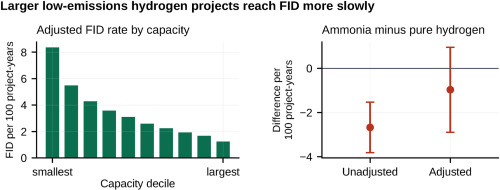
Ammonia and methanol feature in a growing share of announced low-emissions hydrogen projects; evidence on their progression to a final investment decision (FID) remains aggregate. We follow 2098 pre-FID projects, classified by output product, across six releases (2021–2026) of the International Energy Agency hydrogen projects database and estimate discrete-time cause-specific hazard models of progression to FID and exit. Ammonia projects reach FID at 1.6 per 100 project-years, against 4.2 for pure hydrogen; significant before adjustment, the gap narrows by 64% and becomes imprecise once capacity, region, technology, stage and other controls are added. Each capacity doubling is associated with a 17% lower FID rate, significant under both exit-dating conventions and on common support. For recorded exits, whose categories are distinguished in the database only from 2026 onward, no statistically precise association with capacity is detected over the full period, and the association with cancellation depends on the recording channel.


Graphical abstract


RELATED CONTENT

  • Authors
    March 16, 2022
    The 2021 German federal election brought about a historic reshuffle of the political parties’ hierarchy in Europe’s biggest economy. The Social Democratic Party are back in control of the Chancellery for the first time since 2005, as part of a three-party coalition at the federal level with the Greens and the Liberals, a first in Germany’s post-war history. Now, the federal government has turned its gaze towards its founding mission: more progress. The first 100 days of the three-pa ...
  • February 25, 2022
    The One Planet Summit for the Ocean was held in Brest during which President Emmanuel Macron brought together heads of state and government, heads of multilateral institutions, business l ...
  • Authors
    February 14, 2022
    Si les liens existant entre l’exportation de matières premières et l’industrialisation sont étudiés depuis longtemps, l’entrée résolue de l’économie mondiale dans l’ère de la transition environnementale et numérique leur offre une dimension toute particulière. L’évidence de la lutte contre le réchauffement climatique par la décarbonation de notre monde ne saurait, en effet, faire oublier toute la complexité de la stratégie à adopter pour y parvenir. Il s’agit, pour l ...
  • Authors
    February 9, 2022
    Energy markets have experienced significant disruptions since the outbreak of COVID-19. In late 2021, soaring natural gas prices triggered a new crisis, leading to risks of energy supply shortages worldwide and propelling the issue of energy security to the forefront. Africa will not be spared the repercussions of this crisis, which could further increase energy inequality, which is in turn linked to other forms of inequality. Indeed, in a context of persistent inflation, the lack o ...
  • Authors
    January 13, 2022
    “This opinion was prepared within the framework of the Jean Monnet Atlantic Network 2.0. The European Commission's support for the production of this publication does not constitute an endorsement of the contents, which reflect the views only of the authors, and the Commission cannot be held responsible for any use which may be made of the information contained therein.”   As part of the lengthy fight against climate change, the European Union (EU) has introduced a Border Car ...
  • Authors
    December 10, 2021
     Accelerating the transition toward low or net-zero carbon emissions is necessary to keep global warming at theoretically safe levels. That will likely bring price shocks associated with rising metal prices, energy costs, and carbon taxes – what has been called “greenflation”. Greening the economy will also require public spending and redistributive policies. ...
  • November 19, 2021
    This Podcast is based on a Policy Brief by Rim Berahab and Uri Dadush. It examines how Morocco progresses on the mitigation component of its Nationally Determined Contribution (NDC) targe ...
  • November 9, 2021
     Lors de la COP 26, il est probable que l'on accorde plus d'attention aux grands émetteurs comme la Chine et les États-Unis qu'à la situation des petits pays en développement, pourtant plus exposés aux conséquences du changement climatique. Le Maroc fait partie de cette catégorie. Ce Policy Brief examine les objectifs d'atténuation du Maroc dans le cadre de ses CDN et ses performances à ce jour avant de s'intéresser aux mesures nécessaires pour atteindre l'objectif à moyen term ...