Publications /
Paper in Academic Journals
Back
Project scale and final investment decisions in low-emissions hydrogen: evidence from ammonia, methanol and pure-hydrogen projects
Authors
Georges Ali Benyahia
November 20, 2026

This paper was originaly published on sciencedirect.com


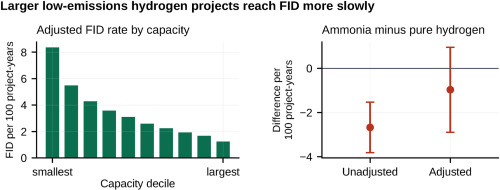
Ammonia and methanol feature in a growing share of announced low-emissions hydrogen projects; evidence on their progression to a final investment decision (FID) remains aggregate. We follow 2098 pre-FID projects, classified by output product, across six releases (2021–2026) of the International Energy Agency hydrogen projects database and estimate discrete-time cause-specific hazard models of progression to FID and exit. Ammonia projects reach FID at 1.6 per 100 project-years, against 4.2 for pure hydrogen; significant before adjustment, the gap narrows by 64% and becomes imprecise once capacity, region, technology, stage and other controls are added. Each capacity doubling is associated with a 17% lower FID rate, significant under both exit-dating conventions and on common support. For recorded exits, whose categories are distinguished in the database only from 2026 onward, no statistically precise association with capacity is detected over the full period, and the association with cancellation depends on the recording channel.


Graphical abstract


RELATED CONTENT

  • November 28, 2023
    À l'approche de la COP 28 à Dubaï, la problématique du financement climatique pour les pays en développement persiste. Jusqu'à 2022, les pays développés n'ont pas honoré leur engagement de mobiliser 100 milliards de dollars par an d'ici à 2020 pour ces nations en développement. Ces dern...
  • November 28, 2023
    COP27 in Sharm El Sheikh marked a significant milestone with the establishment of a historic Loss and Damage (L&D) fund, signaling progress in global climate justice. Collaboration between developed and developing economies played a pivotal role in this achievement. The conference a...
  • November 28, 2023
    To achieve a fair Energy Transition in Africa, it is imperative to consider the diversity of African nations, their unique resources, and how each solution should be tailored to the needs and means of the country. The world must address these challenges while confronting issues such as ...
  • September 27, 2023
    In this episode, we delve into the critical issues of climate change, energy transition, and food security in Africa. Our discussion highlights the multifaceted impact of climate change o ...
  • Authors
    Javier Cantero
    June 16, 2023
     This brief was originally published on gmfus.org as part of a partnership between the Policy Center for the New South and the German Marshall Fund of the United States.   Air and ocean temperatures are increasing at record levels despite international efforts to mitigate carbon emissions. The consequences of this failure go beyond its harmful effects on climate patterns to endangering global political, economic, and social stability. ...
  • May 19, 2023
    This Policy Paper was originally published on freiheit.org This study explores how Morocco can successfully develop a green hydrogen market and at the same time contribute to the global energy transition. Authors Rim Berahab and Afaf Zarkik show how Morocco’s bold strategies and investments in renewables can shape a promising future for green hydrogen. They chart a path to decipher the potential of this energy vector, while outlining the elements necessary for the emergence o ...
  • July 6, 2022
    Le Policy Center for the New South et Enel Green Power Maroc co-organisent un webinaire sur "la tarification du carbone et le développement économique". Cette rencontre permettra de débattre des défis, des avantages et des limites des mécanismes de tarification du carbone et de leur imp...
  • March 18, 2022
    تم تقديم إطلاق مبادرة جماعية لتطوير شراكات جديدة من أجل انتقال عادل للطاقة في إفريقيا خلال القمة بين الاتحاد الأوروبي والاتحاد الإفريقي. فما هي المبادرات المبرمجة بين الاتحاد الأوروبي و إ ...