Publications /
Paper in Academic Journals
Back
Project scale and final investment decisions in low-emissions hydrogen: evidence from ammonia, methanol and pure-hydrogen projects
Authors
Georges Ali Benyahia
November 20, 2026

This paper was originaly published on sciencedirect.com


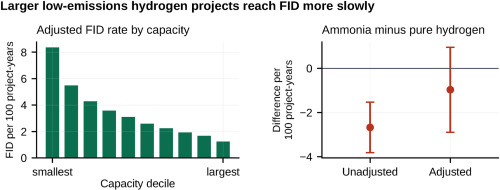
Ammonia and methanol feature in a growing share of announced low-emissions hydrogen projects; evidence on their progression to a final investment decision (FID) remains aggregate. We follow 2098 pre-FID projects, classified by output product, across six releases (2021–2026) of the International Energy Agency hydrogen projects database and estimate discrete-time cause-specific hazard models of progression to FID and exit. Ammonia projects reach FID at 1.6 per 100 project-years, against 4.2 for pure hydrogen; significant before adjustment, the gap narrows by 64% and becomes imprecise once capacity, region, technology, stage and other controls are added. Each capacity doubling is associated with a 17% lower FID rate, significant under both exit-dating conventions and on common support. For recorded exits, whose categories are distinguished in the database only from 2026 onward, no statistically precise association with capacity is detected over the full period, and the association with cancellation depends on the recording channel.


Graphical abstract


RELATED CONTENT

  • Authors
    July 28, 2017
    Renewable energy technologies are projected to have substantial growth in the coming decades, especially given the environmental, social and economic drivers observed globally. The Middle East and North Africa (MENA) region encloses abundant alternative energy sources such as solar, wind and hydropower. The concern is more whether the Arab region will be able to respond to and manage the growth opportunities in this emerging sector. This Policy Brief explores opportunities and chall ...
  • Authors
    March 29, 2017
    Dans un contexte mondial de plus en plus préoccupé par les aléas climatiques, comprendre l’impact de la croissance économique sur l’environnement devient crucial, notamment pour les pays en voie de développement. Ce papier aborde cette problématique sous le prisme des émissions de dioxyde de carbone (CO2) et examine comment la croissance économique se répercute sur l’environnement. L’objectif de cette étude est de tester la validité de la courbe environnementale de Kuznets (CEK) pou ...
  • March 01, 2016
    Ce podcast est délivré par Carole Mathieu. A sa clôture le 12 décembre 2015, la COP21 a été saluée comme un grand succès diplomatique. En adoptant l’accord de Paris, les 196 Parties à la ...
  • From

    29
    5:30 pm October 2026
    Cet épisode examine le stress hydrique en Afrique du Nord en démêlant ses causes (changement climatique, hausse des besoins, gouvernance de l’eau) et en montrant que leur poids varie selon les pays. Il interroge ensuite la répartition du coût de la pénurie et les arbitrages entre villes, agriculture et industrie, afin de limiter les inégalités sociales et territoriales. Enfin, il évalue la place du dessalement : ce qu’il permet de sécuriser, ce qu’il ne règle pas, et les conditions (accessibilité des prix, maîtrise énergétique, protection du milieu marin) pour qu’il devienne une solution durable plutôt qu’un simple prolongement des modèles actuels. ...
  • يخصص مركز السياسات من أجل الجنوب الجديد حلقة برنامجه الأسبوعي "حديث الثلاثاء" لتقديم التقرير السنوي لتحليل ديناميات السلع في إفريقيا مع بدر منظري، باحث في الاقتصاد، مركز السياسات من أجل الجنوب الجديد. بتعاون بين مركز السياسات من أجل الجنوب الجديد ومركز سيكلوب، تم إصدار النسخة الرابعة من...