Publications /
Paper in Academic Journals
Back
Project scale and final investment decisions in low-emissions hydrogen: evidence from ammonia, methanol and pure-hydrogen projects
Authors
Georges Ali Benyahia
November 20, 2026

This paper was originaly published on sciencedirect.com


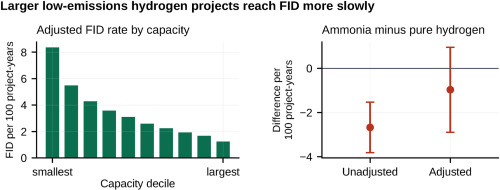
Ammonia and methanol feature in a growing share of announced low-emissions hydrogen projects; evidence on their progression to a final investment decision (FID) remains aggregate. We follow 2098 pre-FID projects, classified by output product, across six releases (2021–2026) of the International Energy Agency hydrogen projects database and estimate discrete-time cause-specific hazard models of progression to FID and exit. Ammonia projects reach FID at 1.6 per 100 project-years, against 4.2 for pure hydrogen; significant before adjustment, the gap narrows by 64% and becomes imprecise once capacity, region, technology, stage and other controls are added. Each capacity doubling is associated with a 17% lower FID rate, significant under both exit-dating conventions and on common support. For recorded exits, whose categories are distinguished in the database only from 2026 onward, no statistically precise association with capacity is detected over the full period, and the association with cancellation depends on the recording channel.


Graphical abstract


RELATED CONTENT

  • Authors
    Georges Ali Benyahia
    November 20, 2026
    This paper was originaly published on sciencedirect.com Ammonia and methanol feature in a growing share of announced low-emissions hydrogen projects; evidence on their progression to a final investment decision (FID) remains aggregate. We follow 2098 pre-FID projects, classified by output product, across six releases (2021–2026) of the International Energy Agency hydrogen projects database and estimate discrete-time cause-specific hazard models of progression to FID and ex ...
  • From

    17
    9:00 am November 2026
    Industrialization in North Africa is entering a new phase shaped by global megatrends, the green and digital transitions, evolving value chains, and the growing need for resilient and competitive production systems.Against this backdrop, the Policy Center for the New South and the United Nations Industrial Development Organization (UNIDO) are convening The Future of Industrialization: Building Future-Ready Industries in North Africa on November 17, 2026, at the Policy Center for the New South in Rabat.The event will present key insights from the Industrial Development Report 2026 (IDR26) and bring together policymakers, industry leaders and experts to discuss the region’s industrial opportunities, constraints and policy priorities. The exchanges will focus on pathways toward s ...
  • Authors
    July 2, 2026
    Africa is facing a massive electricity deficit that is impacting its economic and social development, and its ability to catch up with the rest of the world. It is imperative that the continent increase its electricity production to connect the 600 million people who are currently without access and to improve the quality of service for the millions who are suffering from frequent blackouts and load-shedding. Economic development in the 21st century will crucially depend on the digi ...
  • June 30, 2026
    This episode explores Morocco’s green transition, examining the country’s progress in renewable energy alongside the challenges of reducing dependence on fossil fuels. It discusses the economic and social impacts of climate change, particularly on water, agriculture, and health, while h...
  • April 9, 2026
    Cet entretien explore le Nexus Eau-Énergie-Alimentation comme un défi systémique majeur pour le Maroc, dans un contexte de rareté croissante des ressources et de pressions sur la souveraineté. Il met en lumière les interdépendances critiques entre ces trois secteurs et les limites d’app...
  • March 30, 2026
    L’épisode explore les mutations profondes du secteur énergétique mondial, marqué par une transition complexe entre crise des prix et crise des systèmes. Après une période de tensions extrêmes sur les coûts de l’énergie (pétrole, charbon, gaz), 2025-2026 marque un tournant : les prix se ...
  • February 5, 2026
    In this episode, we explore the tough questions facing agriculture in a changing climate. Rising temperatures, water scarcity, and extreme weather are straining food systems and rural livelihoods like never before. At the same time, technologies such as artificial intelligence, renewabl...