Publications /
Book / Report
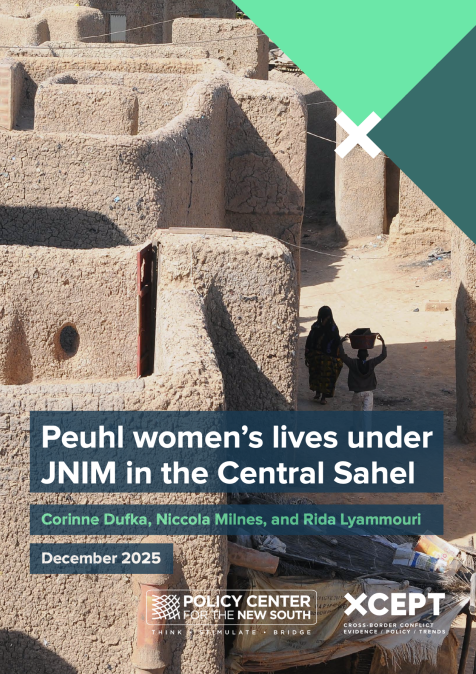
Although the crises affecting the Sahel have been widely analysed through the lenses of armed groups, state fragility and geopolitics, much less is known about how women experience insurgent governance in their everyday lives. This is particularly pertinent to members of the pastoralist Peuhl ethnic group, which has been strategically targeted for recruitment by the Central Sahel’s dominant Islamist armed group, Jama’at Nusrat al-Islam wal-Muslimin (JNIM), as a means of facilitating both local entrenchment and territorial expansion.1 JNIM’s attempts to regulate mobility and economic activity, as well as social, cultural and religious practices, affect women in profound ways. Understanding these dynamics is not simply a matter of documenting hardship. Rather, it is essential to grasp how legitimacy is constructed, how communities adapt, and how conflict dynamics extend across porous borders.
Drawing on 77 in-person interviews conducted between May and August 2025 with women from Mali and Burkina Faso, backed up by 24 key informant interviews (KIIs) with village elders, West African security force members, policymakers, and local civil society actors (see Annex 1 and 2 for further details), this study reveals that women’s adaptation to JNIM’s governance model more often reflects a survival strategy than radicalisation.
The women’s perspectives provide critical insights into both the attraction and limits of JNIM’s governance model, revealing a nuanced picture of life under the group. The accounts highlight how coercion is partially counterbalanced by service provision; how women navigate imposed constraints through adaptation and agency; and how state abuses often enhance insurgent legitimacy. Here it is worth noting that the women with the most positive perceptions of JNIM governance hailed from areas that had been under the group’s effective control the longest, specifically areas in Central Mali (especially north of the Niger River, known as the flooded zone, or ‘zone inondée’) and northern Burkina Faso.
The respondents were drawn from different generations and walks of life, encompassing recent brides, family matriarchs, housewives, artisanal gold miners, entrepreneurs, and women affiliated with JNIM fighters. Many were grieving for loved ones killed by government soldiers, ethnic militia or JNIM fighters. Some loathed JNIM and had fled into exile to escape, while others supported the group and could not imagine living under the state again.
The testimonies illustrate JNIM’s ability to both assert authority over and secure compliance from women. Building on this, the paper demonstrates how deeper understanding of JNIM’s governance model in Mali and Burkina Faso – where it is more advanced than in neighbouring states – can help inform cross-border conflict and counterterrorism (CT) responses and prevention efforts across the Central Sahel and Coastal West Africa (CWA). In particular, it points to the danger of such strategies inadvertently reinforcing the extremist dynamics they seek to address should women’s lived realities continue to be overlooked.
1 This report uses ‘Peuhl’ to refer to the West African ethnic group also known as Fulani or Fulbe, as it is the term most commonly used by the communities themselves. All women respondents selected for this research were Peuhl, in order to capture the views of less represented members of an ethnic group targeted by JNIM for recruitment and territorial expansion, as well as by state counterterrorism operations.