Publications /
Policy Brief

Back
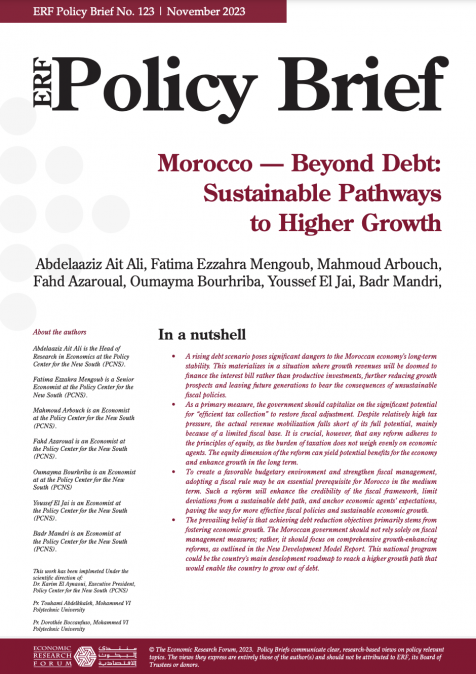
Morocco — Beyond Debt: Sustainable Pathways to Higher Growth
November 14, 2023

This Policy brief was originally published on erf.org.eg

Like many emerging and developing economies, Morocco has experienced a significant increase in public debt since the COVID-19 pandemic. Central government debt reached 69.6 percent of GDP in 2022, up from 60.3 percent in 2019, and overall public debt increased to 82.5 percent of GDP in 2022, well above the presumed critical threshold of 60 percent. Therefore, it becomes crucial to conduct a comprehensive debt sustainability analysis (DSA) that extends beyond a simplistic rule-of-thumb assessment to consider several factors, such as the level and structure of debt, the GDP growth rate, the primary fiscal balance, the real interest rate, and the exchange rate.

In the realm of debt management, the conventional approach of bringing debt to sustainable levels has been shown to be insufficient or rather counterproductive. The “trivial solutions” of manipulating financial records, either by expanding revenues or rationalizing expenditures without careful consideration or scrutiny, often produce adverse consequences, thereby undermining economic growth. Ultimately, the paramount concern lies in fostering growth and ensuring that the economic structure generates the necessary resources to repay debts and bolster overall economic well-being. This policy brief delves into these dimensions and draws from the Moroccan experience of surmounting debt burdens and steering the economy toward a path of fiscal stability and prosperity. This policy brief proposes recommendations to address the challenges of public debt sustainability in Morocco. It also draws from the results of an analysis of the debt and its sensitivity through scenarios and simulations. 1 The policy brief is divided into three sections. The first examines the main trends in the Moroccan economy over the past two decades, the second presents a summary of the simulation model results, and the third proposes policy recommendations to address Morocco’s debt sustainability challenges.

  This policy brief is an output of the project on “Stabilization and Adjustment in MENA”. The project has been managed under the auspices of the Economic Research Forum and Finance for Development Lab (FDL). ERF acknowledges the financial support of the International Development Research Centre (IDRC) for this project.

RELATED CONTENT

  • April 6, 2020
    Depuis l'entrée en vigueur de l'Accord de libre-échange (ALE) entre le Maroc et l'Union européenne (UE), il y a près de deux décennies, les performances des exportations marocaines vers les marchés de l'UE ont été plutôt décevantes, tandis que le déficit commercial du Maroc avec l'UE a augmenté de manière significative. Cela a conduit de nombreux observateurs à percevoir l'accord d'un oeil critique. Cependant, les balances commerciales bilatérales ne sont pas toujours suffisantes po ...
  • Authors
    Youssef El Jai
    April 1, 2020
    « Economists have a bad track record in predictions, so I will not try my hand at predicting the effect of the novel coronavirus (COVID-19) on the global financial system or the global economy. » Thorsten Beck .ctc ul{padding-left:30px; } .ctc ul li{list-style:disc;} Comme le dit si bien Thorsten Beck, il serait illusoire de prévoir à ce stade, compte tenu de l’information disponible, un impact chiffré de la crise sur l’économie. A l’issue de son Conseil du17 mars 2020, ...
  • March 9, 2020
    The Moroccan diaspora contributes in major ways to Morocco’s economic development. Moroccan migrants ease the country’s chronic unemployment and underemployment problems, send remittances, invest in the home country, and typically visit Morocco frequently as tourists. In addition to that migrants usually retain close links with Morocco, and help in less direct ways to forge trade and third-party investment links between Morocco and their host countries. Drawing on the relatively sma ...
  • February 14, 2020
    L’écosystème aéronautique marocain représente l’un des plus beaux cas de réussite industrielle dans un pays en développement. Bien sûr, le Maroc ne produit pas d’avions. Le marché mondial de l’aviation est dominé par un duopole constitué de l’Américain Boeing et de l’Européen Airbus. Une suprématie écrasante, renforcée encore récemment par l’acquisition des divisions commerciales des deux derniers concurrents significatifs dans le domaine des monocouloirs courts courriers : le Canad ...
  • February 10, 2020
    This book studies Morocco’s growth and employment prospects in the context of a new growth model aimed at avoiding a middle-income trap, in a rapidly changing international environment marked by increased competition from low-wage economies and growing automation of low-skilled jobs. Chapter 1 discusses the changing nature of the international environment facing Morocco and provides the rationale for changing the country’s growth model. Chapter 2 reviews the growth model that Morocc ...
  • Authors
    January 20, 2020
    Le 3 octobre 2016, la Turquie a déposé une plainte contre le Maroc devant l’Organisation Mondiale du Commerce (OMC) au sujet des mesures antidumping appliquées par le Maroc contre les exportations turques en Acier laminé à chaud.1 Suite à l’échec des consultations entre les deux pays, la Turquie a demandé, le 12 janvier 2017, l’établissement d’un groupe spécial pour examiner la conformité des mesures prises par le Maroc avec le droit de l’OMC. Demande qui marque le passage du litige ...
  • Authors
    Numéro spécial du cahier du plan - Volume 2
    December 18, 2019
    Lors du colloque autour du thème « Croissance économique au Maroc : théories, évidences et leçons des expériences récentes », organisé conjointement par le Haut-Commissariat au Plan (HCP) et le Policy Center for the New South et accueilli par le HCP en mai 2017 dans ses locaux à Rabat, des experts et praticiens de près de 30 institutions académiques et non académiques ont échangé et débattu de la croissance économique au Maroc dans un framework transverse alliant le théorique au pra ...
  • November 29, 2019
    Questions : 1/ Est ce que le Maroc remplit les critères de l’émergence économique selon vous? 2/ Quels sont les ingrédients secrets de l’émergence ? 3/ Quels sont les défis qu'il reste à relever en matière de développement économique ? 4/ Si vous aviez une baguette magique et que vous p...
  • November 5, 2019
    In this brief, we review the evidence on Morocco’s export concentration, discuss its causes, and then draw some policy implications. The main message is that Morocco needs to raise its game in some less familiar markets and move outside its comfort zone. This implies not only investments by private firms, greater efforts on export promotion by the government and professional associations, but also deeper changes within Morocco, including in its educational system. Over the past two ...
  • September 24, 2019
    En pleine transition ordonnée de son régime de change, sous l'autorité bienveillante du Fonds monétaire international (FMI), le Royaume du Maroc est un exemple très concret des avantages et des inconvénients des deux régimes de change dominants ces dernières décennies/change fixe et change flottant /. L’objet de cette note est de rappeler, tout d'abord, les fondamentaux économiques des deux systèmes et leur environnement historique (I). Ensuite, à la lumière de ces fondamentaux, pré ...