Publications /
Policy Brief

Back
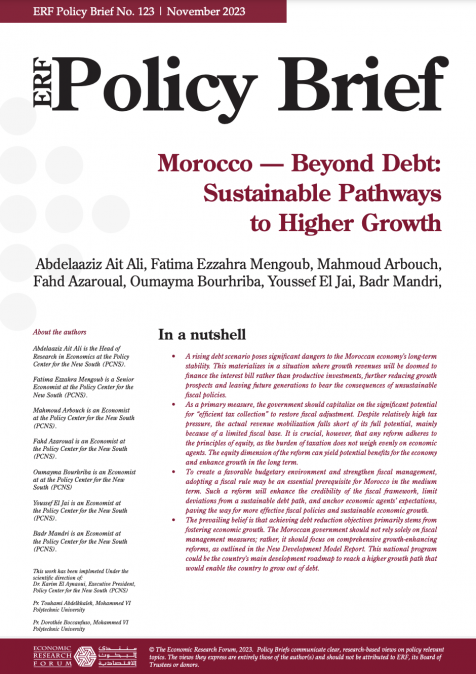
Morocco — Beyond Debt: Sustainable Pathways to Higher Growth
November 14, 2023

This Policy brief was originally published on erf.org.eg

Like many emerging and developing economies, Morocco has experienced a significant increase in public debt since the COVID-19 pandemic. Central government debt reached 69.6 percent of GDP in 2022, up from 60.3 percent in 2019, and overall public debt increased to 82.5 percent of GDP in 2022, well above the presumed critical threshold of 60 percent. Therefore, it becomes crucial to conduct a comprehensive debt sustainability analysis (DSA) that extends beyond a simplistic rule-of-thumb assessment to consider several factors, such as the level and structure of debt, the GDP growth rate, the primary fiscal balance, the real interest rate, and the exchange rate.

In the realm of debt management, the conventional approach of bringing debt to sustainable levels has been shown to be insufficient or rather counterproductive. The “trivial solutions” of manipulating financial records, either by expanding revenues or rationalizing expenditures without careful consideration or scrutiny, often produce adverse consequences, thereby undermining economic growth. Ultimately, the paramount concern lies in fostering growth and ensuring that the economic structure generates the necessary resources to repay debts and bolster overall economic well-being. This policy brief delves into these dimensions and draws from the Moroccan experience of surmounting debt burdens and steering the economy toward a path of fiscal stability and prosperity. This policy brief proposes recommendations to address the challenges of public debt sustainability in Morocco. It also draws from the results of an analysis of the debt and its sensitivity through scenarios and simulations. 1 The policy brief is divided into three sections. The first examines the main trends in the Moroccan economy over the past two decades, the second presents a summary of the simulation model results, and the third proposes policy recommendations to address Morocco’s debt sustainability challenges.

  This policy brief is an output of the project on “Stabilization and Adjustment in MENA”. The project has been managed under the auspices of the Economic Research Forum and Finance for Development Lab (FDL). ERF acknowledges the financial support of the International Development Research Centre (IDRC) for this project.

RELATED CONTENT

  • Authors
    Vera Songwe
    December 23, 2016
    Partout dans le monde, l'intégration économique régionale permet d'accélérer la croissance et le développement en apportant une panoplie d'avantages liés à une meilleure coopération politique, à un commerce intra-régional accru et à la création d'emplois. Les régions qui sont plus intégrées se sont révélées capables de connaître une croissance plus rapide et ont fait preuve d'une plus grande capacité d'adaptation en période de ralentissement de l'économie mondiale. Alors que l'écono ...
  • Authors
    Karim EL Mokri
    October 13, 2016
    Morocco is now more than ever threatened by the trap of middle-income economies. On one hand, it is caught between increased competition from low-income countries in low productivity and labor-intensive sectors and, on the other hand, the difficulty of accelerating its pace of structural transformation towards activities with higher value added and higher technological content. International experience shows that few countries have managed to climb to the status of an advanced econo ...
  • Authors
    June 16, 2016
    L’écart entre filles et garçons en termes de scolarisation, au Maroc, a longtemps préoccupé tant les académiciens que les décideurs. En revanche, très peu d’études se sont penchées sur l’analyse de cet écart sous une toile de fond quantitative. Ce présent travail s’intéresse à l’écart genre en termes d’acquis scolaires en lecture. La finalité étant de mettre en exergue les facteurs influençant les différences de performance entre les genres ainsi que leur ampleur. Pour ce faire, une ...
  • Authors
    May 20, 2016
    The 2015-2030 strategic vision innovates the Moroccan educational system. Unlike previous reforms, this vision addresses problems that have long been ignored. Among these problems is the quality of education. Although educational quality may have been included in previous reform programs, it is considered as one of the priorities in this new vision. The purpose of this Policy Brief is to assess the status of learning achievement, which is an integral part of educational quality, of ...
  • Authors
    December 23, 2015
    Global economic growth is likely to be a little better in 2016 than this year’s lackluster outcome. The ongoing slow recovery in the United States and Europe is likely to continue. However, weakness in China as well as several large emerging markets, and sluggishness of world trade, mean that risks are weighted on the downside of this forecast. Morocco, which is reliant on European markets, is a heavy importer of oil, and whose currency has devalued in effective terms, should find t ...
  • Authors
    Edité par:
    Karim El Mokri
    Aziz Ragbi
    Said Tounsi
    November 23, 2015
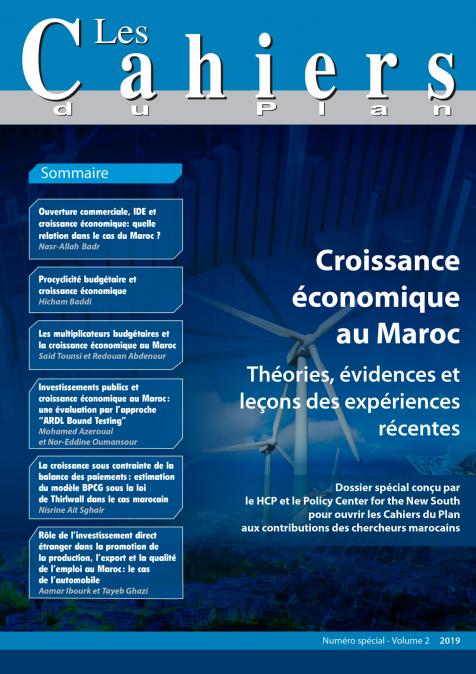
    Depuis le déclenchement de la crise économique et financière internationale, la politique budgétaire a connu un vif regain d’intérêt dans les arènes académiques et dans les débats des policy-makers, aussi bien dans les pays avancés que ceux en voie de développement. Pour un pays en voie de développement comme le Maroc, l’importance de la politique budgétaire réside dans le potentiel qu’elle offre en matière de stabilisation du cycle économique et de relance de l’activité en période ...
  • Authors
    Karim El Mokri
    Aziz Ragbi
    Said Tounsi
    November 23, 2015
    The issue of a powerful fiscal policy comeback is not only being debated in Europe. It is also interesting for Morocco, in many respects. If in Europe there is controversy between the proponents of the structural budgetary balance rule and critics of restrictive policies in the context of major financial and recessive shocks, in the South of the Mediterranean fiscal policy is caught between the multiple social and economic requirements and the constraint of sustainability. ...