Publications /
Paper in Academic Journals

Back
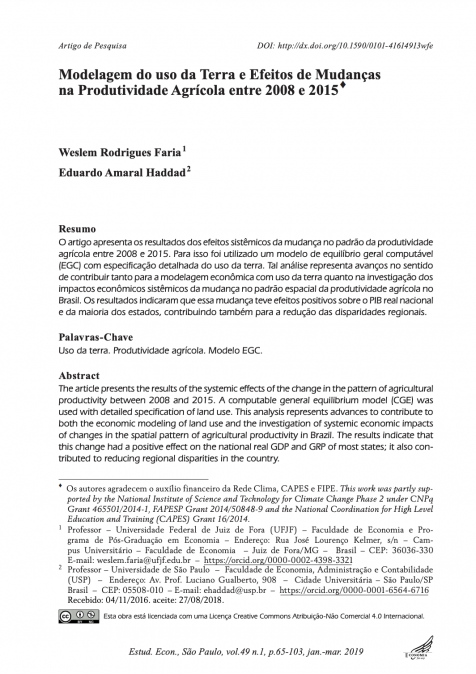
Modelagem do uso da Terra e Efeitos de Mudanças na Produtividade Agrícola entre 2008 e 2015
January 5, 2019

O artigo apresenta os resultados dos efeitos sistêmicos da mudança no padrão da produtividade agrícola entre 2008 e 2015. Para isso foi utilizado um modelo de equilíbrio geral computável (EGC) com especificação detalhada do uso da terra. Tal análise representa avanços no sentido de contribuir tanto para a modelagem econômica com uso da terra quanto na investigação dos impactos econômicos sistêmicos da mudança no padrão espacial da produtividade agrícola no Brasil. Os resultados indicaram que essa mudança teve efeitos positivos sobre o PIB real nacional e da maioria dos estados, contribuindo também para a redução das disparidades regionais.


RELATED CONTENT

  • October 02, 2026
    Building on his Policy Brief "Latin America, World Politics and the Great Powers", Nizar Messari examines how recent developments are reshaping U.S. influence in the region and affecting ...
  • Authors
    September 30, 2026
    You can imagine how often I've been asked to comment on where the Brazilian economy is headed after the election. With polls pointing to a runoff on October 25 and currently showing a statistical tie between Luiz Inácio Lula da Silva and Flávio Bolsonaro in vote simulations, I'm naturally asked about their economic programs and about the country's relations with the United States. ...
  • Authors
    Pedro Henrique de Christo
    Travis Knoll
    September 18, 2026
    The Brazilian context involving a clean-electricity base, a more balanced lobbying landscape, and mounting climate and social pressure, makes it more difficult for the kind of abrupt and unrestrained energy policy swing seen in Colombia. The trend in Brazil tends to be more economically viable for renewables. However, these structural conditions by themselves will not guarantee the success of the transition. Fruition will depend on whether policymakers use this window to prepare for ...
  • Authors
    August 12, 2026
    La géographie mondiale des hydrocarbures n'est évidemment pas figée. De nouveaux producteurs de pétrole et/ou de gaz naturel apparaissent suite à des découvertes, le plus souvent réalisées par des compagnies pétrolières internationales. On pense notamment au Mozambique, qui produit et exporte du gaz naturel liquéfié (GNL) depuis la fin 2022, au Sénégal, qui est un producteur de pétrole offshore depuis la mi-2024, et au Sénégal et à la Mauritanie, qui sont devenus conjointement expor ...
  • Authors
    Sérgio R. R. de Queiroz
    Nicholas S. Vonortas
    May 9, 2025
    This paper aims to demonstrate how certain transformations in the international economy since the 1980s¾notably the globalization of firms and industries¾combined with a set of domestic challenges, disrupted the path of industrial and technological development that Brazil had pursued since the 1930s. In essence, growth strategies based on the scale of the domestic market ceased to be effective. The innovation and economic challenges the country now faces cannot be addressed without ...
  • Authors
    João Gabriel Sacco
    January 23, 2024
    - Brazil’s latest tax reform will replace five taxes on consumption with one single VAT to promote greater efficiency and sectoral isonomy. - Forecasts produced by a detailed ICGE model point to sizeable gains in GDP exceeding 4% in the long run, even if spatially unequal. - Exceptions to the rules reduce potential benefits in efficiency terms. - Policies meant to promote regional development and close the gap deepened by the reform partially achieve their goal at the expense of ...
  • Authors
    October 26, 2023
    The Brazilian economy is stuck in a so-called middle-income trap—growth that stalled long before Brazil caught up with the living standards of the highly industrialized countries. After exhibiting a stellar performance in the decades before the 1980s, the economy has since been unable to sustain growth for long periods. The predicament can be summarized using a medical analogy: Brazil has been suffering from both productivity anemia and public sector bloat. On the one hand, it hasn ...
  • Authors
    Xiaofeng Wang
    October 13, 2023
    The surprising victory of Javier Milei, the unconventional ‘anarcho-capitalist’ candidate, in the August primaries ahead of Argentina’s October 2023 general election, can be largely credited to his commitment to dollarize the Argentine economy, a move perceived as the ultimate solution to bring an end to the nation's economic turmoil. The potential shift from the local currency to the dollar has sparked concerns about Argentina's bilateral currency swap line with China. This swap l ...
  • Authors
    Jaime Bonet
    Geoffrey J. D. Hewings
    August 30, 2023
    This Book was originally published on springer.com   This book examines regional structural challenges on Colombia’s path to sustainable social cohesion and regionally inclusive growth. These challenges can be divided into three main groups: (i) those that focus on competitiveness and the supply side, (ii) those that arise from critical business cycle issues on the demand side, and (iii) those concerning environmental sustainability, employment and social inclusion.&nbsp ...
  • Authors
    February 15, 2023
    China’s rate of economic growth has slowed. Chinese GDP ended 2022 up 3%, but this was the lowest growth rate in the last 40 years, except for 2020, the first year of the pandemic. In addition to problems in its real-estate sector, China’s severe ‘COVID zero’ confinement policy is one of the causes. The post-‘COVID zero’ reopening of the Chinese economy has improved its growth outlook. In the International Monetary Fund’s annual report on China, published in early February 2023, 5. ...