Publications /
Opinion
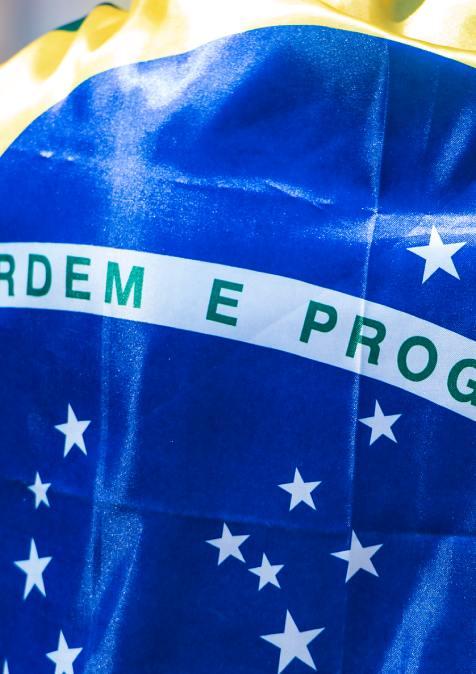
You can imagine how often I've been asked to comment on where the Brazilian economy is headed after the election. With polls pointing to a runoff on October 25 and currently showing a statistical tie between Luiz Inácio Lula da Silva and Flávio Bolsonaro in vote simulations, I'm naturally asked about their economic programs and about the country's relations with the United States.
Regardless of who wins, the next president will inherit a Brazilian economy that is slowing down. GDP growth is estimated at 1.9% in 2026, which would be the worst performance since 2020.
Although the Central Bank cut the benchmark rate by 1.25 percentage points over the course of the year, interest rates remain very high in both nominal and real terms. The burden on households has also increased: household debt-service commitment as a share of income reportedly reached 29%, a record high.
To ease that pressure, Lula announced a 15% increase in social benefits and proposed a consumer debt renegotiation program. That additional spending could, in turn, help push nominal borrowing costs back up.
Fiscal policy has long been one of the main vulnerabilities of the Brazilian economy. In 2016, the Michel Temer government passed a rule freezing public spending in real terms, following a "spending cap." That measure helped reduce financing costs but was later weakened during the Bolsonaro administration.
Lula replaced the old spending cap with a fiscal rule considered more flexible, tied to revenue growth. However, the fact remains that successive governments have failed to consistently meet even relatively modest fiscal consolidation targets. As a result, investors demand a high premium to buy Brazilian debt.
At this point, the two candidates' proposals diverge. The Lula government has spoken of pursuing a primary surplus within the existing fiscal framework by reducing tax benefits and controlling spending growth. Flávio Bolsonaro's team, for its part, has talked about replacing the current framework with a rule that ties spending growth to the debt level.
I point out to those who ask me that any scenario involves a political challenge: any significant fiscal reform will need the support of the "Centrão," (the Big Center), a parliamentary bloc characterized by its pursuit of budgetary favors for its clienteles and by the absence of any single ideological orientation. Passing any radical fiscal reform will face the arduous task of negotiating favors with that group.
I'm also asked about the "commodities" factor. As a major commodity exporter, Brazil is currently benefiting from high prices for oil, soybeans and sugar. During Lula's first governments (2003–2010), the strong commodity cycle — especially iron ore, oil, soybeans, sugar and coffee — helped significantly improve public finances and the economy. During that period, Lula was able to expand the welfare state while the public debt-to-GDP ratio fell 15 percentage points.
A perfect repeat of that scenario doesn't seem likely, however. The price of iron ore, particularly sensitive to China, fell 6% in 2026, while the current favorable oil cycle could lose momentum if the conflict in the Middle East eases.
Of course, I'm also asked about the significant geopolitical dimension of the election, particularly regarding the relationship with the United States. The Trump administration is politically backing Flávio Bolsonaro, who maintains a close relationship with the American president. Trump made political references following U.S. tariff measures against Brazil, including the new 25% tariff resulting from an alleged trade investigation.
The economic effect of the tariffs is considered significant, though not catastrophic. The United States' share of Brazilian exports fell from 12% in 2024 to 9.6% between January and August 2026. A Flávio Bolsonaro victory could lead Trump to remove the additional 25% tariff. A Lula victory, on the other hand, would likely see the tariff maintained, although negotiations between the two countries are still ongoing. Lula has threatened to use the Economic Reciprocity Law to retaliate should negotiations fail.
U.S. Secretary of State Marco Rubio has a particularly contentious relationship with Lula. Rubio is reportedly trying to build a kind of "coalition of friendly countries" for the United States in Latin America. In that strategy, Lula's Brazil is seen as a left-wing government poorly aligned with Washington, while the right has recently won in 20 countries in the region. A Flávio Bolsonaro presidency, on the other hand, would likely place Brazil among the members of that U.S.-led coalition.
Another point I'm asked about is the relationship with China, particularly regarding the "Donroe Doctrine" that we discussed here in April. This doctrine seeks to limit Chinese presence in strategic Latin American assets, such as ports, energy infrastructure, telecommunications and critical minerals.
Washington is reportedly using its trade and tariff leverage to pressure Brazil into limiting Chinese access to its strategic minerals. The Lula government, however, says it wants U.S. investment and technology without granting Washington veto power over Chinese investments.
Rather than choosing between the United States and China, Lula advocates a policy of "autonomy through diversification": Brazil should maintain relations with both and contribute to a multipolar international order. Lula rejects the idea that Brazil should belong to either power's sphere of influence. That's why his government has once again deepened relations with China after the strain that occurred during the Jair Bolsonaro administration.
One example of this is BYD's US$1.1 billion investment in a former Ford plant in Bahia. In addition, Brazil and China have expanded agreements in agriculture, infrastructure and railways following the trade disruptions caused by the United States in 2025. China's importance to Brazilian trade is substantial: it now accounts for more than 30% of Brazilian exports.
If Flávio Bolsonaro wins, Brazil would likely move politically and militarily closer to the United States, reinforcing Latin America's rightward shift. If Lula wins, Brazil would likely continue trying to preserve its strategic autonomy, avoiding full alignment with either the United States or China.