AFRICAFE: Brazil's relationship with Africa

February 19, 2026

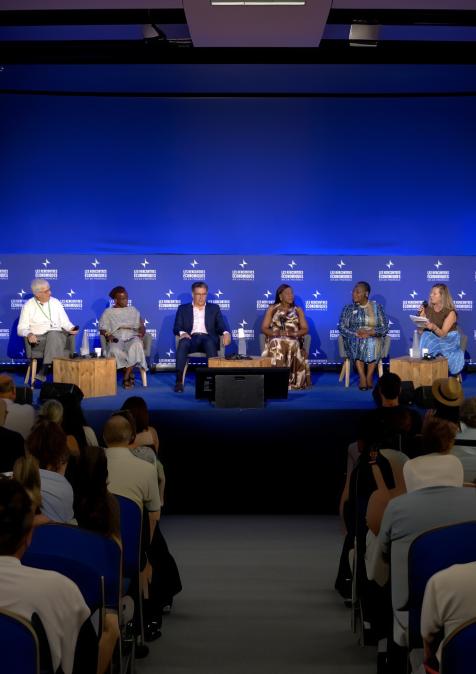
This Africafe's episode examines Brazil-Africa relations: historical ties shaped by the slave trade and diaspora, Lula’s trade expansion, and competition with China/EU. It explores South-South diplomacy’s potential to reshape global institutions, the role of “South Atlanticism,” and future cooperation opportunities and limits. How can these partnerships redefine post-Cold War dynamics?

Speakers

Nizar Messari
Professor of International Relations at Al Akhawayn University
...
Khadija Mamouni
Junior Analyst - International Relations Research Department
...

RELATED CONTENT

  • March 18, 2026
    Le premier sommet des BRICS, tenu à l’initiative de la Russie en 2009, sera suivi de 16 autres, le dernier étant celui de Rio dont les travaux se sont déroulés les 6 et 7 juillet 2025. Jusqu’en 2022, un seul élargissement est intervenu, celui accueillant l’Afrique du Sud, transformant les BRIC en BRICS. À partir de 2023, en revanche, trois sommets, ceux de 2023, 2024 et 2025, vont se solder par la transformation des BRICS en BRICS+5, accueillant 5 nouveaux pays membres, en ...
  • February 19, 2026
    This Africafe's episode examines Brazil-Africa relations: historical ties shaped by the slave trade and diaspora, Lula’s trade expansion, and competition with China/EU. It explores South-South diplomacy’s potential to reshape global institutions, the role of “South Atlanticism,” and fut...
  • Authors
    Gabriela Keseberg Dávalos
    January 26, 2026
    This Opinion was originally published by the Hanns Seidel Stiftung on January 19th, 2026. The author of this opinion, Gabriela Keseberg Dávalos, is a 2013 alumna of the Atlantic Dialogues Emerging Leaders Program. The signing of the EU–Mercosur agreement is a small geopolitical miracle. Signed on 17 January 2026 in Paraguay, it arrives at a moment when Europe is unmistakably being cast aside by the United States. Meanwhile Latin America, and with it, the Mer ...
  • Authors
    Marianna Albuquerque
    Santiago Theoduloz
    October 3, 2023
    Marianna Albuquerque and Santiago Theoduloz are 2022 alumni of Atlantic Dialogues Emerging Leaders program. Learn more about Marianna here and Santiago here.  From our experience of participating in the ADEL Program and the Atlantic Dialogues in 2022, we learned that the Atlantic countries have the potential to improve their economies through regional coordination. This led us to reflect on how many opportunities the countries from the wider Atlantic missed ...
  • September 01, 2023
    In this podcast, we are joined by Dr. Len Ishmael, editor and co-author of the book “Aftermath of War in Europe: The West VS. the Global South?”. Dr. Ishmael delves into the groundbreakin ...
  • Authors
    Ahmed Rachid El-Khattabi
    Alessandro Minuto-Rizzo
    Amaye Sy
    Hamza Rkha Chaham
    Ian O. Lesser
    Jorge Castañeda
    Moubarack Lo
    Umberto Profazio
    December 14, 2022
    This ninth edition of “Atlantic Currents” appears in an international context marked predominantly by a ten month-war between Russia and Nato members that began February 2022. The war is affecting not only the European and American member States directly and actively involved in an unprecedented manner, but more importantly the countries of the global South that have suffered collateral damage. Indeed, the nations of the world were barely out of the most painful and costly phase o ...
  • Authors
    March 11, 2022
    The pros and the cons of regional market integration are well exemplified by the experience of Uruguay, a small, open economy in MERCOSUR, which is a highly protectionist trade bloc, dominated by Argentina and Brazil. With access to such large markets, Uruguay did raise its growth rate during the first decade of MERCOSUR, the 1990s. However, market integration as implemented in MERCOSUR was also problematic in that Uruguay suffered from the high protectionism of Argentina in the for ...