Publications /
Opinion

Marianna Albuquerque and Santiago Theoduloz are 2022 alumni of Atlantic Dialogues Emerging Leaders program. Learn more about Marianna here and Santiago here.
From our experience of participating in the ADEL Program and the Atlantic Dialogues in 2022, we learned that the Atlantic countries have the potential to improve their economies through regional coordination. This led us to reflect on how many opportunities the countries from the wider Atlantic missed out on by not considering joint development of policies. If we analyze the current situation from a South American perspective, the promising links between the wider Atlantic countries are as yet unfulfilled. Thus, we will focus on how Mercosur could approach this topic.
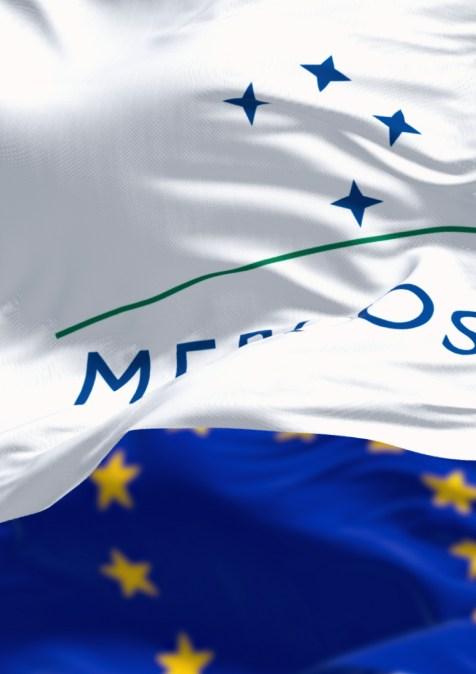
As a first step, we have to determine if we can speak about Mercosur as a political or regional structure that can develop common policies, or if we have to consider Mercosur countries individually. If we consider the current reality in our region, the second approach seems to be most suitable. Mercosur is not having its best moment. Many political actors have called to start a procedure to review the whole structure, and many have questioned the Mercosur raison d'être as progress within it has apparently stalled. The reality is that the divergent ideological perspectives of its members has played a major role in misunderstandings and in the lack of political will. Hence, is it possible to consider developing partnerships with foreign countries if Mercosur members cannot deal with their own problems?
Who is interested in the Mercosur region? First, we need to mention China. China’s interest in the Mercosur region is not new and has been on the agenda in recent years. Because of the Mercosur quasi-paralysis, some of its members started to rethink the rule about only signing trade treaties collectively and consensually. Aware of this window of opportunity, China approached some Mercosur members individually to negotiate free trade agreements. This had an impact on relations between Mercosur countries and restarted old discussions about decision-making procedures and external partnership limitations.
The first controversy emerged in 2021, after the conversations between China and Uruguay on an FTA, a treaty announced with much enthusiasm.
Following the announcement, the other Mercosur full members—Brazil, Argentina, and Paraguay—relaunched the debate about negotiating an FTA with a third country without departing from Mercosur as a bloc. At the center of the discussion was the recall of Mercosur Decision 23/00 on re-activating Mercosur initiatives by simplifying and clarifying legal procedures, originally published in 2000. Since then, one of the topics (in simple words, if Mercosur countries can individually negotiate an agreement with a third country) has remained open, undecided, and controversial.
In this specific case, when Uruguay and China announced the agreement, the opposition of other Mercosur members was immediate. The strongest opposition came from Argentina, after President Alberto Fernández declared that Uruguay would breach the Mercosur treaties if it negotiated a solo agreement with China.
For Uruguay, from a political point of view, it was an easy yes. Considering the importance of negotiating trade deals with foreign countries—especially China—Uruguay did not want to miss an opportunity because of limits imposed by Mercosur. According to their interpretation of Decision 23/00, the Uruguayan government has insisted that it did not need permission to negotiate alone. In the end, as a sovereign country, and considering the intergovernmental nature of Mercosur, the decision was political, and Uruguay seems to be determined to follow that path.
In this context, a remarkable event was the visit of Brazilian President Lula to Montevideo to meet his Uruguayan colleague, President Lacalle Pou, as soon as the former took office in 2023. Lula agreed with Lacalle Pou on the need for open markets and the potential that the agreement with China can represent. It was an intriguing event because both presidents are from different ideological backgrounds, but China's importance seems to be common ground. Subsequently, in April 2023, Lula visited China and took a new approach that could change how Mercosur deals with the Asian country. During the visit, Lula sent a clear message about Mercosur's unity that could represent difficulties for Uruguay to continue negotiating solo.
The well-known agreement between Mercosur and the European Union is an additional obstacle. After years of discussion and the aim of concluding negotiations in 2019, the approval of the trade agreement remains faraway. The stalemate links to additional EU demands on climate commitments. In parallel, Mercosur countries (and especially their national industries) question the asymmetries in the manufactures-commodities ratio. Leaders discussed this aspect on July 2023 at the EU-CELAC Summit. If the agreement enters into effect, it will impact the development of both regions—for better or worse.
In this scenario of overlapping problems in reaching agreements with China and the EU, suggesting institutionalized partnerships between Mercosur and other countries from the wider Atlantic might seem unrealistic. It is doubtful if the Mercosur region is prepared to think about a deal with African Atlantic countries—despite the potential gains that an agreement with a country like Morocco could generate. Is this because Mercosur countries are not interested in doing so? The answer, again, is not clear. We argue that Mercosur and African countries have not thoroughly explored the possibility of joint policies, mainly through trade agreements, but also through initiatives to promote development and cultural exchanges, for instance.
In our opinion, Mercosur needs to solve its internal problems before continuing to work in association with different countries or regions. Mercosur needs to redefine its structure and rethink if countries must negotiate together or could proceed on their own. Being transparent in the political intentions is the first step and a hallmark asset to develop. In the current situation, it does not seem that Mercosur—at least as a bloc—is prepared to negotiate a trade deal with China, or to continue with the approval of the agreement with the EU. If the solution is to bring some fresh air by allowing countries to negotiate individually, it could possibly threaten Mercosur's existence.
To conclude, we would highlight the role of electoral timeframes. Brazil held its election in October 2022, and Paraguay in April 2023, with major shifts in political orientations. Argentina will be next in October 2023. The effects of potential ideological turns are yet to be seen, and could deeply affect Mercosur's priorities.