Publications /
Policy Paper

Back
Le Partenariat Afrique-Europe : Quel renouveau dans l’après-Covid-19 ?
July 22, 2020

L’Union européenne (UE) et l’Union africaine (UA) vont se retrouver au mois d’octobre 2020 dans un Sixième Sommet du cycle de la Stratégie Conjointe UEAfrique qui les réunit périodiquement depuis l’année 2000. Ce Sommet se profile dans un contexte de turbulences provoqué par le choc pandémique de la Covid-19. Dans cette perspective, l’UE a présenté à l’UA une nouvelle offre de coopération inspirée du « Green Deal », la stratégie géopolitique et économique arrêtée par la nouvelle Commission européenne depuis sa nomination.

Le Sommet d’octobre offrira l’opportunité de formuler une approche de Partenariat davantage consensuelle pour trois raisons fondamentales. La première est que le choc récent du Coronavirus a fait apparaître la nécessité de reconstruire le narratif du Partenariat, redéfinir sa finalité et de réajuster ses objectifs finaux, en tenant compte de deux principes majeurs, que sont la sécurité humaine et la solidarité basée sur l’interdépendance. La deuxième est de définir une vision des intérêts réciproques et les priorités communes de l’Union européenne et de l’Afrique dans des domaines stratégiques : la santé, la souveraineté alimentaire, les chaînes de valeur, le capital humain, le digital et l’innovation, l’immigration, la paix et la sécurité, la gouvernance… Des domaines stratégiques dans lesquels les partenaires pourraient bâtir un partenariat global, cohérent et mutuellement bénéfique. La troisième est liée à l’adoption de leviers d’intervention et d’une démarche pragmatique fondée sur une amélioration des outils et des structures du partenariat dans un esprit de codécision clarifiant la responsabilité partagée des institutions européennes et africaines dans la mise en œuvre de la stratégie partenariale.

Cette clarification pourrait contribuer à rendre plus efficace la programmation et la cogestion des instruments du partenariat, tenant compte de la coordination politique globale de l’action des deux institutions. C’est la crédibilité du partenariat aux yeux des citoyens des deux Continents qui est en jeu.

RELATED CONTENT

  • Authors
    October 29, 2026
    Wars are decided by those who hold military power, but their costs are increasingly borne by those who have little or no voice in the decisions that start them. The US–Iran war shows this imbalance very clearly. Its economic consequences have gone far beyond the battlefield and have disrupted energy markets, trade routes, food supplies, public finances and investment in the Gulf, Europe, Africa and Asia. The most striking feature of the conflict, however, is not only the size of the ...
  • Authors
    Niagalé Bagayoko
    Eugène Berg
    Pierre Berthelot
    Vincent Campredon
    Christophe Chabert
    Alain Oudot De Dainville
    Emmanuel Veron
    October 28, 2026
    Bientôt disponible en vente. Cet ouvrage est issu de la 20e édition des Dialogues Stratégiques, organisée le 6 mai 2026. Il s’articule autour de deux thématiques : « Souverainetés critiques : sécuriser les infrastructures essentielles et les ressources stratégiques » et « La Méditerranée : entre coopération régionale et rivalités globales ». La première partie examine les conditions dans lesquelles les États peuvent protéger leurs infrastructures et maitriser leur accès au ...
  • October 14, 2026
    في ظل التوترات الجيوسياسية المتصاعدة، تتغير طرق التجارة العالمية وتتبدل معها موازين الممرات الاستراتيجية. تفتح هذه الحلقة من «حديث الثلاثاء» النقاش حول التقاء المسارات البحرية والبرية داخل هذه الممرات، والعوامل التي تتحكم في طبيعة السلع التي تعبرها. وتبحث كذلك في ما يمكن للمغرب أن يجنيه...
  • Authors
    Paul Isbell
    October 9, 2026
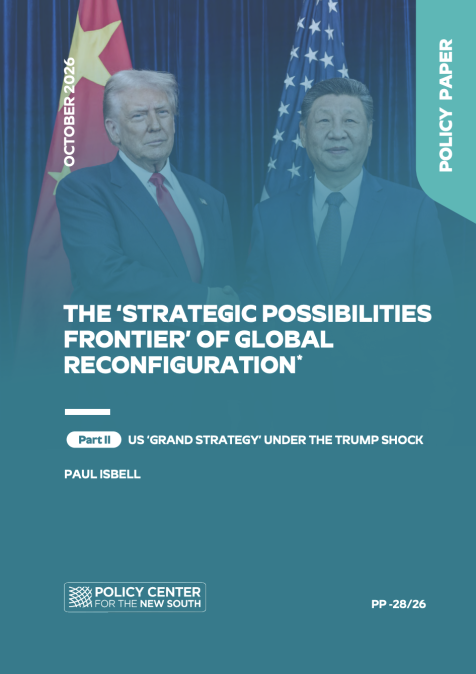
    In the first seven Policy Briefs of this ongoing series of analysis on Pan-Atlanticism: The Atlantic Basin in a Multipolar-Transnational World, we developed the argument that the strategic significance of the Atlantic Basin is on the rise for a range of international actors (states, regions and non-state agents) and from distinct political or ideological perspectives. In addition, in the most recently published Policy Brief -- “The U.S. and the Current International Reconfiguration: ...
  • Authors
    Lina Jaoid
    October 8, 2026
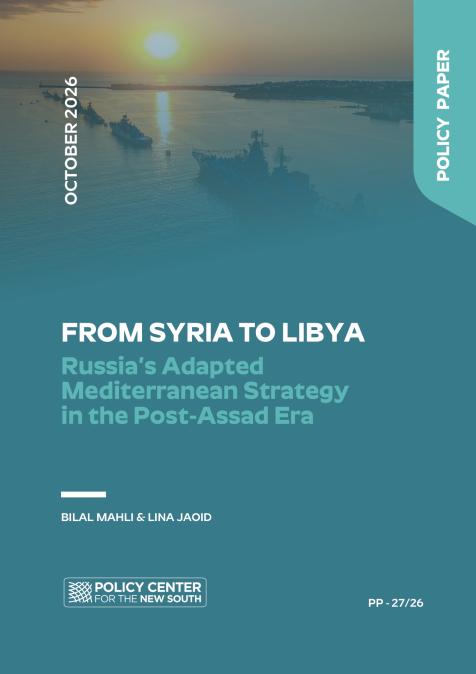
    In the two years since the fall of Bashar al-Assad in Syria, Russia has restructured its Mediterranean presence. Although Russia’s limited and increasingly conditional access to the Khmeimim and Tartus facilities in Syria has been preserved, its presence in the country has morphed from Assad’s ‘patron-client’ configuration to a more negotiated engagement. Simultaneously, Russia has upgraded its force-projection and logistical infrastructure in eastern Libya, giving it an access path ...
  • September 16, 2026
    Much of Western debate was revealingly silent on the Shanghai Cooperation Organization (SCO) summit, which took place on August 31 and September 1 in Bishkek, Kyrgyzstan. That relative silence reflects how poorly the organization’s growing significance is still understood. The meeting has not gone unreported. Any gathering of Xi Jinping, Narendra Modi, and Vladimir Putin inevitably attracts&nbs ...
  • Authors
    August 13, 2026
    The Resolution adopted by an overwhelming majority of elected European officials in Strasbourg on June 10, 2021, on "the violation of the UN Convention on the Rights of the Child and the exploitation of minors by the authorities in the migration crisis in Ceuta" (2021/2747/RSP), could not fail to leave its mark.Decoding the ResolutionThe Resolution shocked Moroccans to such an extent that it was quickly set aside at the time, as if there were a wish to forget it as fast as possible. ...
  • Authors
    August 13, 2026
    Cuando estalla una crisis, esta da lugar a la activación de reflejos para su gestión y la limitación de sus efectos. Comienzan, entonces, los análisis y las suposiciones sobre las disfunciones, los incumplimientos y las fallas que la ocasionaron. En algunos casos, la teoría de la conspiración se inmiscuye y las hipótesis buscan a los autores que provocaron la crisis, sus designios y sus objetivos. Sin embargo, la teoría de la gestión de crisis nos enseña que una crisis surge según ...
  • Authors
    August 12, 2026
    When a crisis erupts, it sets crisis-management reflexes in motion and prompts efforts to contain its effects. Analysts then begin looking for the malfunctions, oversights, and failures that caused it. In some cases, conspiracy theories creep in, and speculation turns to who engineered the crisis, and to what end. Crisis-management theory teaches us, however, that a crisis unfolds under conditions that favor its emergence. Crises take shape in an environment where latent vulnerabil ...