Publications /
Policy Brief

Back
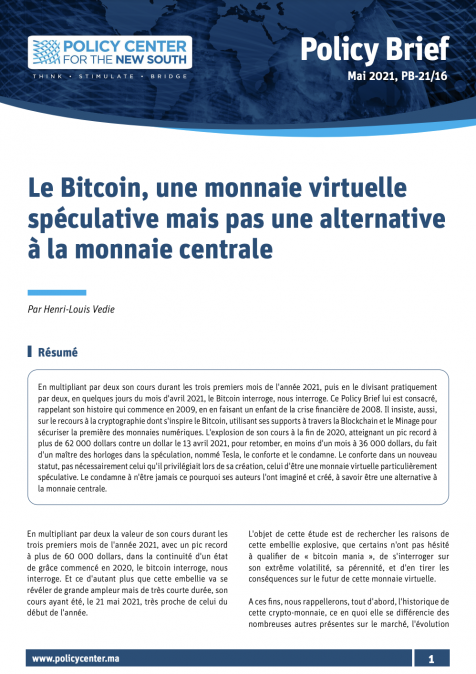
Le Bitcoin, une monnaie virtuelle spéculative mais pas une alternative à la monnaie centrale
May 31, 2021

En multipliant par deux son cours durant les trois premiers mois de l'année 2021, puis en le divisant pratiquement par deux, en quelques jours du mois d'avril 2021, le Bitcoin interroge, nous interroge. Ce Policy Brief lui est consacré, rappelant son histoire qui commence en 2009, en en faisant un enfant de la crise financière de 2008. Il insiste, aussi, sur le recours à la cryptographie dont s'inspire le Bitcoin, utilisant ses supports à travers la Blockchain et le Minage pour sécuriser la première des monnaies numériques. L'explosion de son cours à la fin de 2020, atteignant un pic record à plus de 62 000 dollars contre un dollar le 13 avril 2021, pour retomber, en moins d'un mois à 36 000 dollars, du fait d'un maître des horloges dans la spéculation, nommé Tesla, le conforte et le condamne. Le conforte dans un nouveau statut, pas nécessairement celui qu'il privilégiait lors de sa création, celui d'être une monnaie virtuelle particulièrement spéculative. Le condamne à n'être jamais ce pourquoi ses auteurs l'ont imaginé et créé, à savoir être une alternative à la monnaie centrale.
RELATED CONTENT

  • Authors
    January 27, 2026
    This paper revisits Big Push industrialization theory in the context of open economies deeply integrated into global value chains (GVCs). While classical Big Push models emphasize demand complementarities and coordination failures in largely closed economies, many middle-income countries now industrialize through foreign-owned, import-intensive production networks. We develop an extended Big Push framework that incorporates GVC integration and import leakage, and show how these feat ...
  • January 13, 2026
    Central banks are facing a new era where crypto and AI are reshaping how money is managed. Traditional monetary policies are evolving to meet these technological and financial challenges. This episode explores the risks, opportunities, and innovations redefining the future of finance. D...
  • Authors
    Ahmed Ouhnini
    December 5, 2025
    L’« uberisation », terme né du nom de l’entreprise américaine Uber au début des années 2010, désigne initialement un modèle économique fondé sur la mise en relation directe entre offre et demande via des plateformes numériques. Rapidement popularisé, le concept s’est élargi, avec Airbnb dans l’hébergement, puis à une multitude d’autres secteurs : livraison de repas, services à domicile, commerce en ligne, voire des métiers traditionnellement régulés ou corporatistes. Ce néologisme t ...
  • Authors
    Ahmed Ouhnini
    December 5, 2025
    “Uberization,” a term derived from the American company Uber in the early 2010s, initially refers to an economic model based on directly matching supply and demand through digital platforms. Rapidly popularized, the concept has expanded with Airbnb in accommodation, and then to a wide range of other sectors: food delivery, home services, e-commerce, and even traditionally regulated or corporatist professions. This neologism thus reflects a transformation of economic and social relat ...
  • Authors
    December 3, 2025
     Global GDP growth has proven resilient in 2025, despite the shocks caused by the trade policies implemented by United States President Donald Trump in the first year after his return to office. The gloomy projections offered by multilateral and private institutions in the first quarter of 2025 have given way to revised levels mostly in the 2.5% to 3% range for the year. ...
  • December 2, 2025
    في هذه الحلقة، نحاول اكتشاف ما الذي يجعل المغرب يعيش اليوم تحولاً لافتاً في عالم المدفوعات الرقمية. كيف أصبحت التكنولوجيا المالية أحد مفاتيح الشمول المالي ومحركاً لنمو جديد؟ وكيف يغيّر الاعتماد المتزايد لوسائل الدفع الحديثة حياة التجار الصغار والمقاولات الصغيرة والمتوسطة ويخلق لهم فرصاً...
  • Authors
    December 2, 2025
    This paper assesses the economic and environmental implications of Morocco’s strategic transition from internal combustion engine vehicle (ICEV) manufacturing to electric vehicle (EV) production, with a particular focus on the regional impacts of localizing high-value battery manufacturing. Using an interregional input-output model, extended with environmental satellite accounts, the study simulates a structural shock related to the wholesale substitution of ICEV-specific inputs wit ...
  • November 25, 2025
    This Policy Paper analyses the Fourth Industrial Revolution (4IR) through the critical lens of technological colonialism. It argues that the fusion of physical, digital, and biological technologies is not merely a technical phenomenon but a civilizational shift reshaping the foundations of global power. The article traces a historical continuum from previous industrial revolutions, demonstrating how patterns of inequality and extraction persist, now transposed into the digital realm ...
  • Authors
    November 21, 2025
    This report addresses the business environment in Brazil as one of the determinants responsible for the weak evolution of productivity in recent decades. After addressing this productivity performance, we define what constitutes the business environment, using as a reference the three ways in which the World Bank has been addressing the subject.Next, we highlight how the business environment affects productivity in a country. Finally, we review some recent reforms in the country's b ...