Publications /
Policy Paper

Back
L’AES face aux défis de la fragmentation territoriale et de l’instabilité politique
January 6, 2026

La création de l’Alliance des États du Sahel (AES) symbolise une rupture politique et géostratégique majeure, appuyée sur un discours souverainiste et anti-occidental. Deux ans après, Mali, Burkina Faso et Niger peinent à assurer leur intégrité territoriale, à stabiliser leur sécurité intérieure et à bâtir une gouvernance solide. L’intégrité territoriale est un problème commun aux trois États, car dans ces pays, la cohésion de l’État et le contrôle du territoire sont directement menacés par une combinaison de facteurs sécuritaires, politiques, ethniques et géographiques. Dans le contexte sahélien, l’intégrité territoriale ne renvoie pas seulement à la défense des frontières nationales, mais aussi — et surtout — à la capacité de l’État à exercer son autorité sur l’ensemble de son espace. Les trois pays du Sahel sont confrontés à un même phénomène : une fragmentation territoriale persistante, résultant de l’enracinement du jihadisme, de la crise politique et des défis socio-économiques.
RELATED CONTENT

  • Authors
    November 2, 2021
    In the Sahel, and Central Mali in particular, the proliferation of armed groups over the past decade has resulted in formal and informal non-state governance structures. This paper assesses the various definitions and typologies associated with rebel and jihadist governance in order to better understand the mechanisms of governance provision used by key non-state governance providers in Central Mali.   ...
  • Authors
    Pascal Chaigneau
    Eugène Berg
    Rodolphe Monnet
    Jacques Gravereau
    Jérémy Ghez
    Olivier Tramond
    Niagalé Bagayoko
    Alain Oudot de Dainville
    Jérôme Evrard
    Coordination de l’ouvrage: Imane Lahrich
    Fatine Cherkaoui
    October 28, 2021
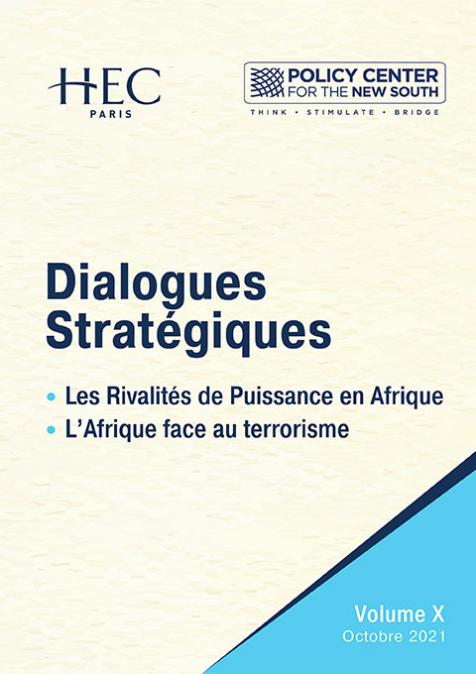
    Depuis l’accession au trône du Roi Mohammed VI, l’Afrique s’est transformée en priorité de la diplomatie marocaine. Sur le plan économique, l’Afrique est devenue le prolongement naturel du Maroc en termes d’investissements et d’implantations. Pascal Chaigneau s’attarde sur les relations affaiblies Europe-Afrique, l’ambitieuse relation Chine-Afrique ainsi que les relations entre la Russie, les Etats-Unis, la Turquie ou encore les pays du Golf et l’Afrique. Ce chapitre traite égalemen ...
  • Authors
    Johannes Claes
    Kars de Bruijne
    Sophie Mertens
    Eman Ragab
    Clara-Auguste Süß
    September 20, 2021
    The COVID-19 pandemic has had a cataclysmic impact on all aspects of the functioning of our world. The relevance of the possibility of the spread of a global virus with the spread of terrorism is not immediately obvious as it is difficult for a direct causal link to be scientifically established. However, taking into consideration how state responses and pre-existing socioeconomic grievances can be impacted by the COVID-19 pandemic can lead to innovative findings on how terrorist gr ...
  • May 4, 2021
    The Sahelian states of Niger, Mali, and Burkina Faso continue to face unprecedented violence arising from multidimensional conflicts. According to the Africa Center for Strategic Studies (2019), “the Sahel has experienced the most rapid increase in activity by militant groups of any region in Africa in recent years. Violent events involving extremist groups in the region have doubled every year since 2015”. In addition to the presence of multiple violent extremist organizations (VEO ...
  • Authors
    Sabine Cessou
    January 4, 2021
    Mali, Niger, Burkina Faso… L’insécurité fait tache d’huile au Sahel, menaçant de s’étendre aux pays du Golfe de Guinée. Le terrorisme a entraîné la formation de milices d’auto-défense communautaires, et ainsi créé des « friches » sécuritaires dans tout le Sahel, du Bassin du lac Tchad à la région du Liptako-Gourma. Les budgets consacrés à la défense augmentent, contrairement à ceux qui soutiennent le capital humain, santé et éducation. Dans un contexte de croissance démogr ...
  • December 16, 2020
    President Trump may not enact his threatened US drawdown of troops from the Sahel, but President Biden will still face pressure to end America’s “forever wars” and reduce the number of American lives and treasure lost to fighting terrorism in Africa. If the United States pulls back from...
  • August 18, 2020
    Fragile, poor, and conflict-affected Sahelian countries of Mali, Niger, and Burkina Faso were expected to witness catastrophic health and security situations following the emergence of COVID-19. However, the number of cases and deaths remained relatively low in all three countries compared to other parts of the world. Violent extremist organizations (VEOs) attempted to exploit the pandemic in their narratives, while continuing to conduct attacks in the region. Violence and attacks b ...
  • Authors
    June 15, 2020
    La Covid-19, menace conjoncturelle en dépit des impacts néfastes attendus, ne doit pas nous détourner complètement de menaces en phase de devenir structurelles et menacer toute une région dans son existence. Le terrorisme au Sahel et dans la région du Lac Tchad s’est avéré résilient face aux efforts jusqu’à présent déployés. Non seulement il n’a pas été vaincu au Sahel mais il avance vers son objectif final : atteindre l’Atlantique à travers les pays côtiers de l’Afrique de l’O ...
  • Authors
    December 7, 2019
    La présence de la France au Sahel n’est pas un sujet facile à discuter, à commenter ou à traiter. D’une part, l’intervention française, en 2013, (Opération Serval), avait permis de prolonger l’existence de l’Etat malien qui, sans l’opération française, n’aurait pas pu résister aux menées terroristes qui visaient Bamako. D’autre part, la présence française semble ne rien pouvoir changer à l’avancée du terrorisme dans la région, le phénomène semble même gagner du terrain devant l’imp ...
  • Authors
    Sabine Cessou
    June 19, 2018
    The second edition of the African Peace and Security Annual Conference (APSACO), organized in Rabat by OCP Policy Center, has started on June 18th with a broad debate on the political and strategic aspects of peacekeeping operations in Africa. Their financial cost was discussed right from the start of the Conference, as well as the ongoing reform processes engaged by the United Nations in addition to the African Union. “This cost is somewhat exaggerated,” said Rachid El Houdai ...