Publications /
Policy Brief
“The emerging global disorder could present an opportunity for Africa. With the right long-term perspective, African countries will be well positioned to take advantage of some of the opportunities that arise from the new geoeconomic reality.”
Gedion Timothewos (Ethiopia’s Foreign Affairs Minister)
The world’s changing geopolitical landscape and increasing tensions could provide an opportunity for Africa to attract more foreign direct investment (FDI) and to enhance FDI’s impact on employment, growth and poverty reduction. World powers are competing for access to critical resources and consumer markets. Africa has an abundance of both.
Current geopolitics are characterized by increased superpower rivalries, together with the rise of middle powers that are seeking to assert their influence. What was once a unipolar world led by the United States (US) has turned into a multipolar world. The US-China rivalry is a central feature of this new geopolitical landscape, while middle powers—such as the European Union (EU), the United Kingdom (UK), Russia, India, Türkiye, Saudi Arabia, and the United Arab Emirates—are also striving to play a more prominent role. These geopolitical changes entail significant risks that are bound to affect investment flows. Significantly, the United Nations (UN) has warned of the dangers arising from the erosion of the world order—including the rise in the number of armed conflicts and the major challenges to international law and multilateral cooperation.
This policy brief argues that recent changes in geopolitics could have a positive impact on FDI flows to Africa and provides policy recommendations for maximizing this positive impact. The brief is divided into five sections. Section 1 shows how global political and economic trends are leading to a decline in development assistance and debt financing for Africa. FDI is becoming even more important for the continent. Section 2 describes how geopolitical upheavals and increased risks are associated with a decline in global FDI. Section 3 presents trends in FDI to Africa and explains why these differ from global trends. Section 4 proposes policy measures that African countries can adopt to enhance the developmental impact of FDI. Section 5 concludes.
1. How is Overall Financing for Africa’s Development Impacted by Geopolitics?
Economic issues are increasingly intertwined with geopolitics. Geopolitical tensions, trade wars, and conflict-related disruptions have affected global growth prospects, energy prices, inflation, and investment flows. Countries are having to balance economic and security priorities. Government budgets are under stress as countries allocate more resources to defense. Governments’ higher borrowing, together with heightened uncertainty and inflationary pressures, is causing interest rates to increase, rendering many countries’ debts unsustainable.
Those changes are bound to have an important impact on the volume and nature of financing available for Africa’s development. They imply less official development assistance (ODA). ODA to Africa fell by some 25% in 2025. The International Monetary Fund (IMF) characterized this decline as historic. It also argued that it represents a structural shift that is unlikely to change anytime soon. Donor countries are increasing defense spending in response to heightened geopolitical risks and are therefore cutting ODA to control their budget deficits. Even within this reduced ODA envelope, priorities have shifted away from Africa. For Europeans, the priority is now in the East rather than the South. In 2025, ODA to Ukraine was $45 billion, whereas ODA to all of Africa was only $29 billion.
African countries cannot replace the decline in ODA with increased foreign borrowing. Some 23 African countries are in debt distress or at high risk of debt distress. With increased perceived risk with African debt, new lending declined sharply. It fell to about $15-18 billion annually in 2020-24, down from $38 billion annually in 2015-19. At the same time, debt service increased. In 2025, Africa paid $89 billion in debt service—$20 billion in interest payments and $69 billion in principal repayments. Thus, Africa is now facing a situation of negative net transfers—it is paying more to the rest of the world than it is receiving from it. The dramatic reversal in Africa’s financial relationship with China best illustrates these developments. Between 2015-19, China’s net transfers to Africa amounted to $30 billion ($6 billion/year), but between 2020-24, those net transfers turned to negative, at $22 billion (-$4.4 billion/year).
Under these circumstances, FDI becomes particularly important for Africa. It appears to be the one of the principal ways to offset the decline in ODA and debt financing. However, FDI is also impacted by the new geopolitics. Investment is often used as an instrument for improving national security and projecting power. Greater geopolitical tensions could lead to a concentration of FDI in certain sectors and countries that are considered strategic, with little impact on Africa’s overall development.
2. How Do Geopolitics Impact Global FDI Flows?
Geopolitical rivalries, tariff wars, military conflicts and trade disruptions are challenging international relations and reversing globalization. This process is referred to as “geoeconomic fragmentation,” and is naturally accompanied by changes in FDI. The perceived risk of investing in foreign countries has increased because trade wars or armed conflicts that disrupt logistics and transport routes are becoming more common and can have serious effects on the return on investment. Thus, geopolitics is causing a relative reduction in global FDI flows, a shift in destination countries in favor of those with geopolitical affinities, and a change in the sectoral allocation of FDI in favor of so-called strategic sectors.
Source: World Bank
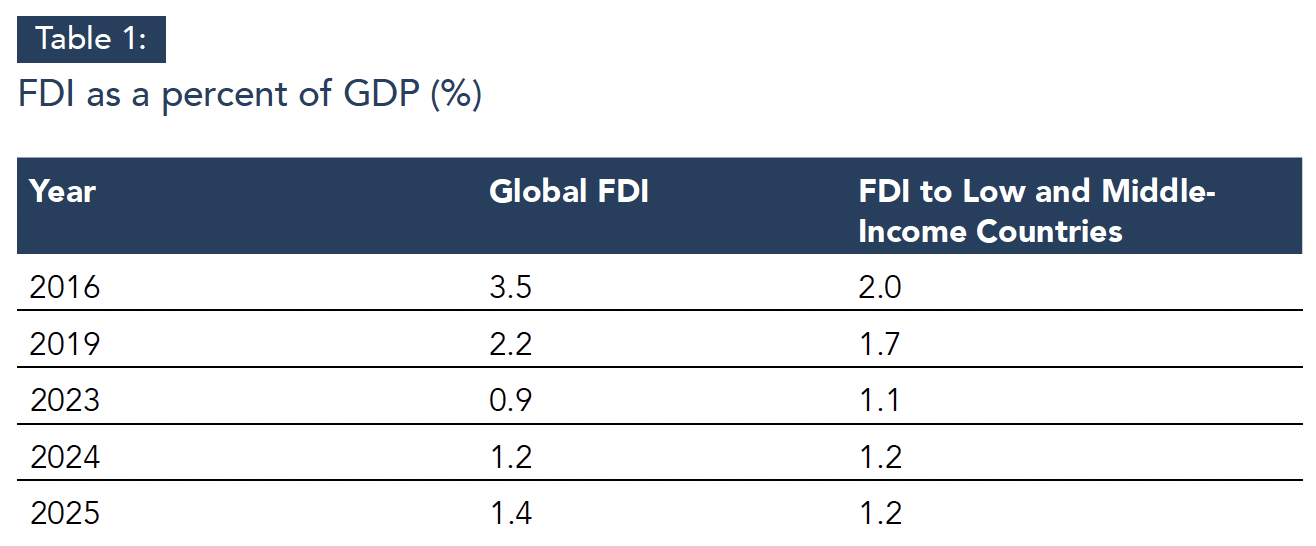
Table 1 shows a huge decline in FDI globally, from 3.5% of global GDP in 2016 to 1.4% in 2025. FDI to low- and middle-income countries followed a similar, but less steep, trajectory, falling from 2% of those countries’ GDP in 2016 to 1.2% in 2025. Faced with unstable geopolitics, policymakers and private firms try to limit risks by keeping production at home and avoiding investments abroad. In some cases, companies have even moved existing investments from foreign countries back to their home countries—a process known as reshoring.
Even as overall FDI levels have declined relative to GDP, the method for selecting destination countries has changed. Selection is no longer based solely on economic grounds, with the aim of reducing costs and increasing efficiency. It is also based on geopolitical affinity—a process known as friendshoring. Thus, the world is fragmented into groups of countries that are geopolitically close, they trade with each other and invest in each other’s economies, while trying to limit interaction with other groups. Empirical work by Grover and Vezina (2025) demonstrates how geopolitical differences have a negative effect on FDI. Moreover, this negative effect has increased over the last decade, implying increased geoeconomic fragmentation.
Geopolitics also affects investors’ choice of sectors and projects as rival countries try to control access to important inputs and technologies. As far as inputs are concerned, access to critical minerals has emerged as an important area of superpower competition. China is a dominant actor that invests in mines around the world and processes the minerals in China. China refines 60% of the world’s lithium, 85% of its rare earth elements, and 95% of its manganese. It even supplies about 50% of the US’s needs for twenty-four critical minerals. Thus, China was able to use export restrictions to pressure the US during trade disputes. That is why the US joined Australia, Canada and the EU to establish the Minerals Security Partnership—an initiative aimed at friendshoring critical mineral processing.
Tensions are also high on the technological front. The US wants to limit China’s advancement in strategic technology sectors such as semiconductors. It has imposed restrictions on exports of advanced computing and semiconductor items to China. Concomitantly, to protect US global leadership, it passed legislation—the CHIPS and Science Act—imposing high domestic content requirements in technology sectors. Moreover, it proposed the Chip 4 Alliance with Taiwan, South Korea and Japan as a way of setting up a semiconductor supply chain independent of China. Under the same pressure, the EU passed the European Chips Act in 2023 and the Chips Act 2.0 in 2026. The ambition is to increase Europe’s share of the global semiconductor market, ensure the resilience of supply chains and reduce dependence on foreign suppliers.
3. How Do Global Developments Affect FDI to Africa?
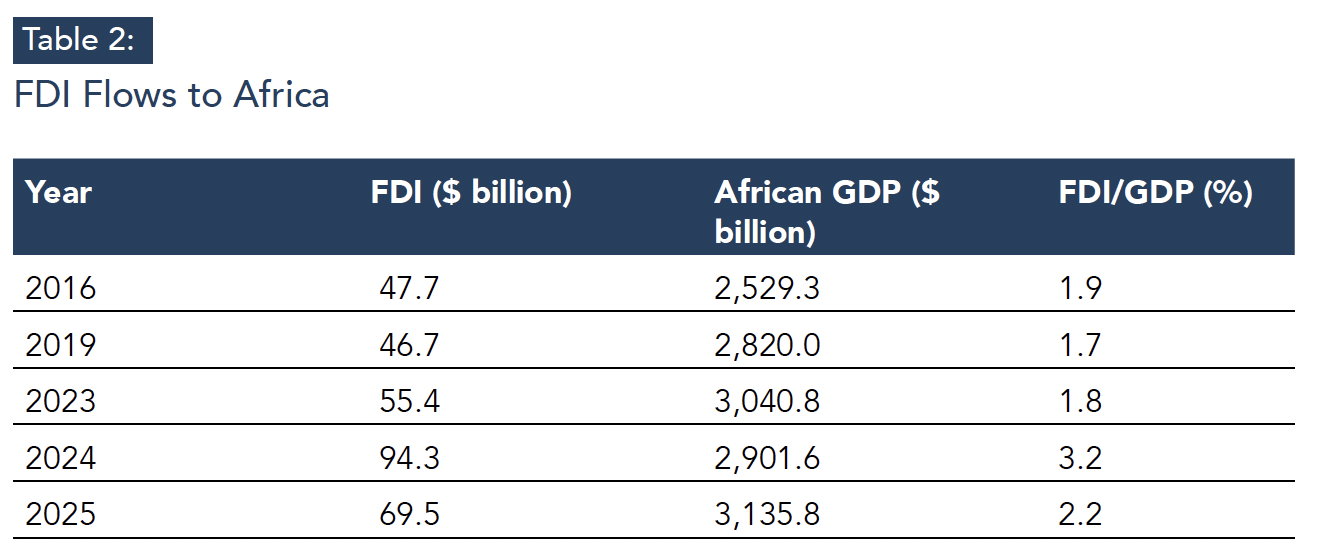
FDI to Africa did not decline as a result of geoeconomic fragmentation. It may even be increasing. Table 2 (below) shows that FDI to Africa has fluctuated from year to year, reflecting the implementation of lumpy investments, but it has remained on an upward trajectory. In nominal dollar terms, FDI to Africa rose from $47.7 billion in 2016 to $69.5 billion in 2025. In relative terms, it rose from 1.9% of African GDP in 2016 to 2.2% in 2025. Close to half of the FDI to Africa in 2025 went to low-income countries.
Source: UNCTAD (2026), IMF (2026), and author’s calculations.
There are four possible explanations for why FDI to Africa has not declined despite geoeconomic fragmentation. First, most African countries have adopted a policy of non-alignment—or, alternatively, poly-alignment—and both China and the West have been trying to attract them to their side, partly through economic incentives, including FDI. Second, FDI is following raw materials. About one-third of the world’s known reserves of critical minerals are in Africa, and the superpowers are competing for control over them, often by investing in African mines. Moreover, two-thirds of the world’s remaining uncultivated arable land is in Africa, which makes the continent attractive for investments in agriculture and food production. Third, Africa’s strategic position is attractive to investors in transport and logistics, especially as Gulf countries are seeking ways to reduce their vulnerability to the closure of the Strait of Hormuz. Fourth, Africa has a young and growing population, which offers an expanding and dynamic market for Chinese as well as Western goods. Some companies prefer to move all or part of their production facilities closer to their potential markets.
Most African countries have avoided aligning too closely with one geopolitical camp or another. They seek partnerships with the US as well as with China. A good description of this African stance can be found in the response of the South African Ministry of International Relations and Cooperation to comments made by the US Ambassador to South Africa. In this response, South Africa clearly states that it refuses to be drawn into geopolitical contestations or pressured to take sides, and that it reserves the right to cultivate bilateral relations across the political spectrum. The policy of not taking sides in the superpower rivalry is supported by African public opinion. According to opinion polls carried out by Afrobarometer, 62% of Africans view China’s role on the continent positively and 52% view the US’s role positively. Africans want to work with both camps.
Naturally, neither the US nor China are satisfied with the non-aligned position of African countries, and both are trying to convince them to join their side. They often use FDI as a carrot. McCauley et al. (2026) describe how both the US and China have been increasing FDI to Africa as a way of projecting soft power and encouraging African countries to join their respective camps. According to McCauley et al., Africans have been happy to host the FDI, but they have not changed their non-aligned position.
Because they are so important for many military and civilian applications, critical minerals are high on the economic and national security agendas of world powers. China is the dominant player in processing and refining critical minerals, except for nickel where Indonesia is the dominant player. China’s share of the processing and refining of critical minerals, excluding nickel, is more than 70%. The United States considers this situation a national security vulnerability and is taking urgent measures to reduce its dependence on imports from China. Two executive orders—a 2025 executive order and a 2026 executive order—established policies and activities that aim to ensure a reliable supply of critical minerals in the US by increasing domestic production and entering into new agreements with foreign partners. Similarly, the EU is trying to diversify its supply chains for critical minerals to ensure greater stability and lower the risk of disruptions. It passed the Critical Raw Materials Act and the RESourceEU action plan. The UK also developed its own critical minerals strategy.
UNCTAD (2026) explains that the rising demand for critical minerals is one of the main reasons why investors are committing increasing volumes of capital to Africa despite geopolitical tensions and a more selective global investment climate. This also explains why nearly half of the FDI to Africa in 2025 went to least developed countries, whose main attraction is that they are resource-rich. More FDI is flowing to countries such as Guinea, the Democratic Republic of Congo (DRC), and Zambia.
The war in Ukraine has affected cereal exports from the Black Sea region, while the war involving Iran has reduced access to fertilizers. Thus, geopolitical instability is increasing food insecurity worldwide. Ensuring food security is another reason why foreign investors, especially from the Gulf, continue to be interested in Africa. About half of all calories consumed in the Arab world are imported, and this dependence on the outside world for food security is bound to increase as Gulf populations grow, and as climate change makes local agriculture even more challenging. That is why Gulf investments in African agriculture are increasing. The UAE’s Al Dahra is investing in farming projects in Egypt, Morocco and Nigeria, with the objective of enhancing the UAE’s food security. Similarly, Saudi Arabia’s Salic/Olam and Qatar’s Hassad Food are increasing investments in African agriculture, including in Nigeria and Sudan.
Geopolitical instability, particularly the war in the Middle East, is affecting maritime transport and logistics and is driving increased FDI to Africa’s ports. The war involving Iran and the closure of the Strait of Hormuz have highlighted the need for Gulf countries to develop alternative shipping routes to avoid being completely dependent on one or two chokepoints. This provides the rationale for increased Gulf investments in African ports and logistics infrastructure. Gulf countries have increased investment in Red Sea ports in the Horn of Africa and in Egypt, where they support the Suez-Mediterranean (SUMED) pipeline that moves oil from the Red Sea port of Ain El-Sokhna to the Mediterranean port of Sidi Kerir—avoiding the Strait of Hormuz, the Bab El-Mandab and the Suez Canal.
Not all FDI to Africa is driven by geopolitical concerns. Some FDI is driven by long-term economic calculations and the need to enhance access to Africa’s consumer markets. Africa’s population is growing faster than that of any other region of the world. By 2050, one-quarter of the world’s population will be African, and by 2100 this ratio will rise to 40%. With a median age of less than 20 years, Africa is the youngest region in the world. The median age is 32 years in Latin America, 33 years in Asia, 39 years in North America, and 43 years in Europe. Thus, Africa is one of the most dynamic markets in the world, with consumption growing at about 4% in 2026, the same as in Asia, but about double the consumption growth in Latin America, at 2%, and more than double the growth in North America and Europe, at 1.9% and 1.4%, respectively. Foreign investments in the manufacturing sectors of some of the large and fast-growing African markets, such as Nigeria, Ethiopia, and Egypt, often aim simply to expand market access, with little or no geopolitical motivation.
As shown in Table 3 (below), the EU and the UK continue to be the largest investors in Africa, holding FDI stocks at the end of 2024 of $260.4 billion and $67.0 billion, respectively. Within the EU, France and Italy are important investors, as is the Netherlands, although its investment is heavily focused on South Africa. China and the US trail the former colonial powers with investment stocks of $43.8 billion and $41.4 billion, respectively. On the other hand, China is Africa’s largest creditor, with Chinese public or publicly guaranteed debt outstanding and disbursed (DOD) to Africa standing at $82.8 billion at the end of 2024, greater than the debt of the three other partners combined.
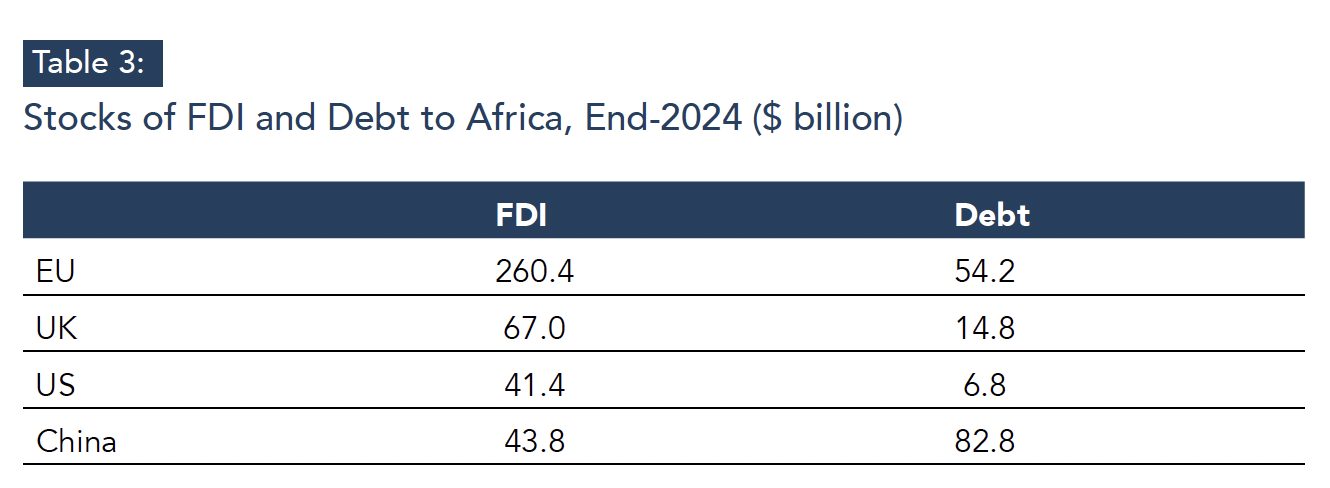
Source: Debt data are from the International Debt Statistics, EU FDI is from Eurostat, UK FDI is from the ONS, US FDI is from the BEA, and Chinese FDI is from the China-Africa Research Initiative.
Among the new investors in Africa, the UAE appears to be the most ambitious. According to its Ministry of Foreign Affairs, the UAE invested $144 billion in Africa between 2020 and 2024, which makes it the second largest investor on the continent after the EU. If this rate of investment continues, it could quickly overtake the EU as Africa’s main investment partner. Saudi Arabia is also prioritizing investment in Africa and announced plans for new FDI of about $25 billion over the next 10 years. India is another important investor in Africa, especially in Mauritius, and UNCTAD reports that the stock of India’s FDI in Africa stood at $16 billion at the end of 2023. Finally, the Turkish government estimates that Türkiye’s stock of FDI in Africa stood at more than $10 billion at the end of 2024.
Five countries receive more than 60% of total FDI to Africa, and new projects are mostly in extractive sectors. The top five recipients of FDI on the continent are South Africa, followed by Egypt, Ethiopia, Mozambique and Senegal. The top sectors for announced greenfield FDI in 2023-24 were renewable energy; coal, oil and gas; and metals—reflecting strong investor interest in both energy and resource extraction.
It is important to note the critical role played by intra-African FDI. Calculations using IMF data indicate that the stock of intra-African FDI at the end of 2024 was about $110 billion, which is higher than FDI from China, the UK or the US. According to Agarwal et al., the African countries investing most in other countries on the continent are Mauritius, South Africa, Nigeria, and Morocco. The data for Mauritius need to be interpreted carefully because Mauritius is a financial center. Hence, many of the investments from Mauritius originate elsewhere. Mauritius accounts for more than $40 billion of the stock of intra-African FDI. Removing Mauritius’s contribution would reduce the stock of intra-African FDI to only $70 billion. Most intra-African FDI went to mining, followed by finance and insurance, and then manufacturing.
4. What Are the Policy Implications for Africa?
African countries could capitalize on the present geopolitical situation to increase the volume of FDI and improve its developmental impact. To do so successfully they will need to: (1) negotiate better agreements with foreign investors; (2) improve their legal and regulatory frameworks for FDI and enhance the quality of their infrastructure; and (3) improve intra-African cooperation and coordination and fully implement the African Continental Free Trade Area (AfCFTA).
Trade and investment agreements play a central role in shaping relationships between investing and receiving countries. Increased competition between global powers for access to natural resources provides a unique opportunity for African countries to capture more economic benefits from their resources. Africa can negotiate better investment agreements.
The starting point for successful negotiations is a clear definition of objectives. What should African countries be aiming for as they negotiate with foreign investors? President John Mahama of Ghana has provided a clear answer: Africa must turn mineral wealth into jobs and shared prosperity. Governments must prioritize local processing, manufacturing, and stronger participation by African businesses to increase local value addition. According to President Mahama: “African minerals must leave our ports as EV batteries, as electric cables and transformers, as finished aluminum parts, as rare earth magnets, and value-added products.” In other words, the old colonial economic model, where Africa exported its raw materials and imported finished products, must end.
Increasing local African processing and value addition would lead to a much-needed increase in job creation. About 13.2 million young Africans enter the job market every year—12 million in Sub-Saharan Africa and 1.2 million in North Africa. Only about 3 million formal sector jobs are created each year. The vast majority of African youth end up in low-productivity, low-paid, and insecure informal jobs. Increasingly, these young people in the informal sector have completed high school, and in some cases even university. The result is a large segment of the African population that is educated and yet feels excluded from the modern economy, with very little hope for the future. This increases the risk of social and political instability. It also provides a strong incentive for young Africans to migrate. That is why ensuring that new FDI contributes to value addition and job creation on the continent should be a key objective of African governments and their partners.
The increased competition between existing global powers and rising middle powers offers Africa an opportunity to renew and modernize its partnerships. With a clear vision of what they want to achieve, and a long-term strategy for achieving it, African countries can use the leverage provided by the resources they possess to negotiate partnerships that could yield the capital and technology they need. To take advantage of these new opportunities, countries need to strengthen their technical and legal negotiation capacities by supporting advisory services and capacity-building programs for civil servants. African countries need to support negotiation frameworks that tie access to raw materials to measurable development goals—e.g. local value addition, workforce development, or technology transfer. This implies adopting negotiation models conducive to long-term partnerships rather than short-term access to resources.
Countries that are attractive to FDI can negotiate better deals with investors. That is why it is important that African countries put in place policy and legal frameworks supportive of FDI. Natural resources and market size are important. But political and macroeconomic stability, a conducive legal and regulatory environment, and strong and transparent institutions are also key determinants of FDI. Moreover, FDI is sensitive to the quality of infrastructure. Mensah and Traore (2024) show how the arrival of high-speed internet to Africa triggered more FDI, and that access to “hard” infrastructure—such as electricity and roads—amplifies the impact of internet connections.
Cooperation and coordination between African countries are important to strengthen Africa’s negotiating position. Most African countries are too small to negotiate with global powers from a position of strength. Regional coordination is necessary to enhance bargaining power. Coordinated regional policies and negotiating positions would give African countries more voice in discussions with large multinational corporations and major powers. For example, Ghanem (2026) proposes the creation of an African Critical Minerals Exporters Platform to help African countries negotiate more effectively with China, the US and Europe, while asserting strong control over their own development trajectories.
Full implementation of the AfCFTA, by increasing market size, would have a strong impact on FDI to Africa. The AfCFTA could be a powerful tool to attract FDI to the continent. It creates a huge market of 1.3 billion people, including a rapidly growing middle class, and a combined GDP of more than $3.4 trillion. Echandi et al. (2022) estimate that implementing the AfCFTA could lead to an increase in FDI to Africa of 111-159%, driven by an increase in intra-African FDI of 54-68% and an increase in FDI from outside Africa of 86-122%. As Africa becomes an increasingly attractive FDI destination, it will be in a better position to negotiate agreements that ensure that this FDI supports its development and jobs agendas.
5. Concluding Remarks
“The future of the world is in Africa.” Africa has the resources and the people that will help define the 21st century. This is why it is not surprising that world powers are competing for greater access to the continent’s natural resources and consumer markets. Great power rivalries provide an opportunity for Africa to attract more investment to support its development agenda. But the focus should not be only on the volume of FDI; its quality is also very important. Africa needs FDI that will maximize domestic value addition, create good jobs for its youth, and transfer technology and knowledge. Geopolitics is playing in Africa’s favor, and the continent should be able to negotiate long-term partnerships with investors to achieve its development objectives. Success would require action at two levels. First, at the national level, countries need to put in place policies and institutions that are supportive of foreign investment and invest in the necessary infrastructure. Second, at the regional level, African countries should coordinate their negotiating positions and implement the AfCFTA to create a large continental market that attracts more investment. Now is the time for Africa to move beyond the old economic structure in which it was merely an exporter of raw materials and an importer of finished goods. Africa should be processing its own resources and creating jobs and wealth for its youth on the continent.
____________________________________________________________________________________
- See OECD (2026).
- See One Data (2025).
- See African Security Analysis (2026).
- For more on the competition for critical minerals, see Canuto and Emran (2025).
- See IMF (2023).
- See, for example, this report by the US’s Congressional Research Service.
- See IEA (2026).
- See Al Dahra, Olam and Hassad.
- See the UN World Population Prospects.
- See IMF, World Economic Outlook (2026).
- See Agarwal et al. (2024).
- See Barsauskaite et al. (2025).
- See Brauch et al. (2025).
- Asiedu (2005) analyses data from 22 African countries and concludes that policies and infrastructure are important, alongside market size and access to resources.
- See Nguemeko (2026).
- President Joe Biden, December 3, 2024.
- See remarks by World Bank President Ajay Banga on July 17, 2025.