Publications /
Research Paper

Back
A Framework to Assess Services as a Driver for Economic Growth and Structural Transformation
Authors
March 12, 2026

Historically, manufacturing has served as the primary pathway to economic development, offering strong scale economies, learning-by-doing effects, and the capacity to generate the foreign exchange necessary to import capital goods and technology. However, advances in robotization and artificial intelligence (AI) are fundamentally undermining manufacturing’s traditional role, making it increasingly skill- and capital-intensive while limiting its ability to absorb labor. This technological transformation forces developing countries to consider service-led development strategies, but most services exhibit low productivity, limited tradability, and minimal capacity to generate foreign exchange. 

This paper is the first in a series to develop a methodology to identify and assess which specific services can serve as drivers for growth and structural transformation for the Global South. It proposes an analytical framework that classifies services into three categories: i) Knowledge Services (ICT and professional business services) which exhibit manufacturing-like characteristics such as tradability and foreign exchange generation capacity; ii) Enabling Services (transport, logistics, finance) which facilitate trade but generate limited independent value capture; and iii) Local Services (retail, hospitality, health, education, arts, and personal services) which absorb labor but cannot drive export-led growth. Critically, the paper addresses the education and health sectors separately, recognizing that, while they function as Local Services, they constitute essential foundational investments that enable the development of Knowledge Services. A companion paper applies this framework to assess the performance of the services sector of three North African countries: Egypt, Morocco, and Tunisia. 

To establish a benchmark against which developing countries can be assessed, we apply this framework empirically to EU15 economies over the period 2010–2022 using OECD Trade in Value Added (TiVA), Trade in Employment (TiM), and inter-country input-output tables, measuring performance across sectoral GDP and employment shares, productivity levels, external integration indicators, employment embodied in external demand, Hirschman-Rasmussen backward and forward linkages, and Leontief employment multipliers. The EU15 evidence shows that successful service-led development is not simply about expanding services in aggregate, but about shifting the internal composition of services toward Knowledge Services while maintaining efficient Enabling Services—precisely the pattern absent in countries that participate in GVCs without capturing significant value. 
RELATED CONTENT

  • Authors
    Youssef El Jai
    April 28, 2020
    Dans le combat contre la pandémie du Covid-19, le Maroc a choisi de fermer ses frontières aériennes, maritimes et terrestres pour contenir la propagation du virus. En décrétant, par la suite, un confinement strict, les autorités actaient l’arrêt partiel de l’économie, avec la mise en place de mesures d’aide en faveur des catégories précaires et des entreprises rencontrant des difficultés sous la houlette du Comité de Veille économique (CVE). Le ralentissement de l’économie a conduit ...
  • Authors
    Seleman Yusuph Kitenge
    April 24, 2020
    Globalization has major linkages to the spread of diseases. This paper analyses the link between globalization and the COVID-19 pandemic and provides an overview of how Africa’s economy is being impacted by this new disease. It highlights the impacts on GDP growth and economic sectors. It provides recommendations of what should be done by African governments to address the problem. It concludes by calling on African governments to consider the socio-economic circumstances of their p ...
  • Authors
    Francisco Cordoba Otalora
    April 21, 2020
    We are entering an economic cycle with a changing nature of consumption focusing on necessities. It seems like the times of luxury, entertainment and vacations are over, at least until the discovery of a vaccine for COVID-19. The unfolding of the health crisis that we have been witnessing in Italy, Spain and other advanced economies will not be as severe as the economic crisis that the Coronavirus will unleash. The International Monetary Fund has been warning us that the financial ...
  • Authors
    Natalia Cotarelli
    Thiago Cavalcante Simonato
    Vinicius Almeida Vale
    Jaqueline Coelho Visentin
    April 18, 2020
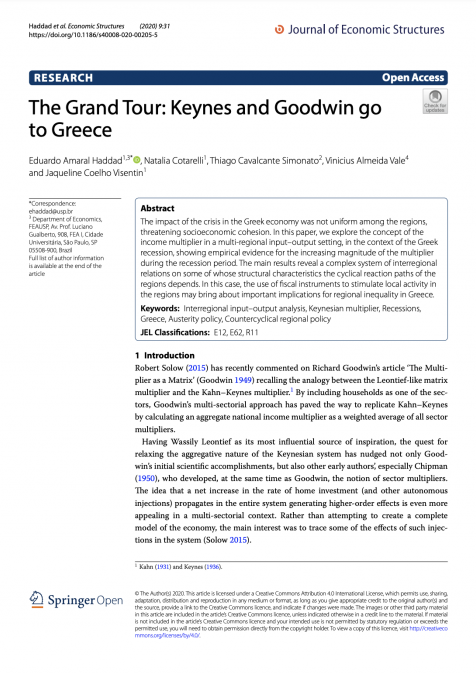
    The impact of the crisis in the Greek economy was not uniform among the regions, threatening socioeconomic cohesion. In this paper, we explore the concept of the income multiplier in a multi-regional input–output setting, in the context of the Greek recession, showing empirical evidence for the increasing magnitude of the multiplier during the recession period. The main results reveal a complex system of interregional relations on some of whose structural characteristics the cyclica ...
  • Authors
    April 17, 2020
    The COVID-19 pandemic threatens to wreak more havoc in developing countries than in developed countries, because of the crumbling healthcare systems and infrastructures in the former, their inadequate budgetary resources, shallow financial systems, and weak government authority and capability. This impact has not yet shown up in cross-country data, possibly reflecting extensive under-reporting and/or less testing for COVID-19 done in developing countries. Policymakers in these count ...
  • Authors
    Meriem Oudmane
    April 16, 2020
    La crise sanitaire du Covid-19 a montré plusieurs fragilités et limites du système économique mondial. En plus de son impact très négatif sur l’économie, cette crise a des impacts sociaux très inégaux et qui varient d’une couche sociale à une autre. Elle a un impact dévastateur sur les ménages pauvres qui n’ont pas suffisamment d’épargne et de ressources financières et ceux ayant des emplois vulnérables[1]. Si le télétravail est une option pour certains, ce n’est pas le cas pour plu ...
  • Authors
    Yonas Adeto
    Thomas Gomart
    Paolo Magri
    Greg Mills
    Karin Von Hippel
    Guntram Wolff
    April 9, 2020
    Alors que le coronavirus se propage à travers le monde, la capacité d’atténuer son impact est liée aux ressources disponibles et à l’efficacité des autorités publiques. Voilà pourquoi il nous paraît primordial que les dirigeants internationaux se concentrent sur les conséquences de la pandémie sur les plus vulnérables, en particulier en Afrique. Il y a trois mois, le 31 décembre, les autorités chinoises informaient le bureau de Pékin de l’Organisation mondiale de la santé (OMS) d’ ...
  • Authors
    April 3, 2020
    His delicate, almost floating touches created a hitherto unseen aesthetic perfection: the enigmatic face the Mona Lisa. The mysterious woman, captured on a panel of poplar wood, is the work of a genius, possibly one of the greatest minds in human history: Leonardo da Vinci. But Da Vinci also had another obsession: the art of war. In a letter to the court of Ludovico Sforza, then ruler of Milan, the celebrated maestro wrote, “I will make covered vehicles, safe and unassailable ...
  • Authors
    Amanda O. Mathe
    April 3, 2020
    The Mara Group, producer of the Mara smartphone, has set up manufacturing facilities in two key strategic countries, Rwanda and South Africa, with a total estimated investment of $100 million. On the back of political shifts in South Africa, President Cyril Ramaphosa embarked on an investment drive, announced in his state of the nation address in 2018. This was followed up with an investment conference, at which Ashish Thakkar, CEO of Mara Group, announced a $100 million investment ...
  • Authors
    Carolina Zuheill Rosales
    April 1, 2020
    The Multidimensional Poverty Index provided for the UNDP (United Nations Developed Program) looks beyond monetary income and shows how poverty is the experience of multiple and simultaneous deprivations. People can fall behind in terms of health, education, and living standards, with challenges including lack of access to drinking water, sanitation, adequate nutrition, or primary education. Those who are deprived of at least one third of the index’s components are classified as mult ...