Secteur Aéronautique face au Covid 19 : Répercussions, Perspectives de sorties, Avenir ...

May 5, 2020

· Présentation de la situation actuelle du secteur aéronautique face au Covid 19 · Répercussions sur le secteur aéronautique · Perspectives de sorties de la crise · L’avenir du secteur aéronautique … Modérateur : Larabi Jaidi, Senior Fellow, Policy Center for the New South Intervenants : . Pedro Da Motta Veiga , Directeur , CINDES - Centre d'études sur l'intégration et le développement . Alfredo Valladao, Senior Fellow, Policy Center for the New South

Speakers

Larabi Jaïdi
Senior Fellow
Larabi Jaïdi is a Senior Fellow at the Policy Center for the New South and an Affiliate Professor at Mohammed VI Polytechnic University. His areas of expertise include international economy, economic policies, international economic relations, regional economies, social development, international relations, and Mediterranean studies. He also served on the Special Commission on the New Development Model of Morocco, a consultative body created in November 2019 to formulate the country's new developmental guidelines. Jaïdi is a former Professor at Mohamed V University in Rabat-Agdal and a founding member of both the Centre Marocain de Conjoncture and the Groupement d’Etudes et de Recherches sur la Méditerranée.   Prof. Jaïdi previously served as Advisor to the Prime Minist ...

Pedro da Motta Veiga
President, CINDES
Pedro da Motta Veiga is the President of CINDES – Centro for Studies on Integration and Development – an independent think tank based in Rio de Janeiro and working on trade, investment and global issues. He is also Senior Fellow at CEBRI – the Brazilian Center for International Relations, a non-resident fellow at Rice University’s Baker Institute for Public Policy – Latin America Initiative, and a partner at Ecostrat, a consulting firm. ...
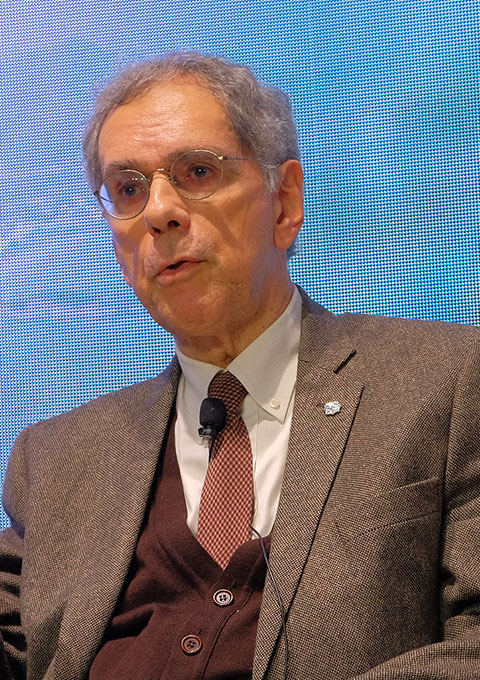
Alfredo Da Gama e Abreu Valladão
Senior Fellow
Alfredo G. A. Valladão is Senior Fellow at Policy Center for the New South and Professor at the Paris School of International Affairs (PSIA) of Sciences Po Paris, who focuses on international affairs, geopolitics, global economics, Brazil and Latin America. Alongside these positions, he is President of the Advisory Board at EU-Brazil association in Brussels, Member International Advisory Board of CEBRI (Brazilian Center for International Relations – Rio de Janeiro), Member of the Comité des Rencontres Internationales de Genève (RIG), Director of the Latin America Research Chair at CESEM-HEM in Morocco and a columnist for Radio France Internationale (RFI). Former member of the Board of Trustees of UNITAR (2009-1015), and former Director of the Mercosur Chair of Sciences Po (199 ...


RELATED CONTENT

  • Authors
    December 3, 2025
     Global GDP growth has proven resilient in 2025, despite the shocks caused by the trade policies implemented by United States President Donald Trump in the first year after his return to office. The gloomy projections offered by multilateral and private institutions in the first quarter of 2025 have given way to revised levels mostly in the 2.5% to 3% range for the year. ...
  • December 2, 2025
    في هذه الحلقة، نحاول اكتشاف ما الذي يجعل المغرب يعيش اليوم تحولاً لافتاً في عالم المدفوعات الرقمية. كيف أصبحت التكنولوجيا المالية أحد مفاتيح الشمول المالي ومحركاً لنمو جديد؟ وكيف يغيّر الاعتماد المتزايد لوسائل الدفع الحديثة حياة التجار الصغار والمقاولات الصغيرة والمتوسطة ويخلق لهم فرصاً...
  • Authors
    December 2, 2025
    This paper assesses the economic and environmental implications of Morocco’s strategic transition from internal combustion engine vehicle (ICEV) manufacturing to electric vehicle (EV) production, with a particular focus on the regional impacts of localizing high-value battery manufacturing. Using an interregional input-output model, extended with environmental satellite accounts, the study simulates a structural shock related to the wholesale substitution of ICEV-specific inputs wit ...
  • November 25, 2025
    This Policy Paper analyses the Fourth Industrial Revolution (4IR) through the critical lens of technological colonialism. It argues that the fusion of physical, digital, and biological technologies is not merely a technical phenomenon but a civilizational shift reshaping the foundations of global power. The article traces a historical continuum from previous industrial revolutions, demonstrating how patterns of inequality and extraction persist, now transposed into the digital realm ...
  • Authors
    November 21, 2025
    This report addresses the business environment in Brazil as one of the determinants responsible for the weak evolution of productivity in recent decades. After addressing this productivity performance, we define what constitutes the business environment, using as a reference the three ways in which the World Bank has been addressing the subject.Next, we highlight how the business environment affects productivity in a country. Finally, we review some recent reforms in the country's b ...
  • Authors
    Lahcen Oulhaj
    November 19, 2025
    La modélisation classique de la croissance repose sur des outils – notamment la fonction de production agrégée et la comptabilité de la croissance – dont les incohérences logiques et les ambiguïtés épistémologiques sont connues depuis la Controverse de Cambridge et les travaux d’Anwar Shaikh. Pourtant, ces failles continuent d’alimenter des raisonnements fallacieux dans le débat économique et les discours institutionnels. Cet article montre que la nature tautologique de ces outils n ...
  • Authors
    Arkebe Oqubay
    November 17, 2025
    Morocco has emerged as one of Africa's success stories, achieving significant progress in economic transformation and the green transition over the past 25 years. Continuing and deepening this transformation is essential to reach the country’s goal of becoming a high-income economy in the coming decades. Significant challenges include managing the risk of the middle-income trap, addressing demographic pressures, promoting inclusive growth, ensuring environmental sustainability, and ...
  • Authors
    October 22, 2025
    This blog was originaly published on orfonline.org. The maritime cities of the 21st century are not merely legacies of the industrial age. Rather, they are becoming platforms of global connectivity and engines of economic transformation. As global trade shifts toward digital platforms and multimodal logistics, the traditional harbour is transforming into a 'Blue City' - a modern coastal centre where trade finance, service industries, and skilled workers are considered as k ...
  • October 10, 2025
    This episode of the Policy Center for the New South Podcast features Dr. Hung Q.Tran, Senior Fellow, discussing the tokenization of money and its impact on the global financial system. He ...
  • Authors
    Jorge Arbache
    October 9, 2025
    Conventional wisdom holds that the United States has undergone massive deindustrialization in recent decades, with the country's manufacturing sector supposedly withering as it lost ground to China. This narrative has fueled debates about industrial policy, economic nationalism, and the reshoring of manufacturing production. But what if this story is only partially true? What if, instead of disappearing, American industry simply changed its address?  ...