Publications /
Research Paper

Back
A Framework to Assess Services as a Driver for Economic Growth and Structural Transformation
Authors
March 12, 2026

Historically, manufacturing has served as the primary pathway to economic development, offering strong scale economies, learning-by-doing effects, and the capacity to generate the foreign exchange necessary to import capital goods and technology. However, advances in robotization and artificial intelligence (AI) are fundamentally undermining manufacturing’s traditional role, making it increasingly skill- and capital-intensive while limiting its ability to absorb labor. This technological transformation forces developing countries to consider service-led development strategies, but most services exhibit low productivity, limited tradability, and minimal capacity to generate foreign exchange. 

This paper is the first in a series to develop a methodology to identify and assess which specific services can serve as drivers for growth and structural transformation for the Global South. It proposes an analytical framework that classifies services into three categories: i) Knowledge Services (ICT and professional business services) which exhibit manufacturing-like characteristics such as tradability and foreign exchange generation capacity; ii) Enabling Services (transport, logistics, finance) which facilitate trade but generate limited independent value capture; and iii) Local Services (retail, hospitality, health, education, arts, and personal services) which absorb labor but cannot drive export-led growth. Critically, the paper addresses the education and health sectors separately, recognizing that, while they function as Local Services, they constitute essential foundational investments that enable the development of Knowledge Services. A companion paper applies this framework to assess the performance of the services sector of three North African countries: Egypt, Morocco, and Tunisia. 

To establish a benchmark against which developing countries can be assessed, we apply this framework empirically to EU15 economies over the period 2010–2022 using OECD Trade in Value Added (TiVA), Trade in Employment (TiM), and inter-country input-output tables, measuring performance across sectoral GDP and employment shares, productivity levels, external integration indicators, employment embodied in external demand, Hirschman-Rasmussen backward and forward linkages, and Leontief employment multipliers. The EU15 evidence shows that successful service-led development is not simply about expanding services in aggregate, but about shifting the internal composition of services toward Knowledge Services while maintaining efficient Enabling Services—precisely the pattern absent in countries that participate in GVCs without capturing significant value. 

RELATED CONTENT

  • Authors
    Sabine Cessou
    May 17, 2019
    Sur quelles contraintes faut-il anticiper lorsqu’on évoque la croissance de l’Afrique? Comment guider les décideurs politiques dans les priorités à définir pour piloter l’économie et arriver à bon port dans le monde qui vient? Le séminaire organisé le 11 avril à Paris par le PCNS et le Centre de développement de l’OCDE a apporté des éléments de réponse. La discussion s’est ouverte en prenant appui sur le rapport de référence publié en 2018 par l’Union africaine et l’OCDE ...
  • Authors
    Bouchra Rahmouni
    April 30, 2019
    In a globalized world, the ability of countries to innovate is crucial to creating high levels of value added and enhancing economic competitiveness. Silicon Valley, USA, is a development model that many African countries seek to emulate by creating «African Valleys». The success of major US corporations has persuaded a great number of players that new technologies are essential drivers of growth, and several states have implemented policies to stimulate the development of start-ups ...
  • Authors
    Ghita El Kasri
    April 25, 2019
    The author is an alumnus of the 2018 Atlantic Dialogues Emerging Leaders program Tech industries, despite leading the charge for change in many areas of modern life, have traditionally been one of the worst industries for gender equality. But now, it looks like technology itself could finally start to break down some of the barriers to entry and alter the socio-economic landscape beyond recognition. It could put women and under-represented minorities on the financial and ...
  • Authors
    Mouhamadou Moustapha Ly
    April 18, 2019
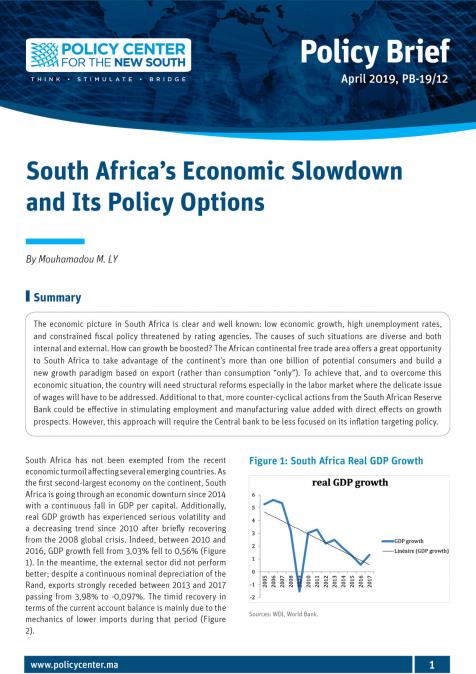
    The economic picture in South Africa is clear and well known: low economic growth, high unemployment rates, and constrained fiscal policy threatened by rating agencies. The causes of such situations are diverse and both internal and external. How can growth be boosted? The African continental free trade area offers a great opportunity to South Africa to take advantage of the continent’s more than one billion of potential consumers and build a new growth paradigm based on export (rat ...
  • Authors
    Lorenzo Colantoni
    Giuseppe Montesano
    Nicolò Sartori
    April 12, 2019
    Access to electricity is a key factor for the future of the African continent. Energy poverty and lack of universal access to electricity services are, in fact, remarkably hurting human progress in Africa. Today, sub-Saharan Africa hosts 14 percent of the world’s population but 60 percent of the world’s people without access to electricity: of the more than 1 billion people globally who had no access to electricity, around 600 million lived in the region. In these conditions, many A ...
  • Authors
    March 14, 2019
    China's push for Latin American consumers reflects changes back home. Chinese financing in Latin America is changing. After becoming a major source of capital flows to Latin America and the Caribbean over the past 15 years, a more diverse range of investors has surfaced, interested in channeling resources towards infrastructure, governments and state companies. The profile of the Chinese investment in the region tracks the evolution of China’s economy as it moves toward a higher r ...
  • Authors
    March 7, 2019
    A well-functioning modern infrastructure is essential for social and economic development. It has the power to change the quality of life of populations as well as the prospects of businesses. Despite developing Asia’s remarkable economic performances since the 1980s, the region still faces important difficulties in delivering adequate infrastructure services. “Over 400 million Asians do not have electricity access; 300 million live without safe drinking water and 1.5 billion withou ...
  • Authors
    Mouhamadou Moustapha Ly
    Bertrand Bio Mama
    Onasis Tharcisse A. Guèdègbé
    March 6, 2019
    L’évaluation d’impact des projets et programmes de développement est un exercice qui est de plus en plus adopté dans les pays en développement notamment ceux d’Afrique subsaharienne. Entre autres facteurs explicatifs, il y a la rareté des ressources allouées au développement mais aussi la nécessité de mieux connaître les contraintes structurelles au développement. Saisissant l’occasion de la première conférence de West Africa Capacity building and Impact Evaluation Program (WACIE-3i ...
  • Authors
    Afrique Contemporaine
    February 28, 2019
    Dans son édition n°266, la revue scientifique Afrique Contemporaine consacre son Dossier à la question de l’industrialisation en Afrique. D’après la Rédaction de la publication, le choix de la thématique s’imposait d’autant plus que « la recomposition de l’ordre mondial repose la question de la place du continent à l’échelle planétaire, en l’occurrence sur le plan économique, social et environnemental tout à la fois. » Outre la coordination du Dossier, Dr. Karim Et Aynaoui, Préside ...
  • Authors
    Yassine Msadfa
    February 25, 2019
    La transformation structurelle d’une économie demeure un point de passage nécessaire pour toute nation qui souhaite gravir les échelons du développement, cette transformation est souvent tributaire de la capacité d’une économie à s’ériger d’une société agraire de subsistance, dans son stade initial, vers une économie de productivité. Pour ce qui est du Maroc, le débat a pris de l’ampleur quant à la capacité des dynamiques actuelles à accélérer le rythme de l’activité économique au p ...