Publications /
Research Paper

Back
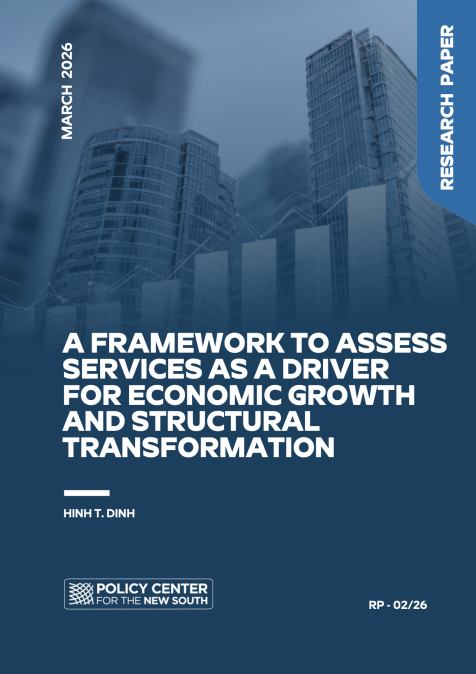
A Framework to Assess Services as a Driver for Economic Growth and Structural Transformation
Authors
March 12, 2026

Historically, manufacturing has served as the primary pathway to economic development, offering strong scale economies, learning-by-doing effects, and the capacity to generate the foreign exchange necessary to import capital goods and technology. However, advances in robotization and artificial intelligence (AI) are fundamentally undermining manufacturing’s traditional role, making it increasingly skill- and capital-intensive while limiting its ability to absorb labor. This technological transformation forces developing countries to consider service-led development strategies, but most services exhibit low productivity, limited tradability, and minimal capacity to generate foreign exchange. 

This paper is the first in a series to develop a methodology to identify and assess which specific services can serve as drivers for growth and structural transformation for the Global South. It proposes an analytical framework that classifies services into three categories: i) Knowledge Services (ICT and professional business services) which exhibit manufacturing-like characteristics such as tradability and foreign exchange generation capacity; ii) Enabling Services (transport, logistics, finance) which facilitate trade but generate limited independent value capture; and iii) Local Services (retail, hospitality, health, education, arts, and personal services) which absorb labor but cannot drive export-led growth. Critically, the paper addresses the education and health sectors separately, recognizing that, while they function as Local Services, they constitute essential foundational investments that enable the development of Knowledge Services. A companion paper applies this framework to assess the performance of the services sector of three North African countries: Egypt, Morocco, and Tunisia. 

To establish a benchmark against which developing countries can be assessed, we apply this framework empirically to EU15 economies over the period 2010–2022 using OECD Trade in Value Added (TiVA), Trade in Employment (TiM), and inter-country input-output tables, measuring performance across sectoral GDP and employment shares, productivity levels, external integration indicators, employment embodied in external demand, Hirschman-Rasmussen backward and forward linkages, and Leontief employment multipliers. The EU15 evidence shows that successful service-led development is not simply about expanding services in aggregate, but about shifting the internal composition of services toward Knowledge Services while maintaining efficient Enabling Services—precisely the pattern absent in countries that participate in GVCs without capturing significant value. 
RELATED CONTENT

  • Authors
    Manfred Hafner
    Simone Tagliapietra
    Lucia de Strasser
    October 4, 2018
    This blog post summarizes the key findings of the new book Energy in Africa: Challenges and Opportunities, co-authored by Manfred Hafner, Simone Tagliapietra and Lucia de Strasser of the Italian think-tank, Fondazione Eni Enrico Mattei. The book, published by Springer, is freely available online. The book presents a picture of the current energy challenges on the African continent- the Sub-Saharan region in particular- and proposes pathways to an accelerated energy t ...
  • Authors
    September 21, 2018
    This blog is based on remarks delivered at the Think-Tank Summit in Buenos Aires on 18 September 2018 held under the G-20’s Argentine Presidency.  Africa has an enormous infrastructure gap that impedes its development. The Compact with Africa (CwA) is an international policy initiative sponsored under the German presidency of the G-20 in 2017 designed to bridge that gap. Intended to draw in the private sector in developing Africa’s infrastructure through a combination of Priva ...
  • Authors
    Mouhamadou Moustapha Ly
    Tharcisse Guedegbe
    September 19, 2018
    La ville de Kigali, au Rwanda, a accueilli du 5 au 8 septembre 2018 le forum de l’AGRA, devenant ainsi la capitale de l’agriculture africaine pendant ces quatre journées. Délégations gouvernementales, partenaires techniques et financiers, chercheurs, universitaires, investisseurs, producteurs, club de réflexion, entre autres, étaient en conclave pour faire l’état des lieux du secteur et mesurer les progrès accomplis sur la route de la transformation de l’agriculture africaine.  ...
  • Authors
    September 5, 2018
    As the world is shifting away from conventional fossil fuels towards renewable energy sources, the power industry is starting to invest more in sustainable clean energy installations rather than the traditional large-scale infrastructures, which rely mainly on oil and coal.  Besides its environmental benefits, this shift to renewables is very likely to benefit economic growth as well. A recent study of the International Renewable Energy Agency shows that, indeed, dou ...
  • August 1, 2018
    “This article has been originally published in 'Morocco in Focus 2018,' the magazine of the Moroccan Embassy in New Delhi, India on the occasion of the Morocco National Day 2018.” Introduction In an article published last year, the author stressed the role of partnership between Morocco and India for the inclusive growth of small farmers. There is no doubt that agriculture remains a major instrument for human development both in India and in Africa. Several international reports&n ...
  • Authors
    François Gaulme
    July 20, 2018
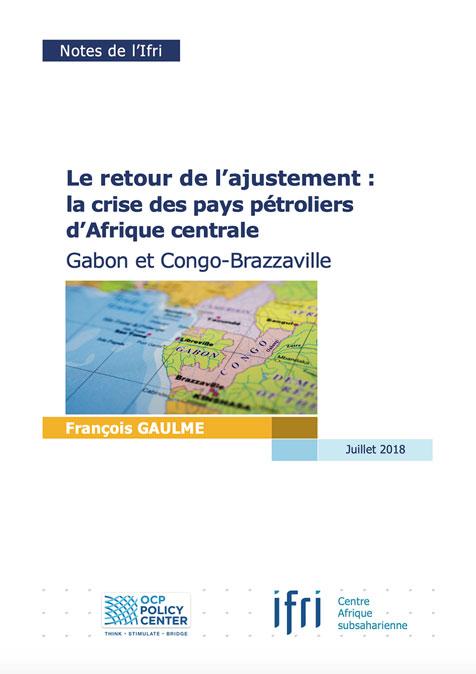
    Cette note vise à mettre en lumière le cycle d’ajustement à la fois financier, économique et politique affectant deux pétro-États d’Afrique centrale, le Gabon et la République du Congo (Congo-Brazzaville). Unis par leur système économique de rente et leur histoire coloniale commune, ces deux pays n’en ont pas moins connu des destins politiques différents après leur indépendance, le premier conservant une relation privilégiée avec la France tandis que le second optait rapidement pour ...
  • May 21, 2018
    Le partenariat Afrique Europe fait son chemin depuis l'adoption de la stratégie commune Afrique-UE et la négociation complexe des Accords de Partenariat Economiques. L’évaluation des volets commercial, financier et humain de ces relations multidimensionnelles fait ressortir la persistance de grands déséquilibres dans les échanges commerciaux de biens et services, des tensions dans la gestion de la mobilité humaine et des dysfonctionnements dans les mécanismes institutionnels de part ...
  • Authors
    May 21, 2018
    The main message of this paper is that our world is undergoing a profound transformation in multiple aspects. These, at a minimum, include the following: - the degree and manner of our acceptance of or opposition to increased integration as trading nations - the constantly evolving technologies we use, the way we work, play and interact as social groups and entire societies - the very climate that conditions our living environment. ...
  • Authors
    May 15, 2018
    Technology and inequality, China's special status, macroeconomic imbalances, and WTO dysfunction, are the challenges confronted by the world trading system, and which lie at the root of resurgent protectionism. Are the trade tensions that have been stoked by Trump unique to him or the outcome of forces that preceded him and will outlast him? ...
  • Authors
    May 10, 2018
    The April issue of the IMF’s “World Economic Outlook (WEO)” included a chapter on how globalization has helped knowledge from technology leaders spread faster than before. Cross-border technological diffusion has not only contributed to rising domestic productivity levels in advanced and emerging economies, but also facilitated a partial reshaping of the technological innovation landscape, with some recipients becoming new significant sources of research and development (R&D) an ...