Publications /
Policy Paper

Back
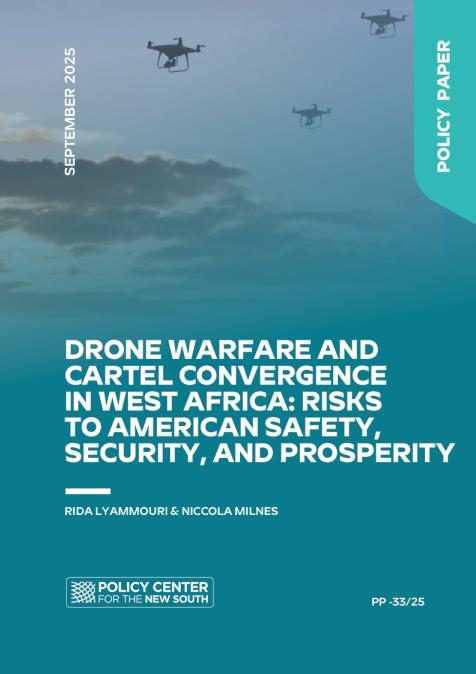
Drone Warfare and Cartel Convergence in West Africa: Risks to American Safety, Security, and Prosperity
Authors
Niccola Milnes
September 19, 2025

The convergence of armed group drone warfare and cartel expansion in the Sahel is a global problem with direct consequences for the United States. Far from being a peripheral conflict, instability in the Sahel directly affects American safety, security, and prosperity. For U.S. safety, Jama’at Nusrat al-Islam wal-Muslimin (JNIM)’s rapid shift from crude drone experiments to battlefield strikes—combined with cartel drone attacks and Ukraine-trained operatives—means tactics tested abroad can now reach Americans and U.S. border communities far more quickly than before.

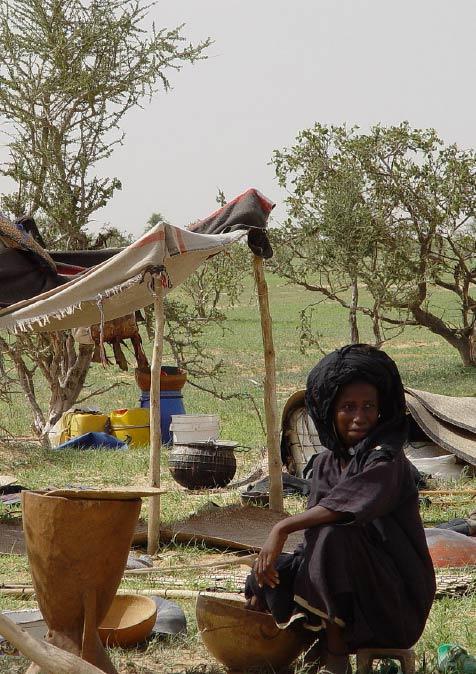
For U.S. security, the Sahel’s role as a trafficking hub links cartels and armed groups in ways that accelerate the spread of new weapons, synthetic drugs, and criminal expertise. This undermines U.S. deterrence, weakens partners, and creates openings for Russia and China to expand their influence. The recent dismantling of an ISIS financial network running through West Africa further demonstrates how the region sustains global terrorist operations with direct implications for American security. 

For U.S. prosperity, the same instability raises costs for American firms, disrupts supply chains, and channels valuable mineral and energy deals toward U.S. competitors. Early U.S. engagement—through counter-drone innovation, maritime security, and financial integrity—can contain the threat at its source and keep America safer, stronger, and more prosperous.

RELATED CONTENT

  • December 9, 2021
    A summit on the African vision of Sahel’s future with a focus on development around the 5 Sahelian Ministers of Economy and the report “Sahel: Moving Beyond Military Containment” ...
  • Authors
    November 29, 2021
    The proliferation of community-based armed groups (CBAGs) in Mali’s Mopti and Ségou Regions has contributed to transforming Central Mali into a regional epicenter of conflict since 2016. Due to the lack of adequate presence of the state, certain vulnerable, conflict-affected communities resorted to embracing non-state armed groups as security umbrellas in the context of inter-communal violence. These local conflicts are the result of long-standing issues over increasing pressure on ...
  • November 12, 2021
    Près de trois ans après l’éviction d’el-Béchir du pouvoir et la formation d’un gouvernement de transition, composé de civils et de militaires, la situation politique et économique du Soudan est loin d’être stable. Bien que des progrès aient été enregistrés depuis décembre 2018, la transition démocratique a été interrompue brutalement suite à la prise du pouvoir par le général al-Burhan et sa décision de dissoudre le gouvernement civil. Malgré le climat d’instabilité et d’incertitude ...
  • Authors
    November 9, 2021
    Events in the Sahel, and Mali especially, are taking an uncertain and worrying turn. Mali witnessed two coups d’état in less than a year, while the West African Sahel went through its most violent year yet and there are no signs that the violence is slowing down. In the midst of this unprecedented instability, recent developments involving Mali’s transitional government and the international community, France in particular, provide no assurances that things are likely to improve any ...
  • Authors
    November 2, 2021
    In the Sahel, and Central Mali in particular, the proliferation of armed groups over the past decade has resulted in formal and informal non-state governance structures. This paper assesses the various definitions and typologies associated with rebel and jihadist governance in order to better understand the mechanisms of governance provision used by key non-state governance providers in Central Mali.   ...
  • Authors
    Pascal Chaigneau
    Eugène Berg
    Rodolphe Monnet
    Jacques Gravereau
    Jérémy Ghez
    Olivier Tramond
    Niagalé Bagayoko
    Alain Oudot de Dainville
    Jérôme Evrard
    Coordination de l’ouvrage: Imane Lahrich
    Fatine Cherkaoui
    October 28, 2021
    Depuis l’accession au trône du Roi Mohammed VI, l’Afrique s’est transformée en priorité de la diplomatie marocaine. Sur le plan économique, l’Afrique est devenue le prolongement naturel du Maroc en termes d’investissements et d’implantations. Pascal Chaigneau s’attarde sur les relations affaiblies Europe-Afrique, l’ambitieuse relation Chine-Afrique ainsi que les relations entre la Russie, les Etats-Unis, la Turquie ou encore les pays du Golf et l’Afrique. Ce chapitre traite égalemen ...
  • Authors
    October 5, 2021
    Seconde nation la plus peuplée d’Afrique après le Nigeria, l’Éthiopie se distingue par un essor économique continu depuis trente ans. Des progrès notables sévèrement remis en question par le conflit avec la province du Tigré, qui dure depuis près d’un an. Pays phare de la Corne de l’Afrique, l’Éthiopie s’est distinguée par une croissance moyenne à deux chiffres (10 %) sur la période 2010-2019. Tombée à 6 % en 2020, celle-ci ne devrait pas dépasser 2 % en 2021 selon l ...
  • Authors
    Johannes Claes
    Kars de Bruijne
    Sophie Mertens
    Eman Ragab
    Clara-Auguste Süß
    September 20, 2021
    The COVID-19 pandemic has had a cataclysmic impact on all aspects of the functioning of our world. The relevance of the possibility of the spread of a global virus with the spread of terrorism is not immediately obvious as it is difficult for a direct causal link to be scientifically established. However, taking into consideration how state responses and pre-existing socioeconomic grievances can be impacted by the COVID-19 pandemic can lead to innovative findings on how terrorist gr ...