Publications /
Policy Brief

Back
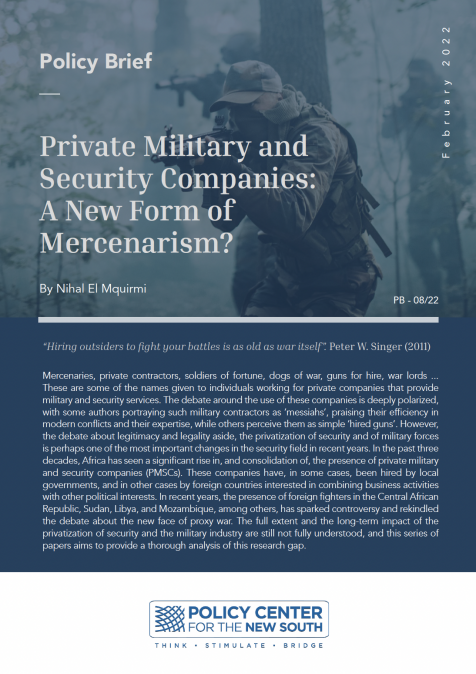
Private Military and Security Companies: A New Form of Mercenarism?
February 14, 2022

“Hiring outsiders to fight your battles is as old as war itself”. Peter W. Singer (2011)

Mercenaries, private contractors, soldiers of fortune, dogs of war, guns for hire, war lords ... These are some of the names given to individuals working for private companies that provide military and security services. The debate around the use of these companies is deeply polarized, with some authors portraying such military contractors as ‘messiahs’, praising their efficiency in modern conflicts and their expertise, while others perceive them as simple ‘hired guns’. However, the debate about legitimacy and legality aside, the privatization of security and of military forces is perhaps one of the most important changes in the security field in recent years. In the past three decades, Africa has seen a significant rise in, and consolidation of, the presence of private military and security companies (PMSCs). These companies have, in some cases, been hired by local governments, and in other cases by foreign countries interested in combining business activities with other political interests. In recent years, the presence of foreign fighters in the Central African Republic, Sudan, Libya, and Mozambique, among others, has sparked controversy and rekindled the debate about the new face of proxy war. The full extent and the long-term impact of the privatization of security and the military industry are still not fully understood, and this series of papers aims to provide a thorough analysis of this research gap.

RELATED CONTENT

  • Authors
    Niccola Milnes
    December 30, 2025
    Fuel access has become a strategic pressure point across Mali and its neighbors. In 2025, Jama’t Nusrat al Islam wal- Muslimeen (JNIM) shifted from sporadic interdictions to a deliberate fuel-blockade strategy intended to pressure Bamako without holding territory. By selectively constraining movement along the Sikasso–Kayes–Bamako corridor, the group turned fuel scarcity into a tool of coercion, governance, and narrative control—shaping behavior in the capital while remaining largel ...
  • Authors
    Chaïma Jabbar
    December 23, 2025
    Les pays membres de l’Alliance des États du Sahel (le Mali, le Burkina Faso et le Niger) demeurent dépendants d’un nombre restreint de corridors d’accès à la mer, une configuration qui limite leur capacité d’ajustement en cas de perturbation et accroît la sensibilité de leurs chaînes d’approvisionnement. Le blocus du tronçon Kayes-Nioro a illustré la forte criticité du corridor Dakar-Bamako : l’interruption d’un segment unique a entraîné une contraction rapide des flux, révélant la ...
  • Authors
    Chaïma Jabbar
    December 23, 2025
    The member countries of the Alliance of Sahel States, Mali, Burkina Faso, and Niger, remain dependent on a limited number of maritime access corridors, a configuration that constrains their adjustment capacity in the event of disruption and heightens the vulnerability of their supply chains. The Jama’at Nusrat al-Islam wa al-Muslimin (JNIM) blockade of the Kayes-Nioro area revealed how critical the Dakar-Bamako corridor is for the political and economic stability of Mali. Its interr ...
  • Authors
    Niagalé Bagayoko
    Eugène Berg
    Christophe Chabert
    Thierry Garcin
    Alain Oudot de Dainville
    Florent Parmentier
    Anne Sophie Raujol
    Hassan Saoudi
    October 23, 2025
    Prochainement disponible sur Livremoi & Amazon. Les Dialogues Stratégiques, fruit d'une collaboration entre le HEC Center for Geopolitics et le Policy Center for the New South, constituent une plateforme d'échanges biannuelle dédiée à l'analyse des grandes tendances mondiales et des problématiques régionalesqui lient l'Europe et l'Afrique. Réunissant praticiens, décideurs, universitaires et représentants desmédias, cet espace de réflexion permet de décoder les transfor ...
  • Authors
    Meryam Amarir
    October 6, 2025
    Le Soudan, en plus de la crise politique et humanitaire qui le secoue depuis des années, doit faire face à une dégradation inquiétante de son patrimoine culturel, matériel et immatériel. Particulièrement dans les zones où les combats sont les plus intenses. Le patrimoine culturel soudanais est l’autre victime de cette guerre : la destruction des sites archéologiques et le pillage des musées alimentent le trafic illicite des biens culturels et contribuent aux dynamiques d’instabilité ...
  • Authors
    Meryam Amarir
    October 6, 2025
    إلى جانب الأزمة السياسية والإنسانية التي تعصف بالسودان منذ سنوات، أضحى التراث الثقافي السوداني ضحية لهذه الحرب حيث شهد تدهوراً مقلقا، لا سيما في المناطق التي تشهد أعنف المعارك ً. فقد أدت عمليات تدمير المواقع الأثرية ونهب المتاحف إلى تغذية شبكات الاتجار غير المشروع بالممتلكات الثقافية، الأمر الذي يزيد من تفاقم ديناميات عدم الاستقرار في المنطقةوتدور رحى الحرب بين الجيش النظامي، أو القوات المسلحة السودانية (SAF) بقيادة عبد الفتاح البرهان، وبين قوات الدعم السريع، (RS ...
  • Authors
    Meryam Amarir
    October 6, 2025
    Sudan’s Heritage: Looting as a Weapon of WarSudan, in addition to the political and humanitarian crisis that has shaken the country for years, is now facing a worrying degradation of its cultural heritage, both tangible and intangible, particularly in areas where the fighting is most intense. Cultural heritage has become another victim of this war: the destruction of archaeological sites and the looting of museums fuel the illicit trafficking of cultural property and contribute to r ...
  • September 26, 2025
    Rida Lyammouri, Senior Fellow at the Policy Center for the New South, examines the rise of drone use by non-state armed groups in the Sahel. The discussion highlights how civilian drones ...
  • September 25, 2025
    This episode examines the African Peace and Security Architecture  amid evolving threats, questioning its effectiveness against modern crises such as terrorism, environmental stress, disinformation, and cyber risks. It highlights institutional and political gaps, exploring the chal...