Publications /
Paper in Academic Journals
Back
Between Brain Drain and Brain Gain: The Role of Public Guidance Policies for Moroccan International Students
October 8, 2026

This paper was originaly published on Higher Education Policy Journal


This article critically assesses the alignment between Morocco’s public guidance schemes for international students and its national development goals. Specifically, it investigates the capacity of these mechanisms to transform student mobility from a potential ‘brain drain’ into a tangible ‘brain gain’. Employing a qualitative case study approach, we conducted a systematic content analysis of 204 mobility programmes and scholarships promoted by the Ministry of Higher Education (2019–2022). These data were triangulated with semi-structured interviews with three key institutional stakeholders, selected through purposive sampling and analysed until theoretical saturation was achieved. The analysis reveals three structural weaknesses in the current policy framework: (1) a passive incentive strategy that focuses almost exclusively on funding while remaining disconnected from national skill shortages; (2) a ‘missing link’ regarding student support during the study-abroad period; and (3) a complete absence of institutional mechanisms for attracting and reintegrating graduates upon completion of their studies. Empirically, this study provides the first systematic mapping of Morocco’s outbound mobility arrangements. Theoretically, it proposes a three-phase analytical model—departure, sojourn, return—demonstrating how flawed career guidance policies can inadvertently institutionalise a passive brain drain pattern even when political discourse explicitly favours circular migration and human capital retention. The paper concludes with concrete recommendations for reframing Moroccan guidance policy and identifies the limits of guidance as a sovereign tool given the structural leverage held by destination countries.
RELATED CONTENT

  • June 26, 2026
    In Morocco, the issue of young NEETs (Not in Employment, Education, or Training) is a national emergency, fueled by 300,000 students dropping out of school each year. In response to this challenge, the “New Generation Second Chance School” (E2C-NG) model has proven its effectiveness by achieving an exceptional employment rate of 81%.However, this institutional success rests entirely on a local network of organizations that is now under strain. A previously unpublished analysis of da ...
  • June 26, 2026
    Au Maroc, la problématique des jeunes NEETs (Ni en emploi, ni en études, ni en formation) constitue une urgence nationale, alimentée par 300 000 abandons scolaires annuels. Face à ce défi, le modèle de l'École de la Deuxième chance nouvelle génération (E2C-NG) a démontré sa pertinence en affichant un taux d'insertion exceptionnel de 81 %.Cependant, ce succès institutionnel repose intégralement sur un tissu associatif local aujourd'hui fragilisé. L'analyse inédite des donné ...
  • June 15, 2026
    Ce papier a été initialement publié dans la revue Carrefours de l'éducation n°61 L’écart entre les sexes en matière de réussite éducative demeure une préoccupation majeure au Maroc. Cette étude analyse les disparités de genre en lecture et en mathématiques aux niveaux national, urbain et rural, en exploitant des données individuelles issues de l’évaluation PIRLS 2021 (7 017 élèves) et de TIMSS 2019 (13 536 élèves), toutes deux menées auprès d’élèves de 4e année du primaire. En ...
  • Authors
    Karim El Mokri
    Idriss El Abbassi
    June 8, 2026
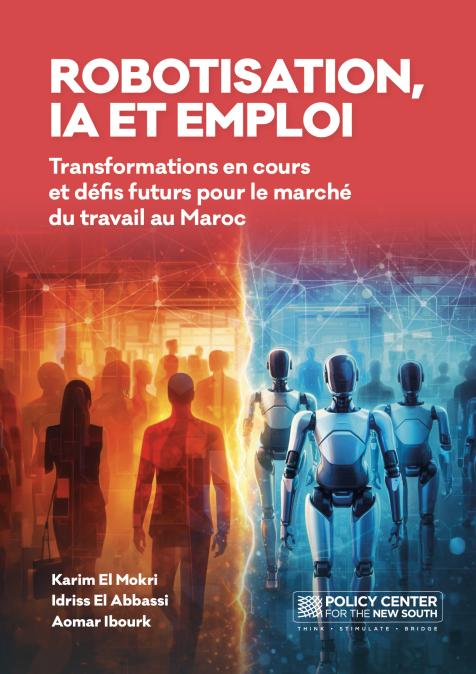
    Le monde du travail est engagé dans un processus de mutation sans précédent. La quatrième révolution industrielle, portée par l’intelligence artificielle (IA) et la robotisation, a été le point de commencement d’une ère nouvelle où les repères économiques et sociaux se redéfinissent à une vitesse inédite. Ces technologies suscitent un engouement légitime et offrent des perspectives prometteuses, mais requièrent une vigilance accrue face aux incertitudes qui les entourent.Bien que, à ...
  • April 14, 2026
    في هذه الحلقة يتم تناول دور الجامعات المغربية في تعزيز الدبلوماسية العلمية للمغرب على المستويين الإقليمي والدولي، وإمكانية تحولها إلى فاعل أساسي في القوة الناعمة الوطنية، كما يناقش أهمية الشراكات الأكاديمية والبحثية الدولية في تعزيز الإشعاع العلمي ونقل المعرفة، ويتطرق كذلك إلى أبرز التح...
  • Authors
    Khalid R. Temsamani
    February 26, 2026
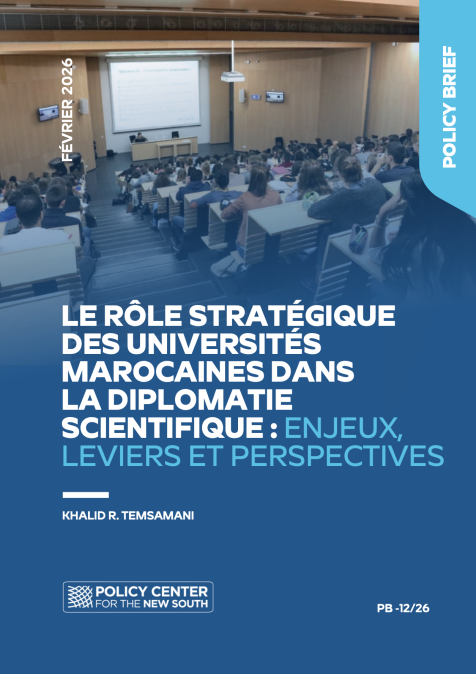
    The multiplication of systemic crises on a global scale - whether environmental, health-related, energy-related or linked to global security issues - calls for a profound change in diplomatic modes of action. In this context, the structured integration of scientific knowledge into international relations appears to be a decisive condition for the formulation of effective and legitimate collective responses. Science diplomacy is thus a strategic field of intervention, at the interfac ...
  • Authors
    Khalid R. Temsamani
    February 26, 2026
    La multiplication des crises systémiques à l’échelle mondiale – qu’elles soient environnementales, sanitaires, énergétiques ou liées aux enjeux de sécurité globale – impose une évolution profonde des modes d’action diplomatique. Dans ce contexte, l’intégration structurée des connaissances scientifiques dans les relations internationales apparaît comme une condition déterminante pour la formulation de réponses collectives efficaces et légitimes. La diplomatie scientifique s’inscrit a ...
  • January 5, 2026
    This Paper was originally published on sciencedirect.com This study provides an original and significant contribution to evaluating educational service quality in Morocco by leveraging, for the first time, microdata from the Service Delivery Indicators (SDI) survey. The survey covers a nationally representative sample of 300 public and private primary schools across rural and urban areas. The use of SDI data represents a major methodological advancement, shifting away from perc ...
  • September 16, 2025
    مع انطلاق الموسم الدراسي 2025، تواجه المدرسة المغربية تحديات جديدة تتعلق بتحسين جودة التعليم وتوسيع فرص التلاميذ في مختلف المناطق، وسط جهود مستمرة لتنفيذ الإصلاحات التربوية. في حلقة اليوم، نستضيف الأستاذ عبد اللطيف اليوسفي، خبير التعليم والمدير السابق للأكاديمية الجهوية لجهة الغرب الشرا...
  • Authors
    September 16, 2025
    Les questions des inégalités sociales et des inégalités territoriales sont profondément liées.  Les politiques publiques ne peuvent réduire l’une sans s’attaquer à l’autre.  Le phénomène des inégalités peut s’accentuer avec la fragilité de la situation socio-économique de certains territoires d’autant que le développement territorial n’est pas spontanément équitable. La réduction de ces inégalités, un des enjeux majeurs des politiques publiques, oblige à con ...