Publications /
Paper in Academic Journals
Back
Between Brain Drain and Brain Gain: The Role of Public Guidance Policies for Moroccan International Students
October 8, 2026

This paper was originaly published on Higher Education Policy Journal


This article critically assesses the alignment between Morocco’s public guidance schemes for international students and its national development goals. Specifically, it investigates the capacity of these mechanisms to transform student mobility from a potential ‘brain drain’ into a tangible ‘brain gain’. Employing a qualitative case study approach, we conducted a systematic content analysis of 204 mobility programmes and scholarships promoted by the Ministry of Higher Education (2019–2022). These data were triangulated with semi-structured interviews with three key institutional stakeholders, selected through purposive sampling and analysed until theoretical saturation was achieved. The analysis reveals three structural weaknesses in the current policy framework: (1) a passive incentive strategy that focuses almost exclusively on funding while remaining disconnected from national skill shortages; (2) a ‘missing link’ regarding student support during the study-abroad period; and (3) a complete absence of institutional mechanisms for attracting and reintegrating graduates upon completion of their studies. Empirically, this study provides the first systematic mapping of Morocco’s outbound mobility arrangements. Theoretically, it proposes a three-phase analytical model—departure, sojourn, return—demonstrating how flawed career guidance policies can inadvertently institutionalise a passive brain drain pattern even when political discourse explicitly favours circular migration and human capital retention. The paper concludes with concrete recommendations for reframing Moroccan guidance policy and identifies the limits of guidance as a sovereign tool given the structural leverage held by destination countries.

RELATED CONTENT

  • October 3, 2024
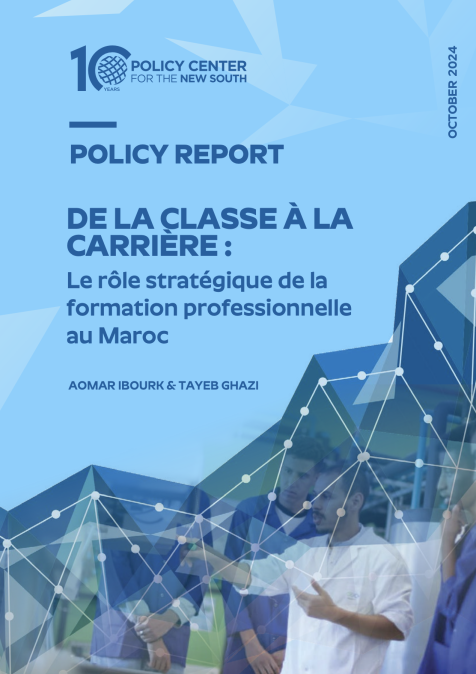
    Ce rapport explore en profondeur le rôle stratégique de la formation professionnelle au Maroc dans le contexte de l’éducation nationale et du développement socio-économique. Il examine les missions et les objectifs du département de la Formation professionnelle (DFP), en mettant l’accent sur l’alignement des compétences individuelles avec les besoins dynamiques du marché du travail. À travers une analyse détaillée, le rapport décrit l’organisation du système de formatio ...
  • Authors
    Zakaria Elouaourti
    September 26, 2024
    This Paper was originally published on emerald.com   Purpose Young graduates in Morocco are encountering an increasingly challenging labor market environment. Confronted with intense competition, job insecurity, and unclear career trajectories, many find themselves in low-skilled positions despite possessing relevant qualifications. This issue is particularly pronounced among vocational training graduates, who experience professional downgrading at a rate three times hi ...
  • May 22, 2024
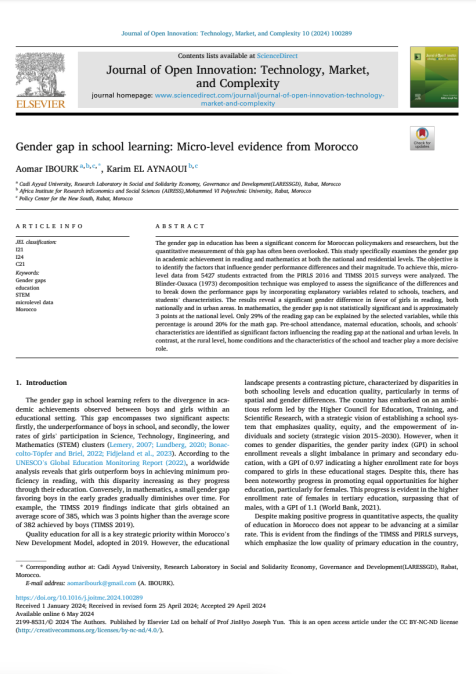
    This Paper was originally published on sciencedirect.com The gender gap in education has been a significant concern for Moroccan policymakers and researchers, but the quantitative measurement of this gap has often been overlooked. This study specifically examines the gender gap in academic achievement in reading and mathematics at both the national and residential levels. The objective is to identify the factors that influence gender performance differences and their magnitude ...
  • Authors
    January 24, 2024
    La célébration de la Journée internationale de l'éducation offre l'opportunité de mettre en lumière le rôle fondamental de l'éducation en tant que pilier essentiel à la construction d'une nation prospère. Cette réalité a toujours été prépondérante au Maroc, cristallisée dans les temps récents par l'élaboration de la charte nationale de l'éducation et de la formation en 1999. Cette charte, axée sur la priorité accordée à l'éducation, visait à rendre les établissements éducatifs égali ...
  • Authors
    Soukaina Raoui
    January 22, 2024
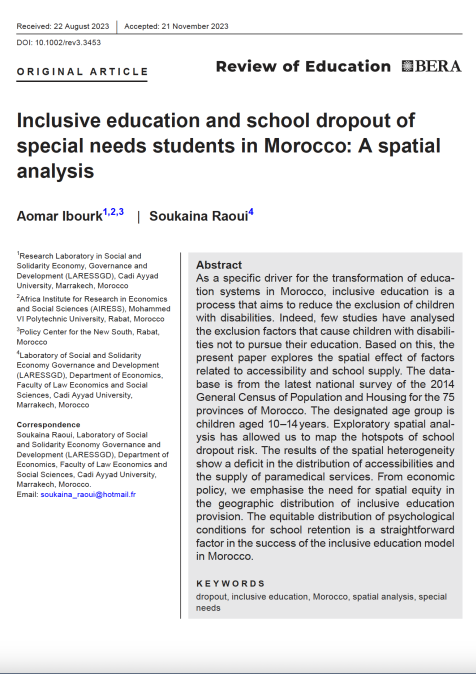
      This Paper was originally published on bera-journals.onlinelibrary.wiley.com   As a specific driver for the transformation of education systems in Morocco, inclusive education is a process that aims to reduce the exclusion of children with disabilities. Indeed, few studies have analysed the exclusion factors that cause children with disabilities not to pursue their education. Based on this, the present paper explores the spatial effect of factors related to acces ...
  • October 9, 2023
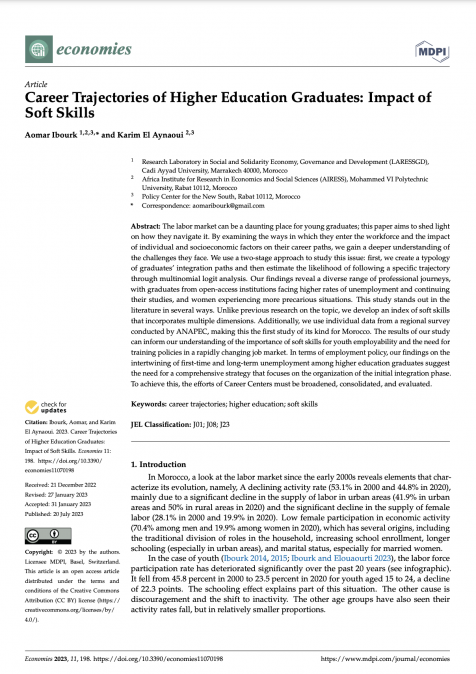
    This paper was originally published on mdpi.com   The labor market can be a daunting place for young graduates; this paper aims to shed light on how they navigate it. By examining the ways in which they enter the workforce and the impact of individual and socioeconomic factors on their career paths, we gain a deeper understanding of the challenges they face. We use a two-stage approach to study this issue: first, we create a typology of graduates’ integration paths ...
  • August 16, 2023
    L’amélioration de la qualité des apprentissages constitue un défi majeur pour le système éducatif marocain, qui, d'après de nombreuses évaluations qualitatives et quantitatives, se positionne parmi les moins performants en termes de compétences scolaires. Les résultats des tests internationaux tels que TIMSS et PIRLS mettent en évidence des scores préoccupants en mathématiques, sciences et lecture, démontrant que plus de 40 % des élèves ne parviennent pas à atteindre ...
  • July 14, 2023
    L'éducation et le patrimoine culturel sont interconnectés. L'éducation permet la transmission et la préservation du patrimoine culturel, tandis que le patrimoine culturel enrichit l'éduca ...
  • June 26, 2023
    L’amélioration de la qualité des apprentissages constitue un défi majeur pour le système éducatif marocain. D’après de nombreuses évaluations, aussi bien qualitatives que quantitatives, le Maroc se place parmi les pays les moins performants en matière de qualité des acquis scolaires. Un autre aspect des faibles réalisations du pays au niveau des tests internationaux est le poids des élèves dits « peu performants1 », et considérés comme particulièrement à risque. L’importance de ce ...
  • Authors
    Abdelmounaim Fanidi
    April 19, 2022
    Suivant une analyse réaliste des relations internationales, des ‘facteurs objectifs’ ont été longtemps mis en avant pour expliquer le blocage de l’intégration régionale au Maghreb (e.g. le conflit du Sahara). Par une approche constructiviste, cet article a pour vocation d’analyser un facteur subjectif susceptible de freiner ou favoriser l’intégration maghrébine, en l’occurrence les identités nationales. Il se focalisera sur « les discours primordialistes ». Autrement dit, les discou ...