
Publications /
Annual Report
Book / Report
Back
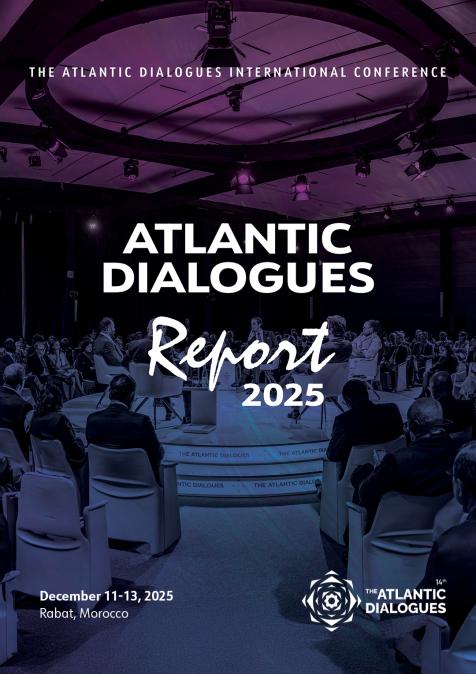
Atlantic Dialogues Report 2025
Authors
Policy Center for the New South
July 1, 2026

At a time when unpredictability has become a defining characteristic of international affairs, meaningful dialogue is both increasingly difficult to sustain and more essential than ever. Geopolitical rivalries, technological transformations, and mounting global fragmentation have challenged many of the assumptions that once underpinned international cooperation. In numerous instances, these developments have eroded confidence in institutions, strained partnerships, and weakened commitment to shared frameworks for collective action. Yet these very transformations have also underscored the importance of forums in which diverse perspectives can engage constructively, ideas can be critically examined, and mutual understanding can be cultivated over time.

Since its inception, the Atlantic Dialogues has sought to provide such a forum. More than a conference, it has evolved into a lasting and expanding community that brings together policymakers, business leaders, scholars, practitioners, and emerging leaders committed to engaging across disciplines, regions, and generations. Through initiatives such as the Atlantic Dialogues Emerging Leaders program, it continues to promote intergenerational dialogue while enhancing the diversity of perspectives, experiences, and expertise represented within its network. In so doing, it creates opportunities for both established and emerging leaders to contribute meaningfully to global discussions and to address collectively the complex geopolitical, economic, technological, and societal challenges shaping the contemporary world. At its core, the Atlantic Dialogues seeks to foster exchanges that deepen understanding of the complexities and interdependencies that characterize the current international landscape.

This ambition reflects a broader conviction: knowledge is a public good. At the Policy Center for the New South, we believe that think tanks have a vital role to play in generating ideas, informing public debate, and creating spaces where knowledge can circulate, be challenged, and contribute to collective understanding. In this sense, the Atlantic Dialogues is part of a wider effort to strengthen the intellectual foundations of constructive engagement across borders. 

Throughout this edition, participants addressed a common question: how can societies preserve cooperation, legitimacy, and opportunity in an era increasingly shaped by disruption? Discussions explored the future of democracy and multilateralism, the transformative impact of artificial intelligence, shifting geopolitical and economic dynamics, and the growing importance of resilience in responding to climate, security, food, water, and development challenges. They also examined development strategies, the evolving role of international financial institutions, the strategic significance of maritime corridors, and the place of Africa and the wider Atlantic space within an increasingly contested global order. 

Across these exchanges, a common theme emerged: the need to rebuild trust while strengthening the agency of Africa and the New South in shaping the institutions, partnerships, and narratives of the future.

Morocco provides a setting in which such exchanges can take place openly and constructively. As a crossroads connecting Africa, the Atlantic space, and the New South, it offers an environment conducive to the dialogue and engagement that the Atlantic Dialogues seeks to promote. The diversity of its participants and speakers remains one of the initiative’s defining strengths, reflecting a longstanding commitment to inclusivity, openness, and intellectual pluralism. 

At the heart of this endeavor lies a simple yet demanding objective: building trust. In an increasingly polarized and fragmented world, trust cannot be imposed or hastened; it is cultivated gradually through sustained interaction, honest exchange, and a willingness to listen. The Atlantic Dialogues continues to invest in this long-term process, recognizing that trust is an indispensable foundation for meaningful cooperation. 

This commitment extends beyond the present. By fostering a culture of learning and encouraging dialogue across generations, the Atlantic Dialogues contributes to the exchange of ideas and the transmission of knowledge and experience to those who will shape the future. Education, openness, and trust are enduring investments that strengthen societies and generate benefits across generations. 

The reflections presented in this Atlantic Dialogues 2025 report bear witness to this shared endeavor. They highlight the diversity of perspectives that continues to define the initiative and reaffirm the value of sustained engagement across regions, sectors, and generations. The conversations captured in these pages remind us that, although unpredictability may shape the present, the future remains open to those willing to engage, listen, and help shape it together. 


Karim El Aynaoui 

Executive President, Policy Center for the New South

RELATED CONTENT

  • Authors
    Ahmed Rachid El-Khattabi
    Alessandro Minuto-Rizzo
    Amaye Sy
    Hamza Rkha Chaham
    Ian O. Lesser
    Jorge Castañeda
    Moubarack Lo
    Umberto Profazio
    December 14, 2022
    This ninth edition of “Atlantic Currents” appears in an international context marked predominantly by a ten month-war between Russia and Nato members that began February 2022. The war is affecting not only the European and American member States directly and actively involved in an unprecedented manner, but more importantly the countries of the global South that have suffered collateral damage. Indeed, the nations of the world were barely out of the most painful and costly phase o ...
  • December 14, 2022
    Inflation is back on the agenda. The rise of inflation occurred in the aftermath of the global activity rebound out of the COVID-19 when global value chains were severely disrupted and have been contending to recover since then. The Russia-Ukraine conflict added new strains over the glo...
  • December 14, 2022
    This session will present and discuss the 9th edition of Atlantic Currents report, one of the flagship annual publications of the Policy Center for the New South. This report comes along with the high-level Atlantic Dialogues conference and explores key global issues facing the Atlantic...
  • Authors
    October 6, 2022
    “Within the realm of military conflicts, the Atlantic Basin can be considered a relatively peaceful area, especially in the northern part. However, the region has faced unprecedented challenges in terms of policy planning and strategizing with the emergence of the global pandemic, the stagnating economic growth, and the population’s growing discontent toward public institutions. The conjunction of sanitary, economic, and political crisis has questioned the historical stability of we ...
  • Authors
    Sabine Cessou
    July 12, 2022
    The Atlantic Dialogues Emerging Leaders Alumni (ADEL) Portraits are a series of journalistic insights that delve into the stories and backgrounds of impactful young leaders of the ADEL community, now 350 alumni strong. These portraits are more than a biography as they capture the motives, success stories, career shifts, and vision behind each emerging leader’s pursuit of positive impact. From Morocco to South Africa, Germany to Canada, Brazil and the United States, these young leade ...
  • Authors
    Yasmina El Kadiri, avec la collaboration de Taoufik Benkaraache et Hammad Sqalli et la participation de Lilia Rizk
    March 21, 2022
    The Policy Center for the New South, in collaboration with Economia HEM Research Center and the LARGEPA Laboratory of the Paris II Panthéon Assas University have conducted a 3-year study on emergent leadership through the ADEL community. This study, titled “Emerging Leaders: Leveraging Networks, Political Skill and Self-Leadership” has been conducted by researcher Yasmina El Kadiri, in collaboration with Taoufik Benkaraache and Hammad Sqa ...
  • Authors
    Yasmina El Kadiri, avec la collaboration de Taoufik Benkaraache et Hammad Sqalli et la participation de Lilia Rizk
    March 21, 2022
    Le présent rapport de recherche est la synthèse d’une étude sur les leaders émergents, leurs stratégies, pratiques et leviers d’empowerment, un travail d’une durée de trois ans, fruit d’un partenariat entre le Policy Center For The New South, Economia HEM Research Center et le laboratoire LARGEPA de l’Université Paris II Panthéon Assas. L’étude a examiné les attitudes, les ressources, les compétences et les capacités d’un échantillon de plus d’une centaine de leaders émergents de d ...
  • Authors
    March 14, 2022
    Ce Policy Paper explore les enjeux de la maritimisation du monde et les opportunités qui se présentent au Maroc et les menaces auxquelles le Royaume fait face sur sa façade atlantique. Nous nous appuyons sur les opportunités que représentent la côte Atlantique pour le Maroc et, plus globalement, pour le continent africain, tant au niveau du commerce de biens et de marchandises qu’aux niveaux logistique et portuaire. Enfin, ce Papier insiste sur l’importance de la jonction entr ...
  • Authors
    Alessandro Minuto-Rizzo
    Bernardo Sorj
    Frannie Léautier
    Iskander Erzini Vernoit
    Kassie Freeman
    Nathalie Delapalme
    J. Peter Pham
    March 7, 2022
    The COVID-19 pandemic has had a huge impact on the global economy and has challenged the best minds to rethink how to design and implement an effective recovery. Countries in the wider Atlantic region have exhibited differential trajectories in traversing the pandemic. A number of countries in Europe succeeded in vaccinating most of their eligible populations, enabling life to return somewhat to normal. A smaller group of countries in Europe could manage infection rates even more ti ...
  • Authors
    Sabine Cessou
    February 16, 2022
    Based in Washington DC, where he launched the Accountability Lab in 2012, this British citizen describes himself as « inquisitive, energetic and values-driven ». He heads a global « translocal network » which is expanding rapidly and about to open new local labs in Uganda and Somalia. The Lab, a non profit organization, currently employs 104 people in 14 countries in Asia, Africa and Latin America. The aim is to make governments more transparent and accountable ...