Publications /
Annual Report
Book / Report
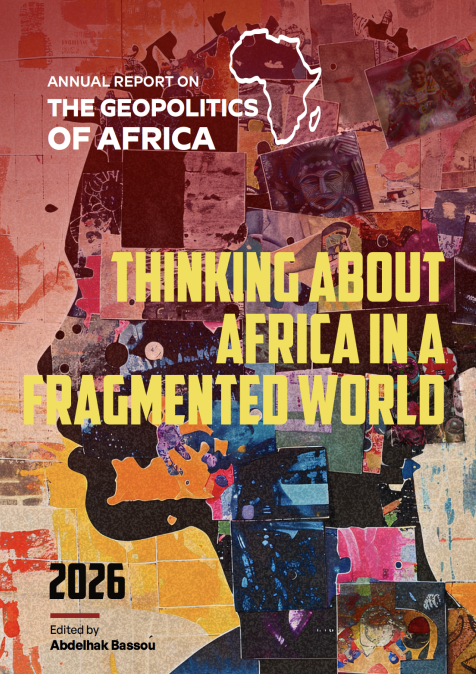
This year marks the tenth edition of the annual report on African geopolitics; for ten years now, the Policy Center for the New South has been providing a platform for Africans to reclaim the narrative about their continent.
The number 10 is significant: it marks the maturity of an editorial project founded on a simple yet demanding conviction - that Africa must define itself, from within, using the analytical tools that its own people forge through engagement with reality.
This tenth volume, bringing together twentyseven contributions from sixteen different African nationalities, is living proof that this conviction was not merely wishful thinking.
Africa in 2026 is no longer the same as it was in 2017. The past decade has seen an acceleration of trends that the earlier editions of this book had merely anticipated: the reshaping of global power dynamics, the proliferation of internal conflict hotspots, the emergence of technology in the realms of warfare and governance, and the open challenge to security architectures inherited from the postcolonial era. The continent no longer sees itself as merely a stage for external rivalries; it is seeking its place as a full-fledged actor in the reconfiguration of the international order, asserting its strategic sovereignty with renewed intensity.
This volume is organized around four main themes, each of which, in its own way, runs through all of the contributions gathered here:
The first is that of power rivalries and their impact on Africa’s room for maneuver. From the new rush to Southern Africa to the reshaping of relations between the European Union and the African Union, and including the rise of non- Western actors, the authors rigorously examine the conditions under which African states attempt to balance sovereignty and survival in the face of competing pressures from major powers. The issue of critical infrastructure and artificial intelligence, analyzed in one of the most forward-looking contributions to this volume, sharply illustrates the depth of this structural dependence and the possible paths toward effective sovereignty by 2036.
The second main theme is that of wars and conflicts in the age of new technologies. The Sahel, Sudan, the Great Lakes region, and Benin are all theaters where the doctrinal and operational transformations brought about by “drone warfare,” cyberthreats, and the digitization of conflicts are playing out in their most concrete forms. The contributions gathered in this section do more than simply map these changes: they situate them within deeper political and social dynamics, reminding us that technology never single-handedly produces conflicts, but rather reconfigures their balances, timelines, and thresholds of violence. The question of the structural roots of instability, in Sudan as elsewhere, is addressed with the depth it deserves, without reductionism or complacency.
The third key focus area concerns strategic spaces, seas, corridors, and areas of projection. Africa is not a landmass closed off from the rest of the world: it is bordered by coastlines whose strategic value increases as geoeconomic competition intensifies. The Mozambique Channel, the Indian Ocean shipping lanes, the Sahelian land corridors, Mauritania as an Atlantic pivot, and Ethiopia grappling with the constraints of its landlocked status - these areas are analyzed not as geographical abstractions, but as arenas where concrete power dynamics play out, where sovereignty is fragile and contested, and where external actors project their influence with a continuity that local political transitions do not always manage to stem.
The fourth key theme, which cuts across all the others, is that of paradigms: how can we conceptualize peace, security, development, political participation, and governance from an autonomous African perspective? Several contributions in this volume explicitly address this question, whether by rethinking narratives about political youth in Kenya, articulating security and development within an endogenous paradigm, or examining the foundations of sovereignty in West African political dynamics.
These texts are part of a collective effort toward epistemic decolonization - not as a rhetorical stance, but as a rigorous intellectual program grounded in empirical data and renewed analytical frameworks.
What stands out when reading these contributions as a whole is their analytical depth and the geographic diversity they represent. From the Great Lakes to the Horn of Africa, from the Sahel to the Indian Ocean coastline, and from Central Africa to the Saharan peripheries, this volume covers a spectrum rarely achieved in a single edited volume - not out of a desire for encyclopedic exhaustiveness, but because the dynamics under study are structurally interconnected. Instability in Mali weighs on Benin; rivalries in the Horn of Africa have repercussions throughout the Great Lakes region; the proliferation of drones in the Sahel foreshadows tactical transformations that extend far beyond this single theater. Understanding Africa geopolitically now requires this systemic perspective.
Ten years after its first edition, The Annual Report on African Geopolitics is fulfilling its founding promise: to serve as a forum for free, rigorous, and engaged African thought on the major issues that shape the continent’s strategic future. The twenty-eight authors of this edition - representing sixteen nationalities, as many fields of expertise, and as many perspectives - are the best proof of this. We thank them for their contributions. This volume belongs to them, just as it belongs to all those in Africa and beyond who believe in the continent’s right to tell its own story.
Karim El Aynaoui Abdelhak Bassou