Publications /
Book / Report
Text Book Series
Back
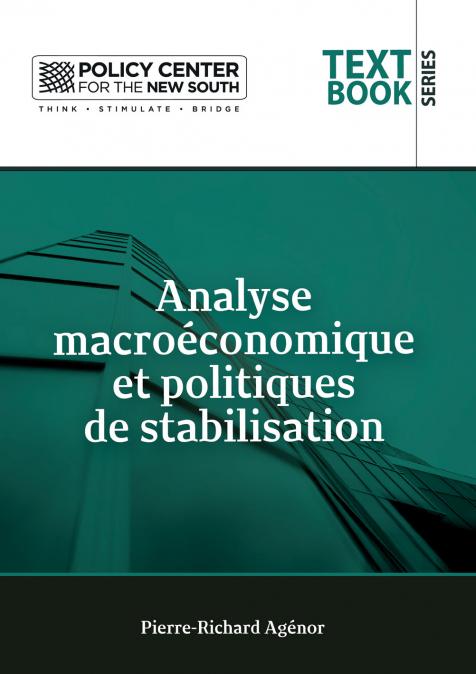
Analyse macroéconomique et politiques de stabilisation
Authors
Pierre-Richard Agénor
November 30, 2018

L'importance de la stabilité macroéconomique et financière pour l'amélioration à long terme des niveaux de vie a conduit à un profond renouvellement de l'analyse macroéconomique dans les pays en développement, tant sur le plan analytique qu'empirique.

Pour la première fois, le présent ouvrage fournit au public francophone un traitement approfondi et rigoureux des questions actuelles liées à l'analyse et à la gestion macroéconomique dans ces pays. Cette macroéconomie du développement souligne la nécessité de prendre systématiquement en compte les principales caractéristiques structurelles des pays en développement pour l'analyse économique. La perspective sous-jacente est que ces caractéristiques jouent un rôle essentiel à la fois dans la transmission des chocs de politique économique et dans la réponse des agents aux politiques macroéconomiques. Il est donc indispensable de les prendre en compte dans la conception des modèles destinés à guider la gestion macroéconomique.
RELATED CONTENT

  • January 23, 2026
    The post-1945 international order, an architecture born of war-weariness and colonial twilight, is now a majestic but empty shell. Its foundational promise—a universal system of rules administered impartially—has been hollowed out by decades of selective enforcement, instrumentalized law, and a chasm between the rhetorical ideals of its custodians and their geopolitical practice. This is not a temporary dysfunction, but a systemic failure of legitimacy. From the invasion of Iraq und ...
  • Authors
    January 21, 2026
    In response to developing countries’ dissatisfaction with the New Collective Quantified Goal (NCQG) of $300 billion, which was decided at the Twenty-Ninth Conference Of the Parties (COP29) to the United Nations Framework Convention on Climate Change, in 2024 in Baku, Azerbaijan, the COP29 and COP30 presidencies promised to develop a roadmap to achieve $1.3 trillion in external climate finance that developing countries need, and to present it at COP30 in Belém, Brazil[1]. The two pre ...
  • January 6, 2026
    La création de l’Alliance des États du Sahel (AES) symbolise une rupture politique et géostratégique majeure, appuyée sur un discours souverainiste et anti-occidental. Deux ans après, Mali, Burkina Faso et Niger peinent à assurer leur intégrité territoriale, à stabiliser leur sécurité intérieure et à bâtir une gouvernance solide. L’intégrité territoriale est un problème commun aux trois États, car dans ces pays, la cohésion de l’État et le contrôle du territoire sont directement men ...
  • Authors
    November 28, 2025
    The adoption of United Nations Security Council Resolution 2803 on November 17, 2025, endorsing the “Comprehensive Plan to End the Gaza Conflict,” is a step in the right direction, but it must be accompanied by the implementation of a Gaza development and post-conflict reconstruction program. Paragraph 6 of Resolution 2803 “calls upon the World Bank and other financial institutions to facilitate and provide financial resources to support the reconstruction and development of Ga ...
  • November 25, 2025
    This Policy Paper analyses the Fourth Industrial Revolution (4IR) through the critical lens of technological colonialism. It argues that the fusion of physical, digital, and biological technologies is not merely a technical phenomenon but a civilizational shift reshaping the foundations of global power. The article traces a historical continuum from previous industrial revolutions, demonstrating how patterns of inequality and extraction persist, now transposed into the digital realm ...
  • November 18, 2025
    The meeting between Donald Trump and Xi Jinping in Busan, South Korea, was more than an exercise in diplomacy. It was an emblematic performance of a world in transformation. Behind the formalities, the cameras, and the studied smiles lay an unspoken recognition: the world is no longer unipolar. The era of American supremacy, sustained for decades through its economic reach, military presence, and ideological projection, is giving way to a more diffuse, multipolar reality. ...
  • Authors
    October 28, 2025
    Now that a cease-fire is in place, it is time to consider Gaza’s reconstruction. This will be the fifth such effort in less than twenty years. Lessons from the previous four indicate that rebuilding houses, bridges, and roads is relatively straightforward. Far more challenging is building a thriving Gazan economy and society—one where young people live with dignity, have jobs, feel heard and included in their communities, and are hopeful about their future. Achieving this requires n ...
  • Authors
    Jorge Arbache
    October 9, 2025
    Conventional wisdom holds that the United States has undergone massive deindustrialization in recent decades, with the country's manufacturing sector supposedly withering as it lost ground to China. This narrative has fueled debates about industrial policy, economic nationalism, and the reshoring of manufacturing production. But what if this story is only partially true? What if, instead of disappearing, American industry simply changed its address?  ...
  • October 7, 2025
    Global economic growth has been more resilient than expected, as the artificial intelligence-led growth seems to be compensating for the negative impacts of trade conflicts. Overstretched asset values and slowing jobs growth may be signaling that the balanced crossing of those two paths...