Publications /
Book / Report
Text Book Series
Back
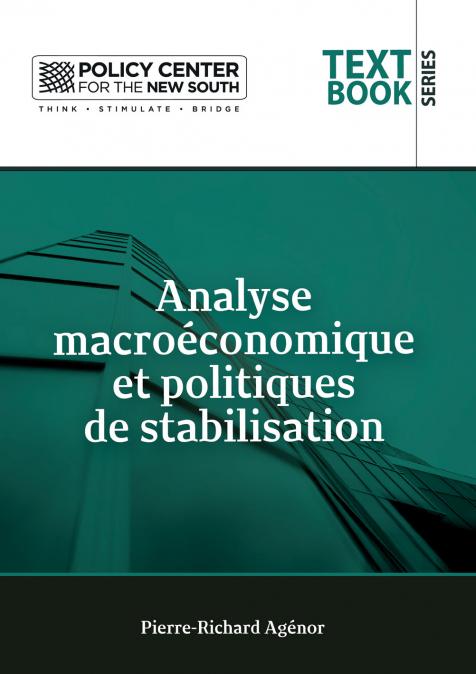
Analyse macroéconomique et politiques de stabilisation
Authors
Pierre-Richard Agénor
November 30, 2018

L'importance de la stabilité macroéconomique et financière pour l'amélioration à long terme des niveaux de vie a conduit à un profond renouvellement de l'analyse macroéconomique dans les pays en développement, tant sur le plan analytique qu'empirique.

Pour la première fois, le présent ouvrage fournit au public francophone un traitement approfondi et rigoureux des questions actuelles liées à l'analyse et à la gestion macroéconomique dans ces pays. Cette macroéconomie du développement souligne la nécessité de prendre systématiquement en compte les principales caractéristiques structurelles des pays en développement pour l'analyse économique. La perspective sous-jacente est que ces caractéristiques jouent un rôle essentiel à la fois dans la transmission des chocs de politique économique et dans la réponse des agents aux politiques macroéconomiques. Il est donc indispensable de les prendre en compte dans la conception des modèles destinés à guider la gestion macroéconomique.
RELATED CONTENT

  • Authors
    October 3, 2025
    Global economic growth has been more resilient than expected, as the artificial intelligence-led growth seems to be compensating for the negative impacts of trade conflicts. Overstretched asset values and slowing jobs growth may be signaling that the balanced crossing of those two paths will be challenged. ...
  • Authors
    Bruno Saraiva
    July 21, 2025
    This article assesses the economic performance of the original BRICS economies, relative to the growth and currency appreciation projections presented in the papers that introduced the acronym, prior to the grouping becoming a diplomatic, political, and economic reality. It also discusses the BRICS agenda in the current challenging geopolitical context, in which economic fragmentation tends to raise costs for the global economy and presents considerable obstacles for emerging and de ...
  • Authors
    Pepe Zhang
    Fernando Straface
    June 13, 2025
    This Paper was originally published on cebri.org Within an ever-evolving system of multilateral development banks (MDB) currently reshaped by four structural geo-economic trends, the emergence of new MDBs like the Asian Infrastructure Investment Bank (AIIB) and the New Development Bank (NDB) carries great geopolitical significance. Yet the new MDBs, attuned to institutional and operational realities, have not upended the MDB system. Their relationship with long-e ...
  • Authors
    March 14, 2025
    The traditional model of Official Development Assistance (ODA) has not only entrenched financial dependence but also served as a tool for geopolitical influence, often prioritizing donor interests over genuine economic self-sufficiency in developing nations. The 2015 Sustainable Development Goals (SDGs) envisioned a shift towards private investment, but this strategy has largely failed. Capital flight, rising debt burdens, and systemic financial asymmetries have ensured that investm ...
  • November 22, 2023
    As part of the webinar series: “The Global Economy in Transition : Implications for Developing Countries”, the Policy Center for the New South is organizing a webinar titled: " The Future of Central Banks in Emerging Markets and Developing Countries” to contribute to the ...
  • Authors
    November 21, 2023
    Multiple shocks faced by the global economy over the past three years have apparently shaken the conventional wisdom on gains from economic integration, and have sparked widespread calls for protectionist and nationalist policies. Is there already evidence of some ‘deglobalization’, or do the factors that underlie globalization remain strong enough despite the shocks? So far, there are no signs of an overall reversal in the long-term trend of greater global trade integration. Howev ...
  • Authors
    April 27, 2023
    Recent initiatives and policy moves by China and other countries to extend the reach of use of the renminbi in the international monetary system, while the U.S. dollar share in global reserves has slightly shrunk in relative terms, have sparked frequent discussions about a hypothetical “de-dollarization” of the global economy. We approach here what that would mean in terms of global currency functions as means of payment and store of value. While we point out a relative decline of ...
  • Authors
    December 6, 2021
    Between January 2020 and June 2021, the world spent about US $16.5 trillion (18% of world GDP) to fight COVID-19, and this amount does not even include the most important losses such as deaths, mental health effects, restrictions on human freedom, and other nonmonetary suffering. Nearly 90% of this amount was spent by developed economies; the rest by emerging market and developing economies. Low-income countries spent just US $12.5 billion, or less than 0.0001% of the total. Moreove ...
  • Authors
    May 31, 2021
    China is the world's largest exporter of goods. It is also, by any plausible criterion, a developing country. China's dual status needs to be better reflected in Chinese policies - recognizing its global responsibilities -- and in those of the Western powers - recognizing China's limitations. Across three important agendas - macroeconomics, development assistance, and climate - important differences between China and the West remain, yet none of these issues appears intractable. ...
  • Authors
    December 30, 2020
    According to this month’s OECD economic outlook, global GDP --- which took a huge hit from the pandemic and is still 3% below its level of a year ago – will not recover its pre-pandemic level until the end of 2021. In a downside scenario, the return could take almost a year longer. The OECD predictions, which imply high and protracted unemployment, are in line with the view of many other official and private organizations. The arrival of effective vaccines such as Pfizer-BioNTech wa ...